
You are using an outdated browser and your browsing experience will not be optimal. Please update to the latest version of Microsoft Edge, Google Chrome or Mozilla Firefox. Install Microsoft Edge

November 9, 2016

Indonesia: Increases to Official Fees Raising for IP and Enactment of New Trademark Law

The Indonesian government has announced two major developments relating to patents and trademarks in the country: (1) increases to the official fees for a range of IP prosecution tasks; and (2) the enactment of an amended Trademark Law.

New Official Fees

Government Regulation No. 45 of 2016 on Non-Taxable State Revenue introduces a number of increases to the official fees for many IP prosecution-related actions in Indonesia, although not all of the fees have changed. Government Regulation No. 45 will become effective on November 10, 2016. The key changes to the official fees are as follows:
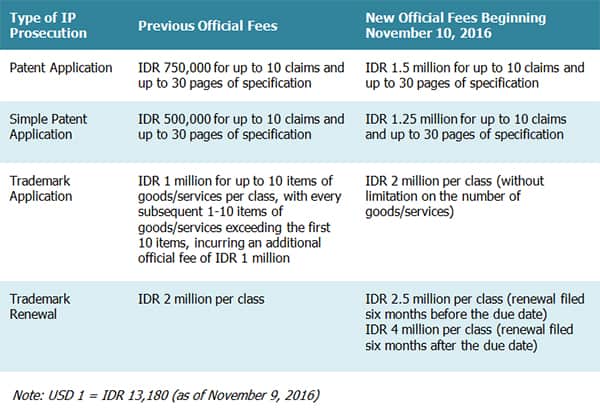
Significantly, the official filing fee for trademark applications is now calculated based on the number of classes, regardless of whether the application is filed on a single-class or multiple-class basis.

New Trademark Law

The Indonesian Parliament approved Indonesia’s new Trademark Law on October 27 this year, and it will come into effect on or before November 26, 2016. The new Trademark Law introduces a number of significant changes to the registration, protection, and enforcement of trademarks in Indonesia. This includes the following key changes:

  • In an opposition, the two-month publication stage will take place before the substantive examination stage, unlike before, where it took place after substantive examination. All trademarks that pass an initial formality examination will proceed directly to the publication stage. There will be no further publication after the substantive examination.
  • A pending trademark application will be assignable, whereas previously only registered trademarks could be assigned.
  • A renewal application can be filed either 6 months before the renewal due date or 6 months after the due date (with a penalty fee). Past practice only allowed the renewal to be filed within 12 months before the due date.
  • Nontraditional trademarks, including three-dimensional trademarks, sound marks, and holograms, will be introduced.
  • The criminal penalty for trademark infringement will be increased.

We will provide a more detailed analysis of the new Trademark Law in our upcoming issue of Informed Counsel, Tilleke & Gibbins’ quarterly law journal.

If you have any questions about Indonesia’s new official fees or the amended Trademark Law, please contact us at [email protected] or +6221 2971 8088.


RELATED INSIGHTS​ 

November 25, 2024
Trademark registration for marks composed of combinations of Roman letters and/or Arabic numerals has long been challenging in Thailand, particularly for those that are neither stylised nor pronounceable. There have been conflicting perspectives regarding the interpretation of “invented letter(s) and numeral(s)” under Section 7 of the Thai Trademark Act. The Department of Intellectual Property (DIP) has considered that letters and numerals must feature notable visual enhancements to be inherently distinctive, and “invented” must be in the form of stylisation, such as overlapping or interlocking letters, or intricate designs like traditional Thai oral patterns or geometric motifs. Some examples of acceptable letter and numeral marks according to the DIP The courts, however, have consistently recognised that three-letter marks, even when presented without stylisation, can be inherently distinctive. The rationale is that these marks, viewed as random and unusual combinations, can in many cases be distinguishable from common words and sufficient for the public to identify the associated goods/services, and distinguish them from others. Following Supreme Court precedents on registrability, the DIP officially updated its Examination Guidelines in January 2022 to recognise that combinations of three or more letters, even if not stylised or forming pronounceable words, can be deemed inherently distinctive. Challenges persist, however, for two-letter marks, which still face significant obstacles in achieving registrability. The JD case Background Beijing Jing Dong 360 Du E-Commerce, one of China’s largest e-commerce companies, led trademark applications for the marks JD.COM (and device) and JD.CO.TH (and device) for services in Class 35 related to advertising and business management: The registrar rejected the applications, citing insufficient stylisation of ‘JD’ and describing ‘.com’ and ‘.co.th’ as common descriptive terms. The applicant appealed to the Board of Trademarks, which upheld the refusal, echoing the registrar’s reasoning and asserting that the marks were devoid of inherent distinctiveness
November 15, 2024
Vietnam’s new Decree No. 147/2024/ND-CP on the management, provision, and use of internet services and online information (“Decree 147”), which will come into effect on December 25, 2024, replacing Decree No. 72/2013/ND-CP (“Decree 72”), introduces several changes to the regime for domain name dispute resolution. The new decree aims to clarify the legal framework and address some longstanding inconsistencies between Vietnam’s laws on intellectual property and information technology. The main changes related to domain name dispute resolution under Decree 147 are summarized below. Removal of Prescriptive Actions Decree 147 no longer lists specific actions for resolving domain name disputes. Decree 72 had outlined three methods: negotiation/mediation, arbitration, and court. However, IP practitioners had long criticized this approach, arguing it conflicted with the IP Law, which additionally allows administrative action. By omitting these methods, the new decree implies an acceptance of administrative action as provided in the IP Law. However, Decree 147 remains silent on establishing a dispute resolution forum aligned with the CPTPP’s requirement for a UDRP-like model. Currently, Vietnam’s available forums do not fully conform to the UDRP framework. An anticipated circular may provide further guidance on this aspect. Deactivation of Domain Names Decree 72 does not have any provision on the deactivation of a domain name. However, Decree 147 has stipulated some situations where domain names will be deactivated, such as when there is a request from an authority, or when it is discovered that incorrect information was used for registration. Clearer Criteria for Dispute Resolution Article 16 of Decree 147 sets out three clear criteria that must be met for domain name dispute resolution to proceed: (i) confusing similarity with the plaintiff’s trademark, trade name, or personal name; (ii) the defendant’s lack of legitimate rights or interests in the domain name; and (iii) bad faith. Previously,
November 4, 2024
On October 31, 2024, Myanmar’s Intellectual Property Department (IPD) announced that it would officially start accepting applications for patent and utility model registration under the Patent Law, effective immediately. Contained in IPD Announcement No. 14/2024, this significant development opens new avenues for securing patent and utility model rights in the country. Myanmar’s Patent Law (Pyidaungsu Hluttaw Law No. 7/2019) was enacted on March 11, 2019, providing a framework for the protection of inventions related to products and processes. This is the first legislation specifically addressing the protection of patents in Myanmar’s history. The Patent Law took effect on May 31, 2024, under State Administration Council Notification No. 106/2024. To implement this new framework, the Ministry of Commerce (MOC) promulgated the Patent Rules under Notification No. 43/2024 on June 4, 2024, detailing the requirements and procedures for patent- and utility model-related matters. Subsequently, the MOC specified the official forms to be used for filing of patent- and utility model-related matters under Notification No. 54/2024 on July 19, 2024. On October 22, 2024, the Intellectual Property Agency announced the official fees, including annuity fees, for patents and utility models under Notification No. 2/2024. Applicants (both individuals and legal entities) can now file to register new patents and utility models with the IPD electronically, in person (directly or through a local representative), or by post. To be patented, an invention must: Not have been disclosed to the public anywhere by any means before the filing date or priority date (if claimed); Involve an inventive step; and Be capable of use in any industry. As for utility model registration, the requirements are the same, except an inventive step is not necessary. This milestone marks a pivotal moment for innovators and investors looking to protect their inventions in Myanmar. All stakeholders are encouraged to
November 4, 2024
On September 30, 2024, Vietnam’s Ministry of Science and Technology (MOST) issued Circular No. 06/2024/TT-BKHCN (“Circular 06”), amending and supplementing certain articles of Circular No. 11/2015/TT-BKHCN dated 26 June 2015. These two circulars are the primary guidance on Decree No. 99/2013/ND-CP and Decree No. 46/2024/ND-CP on administrative sanctions in industrial property. Circular 06, which will come into force on November 15, 2024, will improve the alignment between the recently amended IP Law and its subordinate legal instruments. Some of the notable amendments of Circular 06 are set out below. Clarification of Additional Sanctions: Circular 06 clarifies the application of the additional sanction of “full or partial suspension of production, trading, or service activities for 1 to 3 months”, which was recently amended in Decree No. 46/2024/ND-CP. It specifies that only activities directly related to the violating goods or services will be partially suspended. Preventive Measures for Domain Name Disputes: Circular 06 specifies the required documents for brand owners to request the preventive security measure of placing a temporary hold on the registration of domain names during enforcement action against cybersquatters. The introduction of this regime under Circular 06 is expected to enhance cooperation between the Vietnam Internet Network Information Center, domain name registrars, and enforcement authorities to place the temporary hold on infringing domain names. Unfair Competition Relating to Domain Names: Circular 06 outlines specific requirements to prove unfair competition involving the possession and use of Vietnamese domain names that are identical or confusingly similar to another person’s registered trademark, trade name, or geographical indication. However, the regime established by Circular 06 does not fully align with the Uniform Domain Name Dispute Resolution Policy (UDRP) mechanism, a standard procedure for the settlement of domain name disputes that Vietnam is obligated to adhere to under the Comprehensive and Progressive Agreement