
You are using an outdated browser and your browsing experience will not be optimal. Please update to the latest version of Microsoft Edge, Google Chrome or Mozilla Firefox. Install Microsoft Edge

November 9, 2016

Indonesia: Increases to Official Fees Raising for IP and Enactment of New Trademark Law

The Indonesian government has announced two major developments relating to patents and trademarks in the country: (1) increases to the official fees for a range of IP prosecution tasks; and (2) the enactment of an amended Trademark Law.

New Official Fees

Government Regulation No. 45 of 2016 on Non-Taxable State Revenue introduces a number of increases to the official fees for many IP prosecution-related actions in Indonesia, although not all of the fees have changed. Government Regulation No. 45 will become effective on November 10, 2016. The key changes to the official fees are as follows:
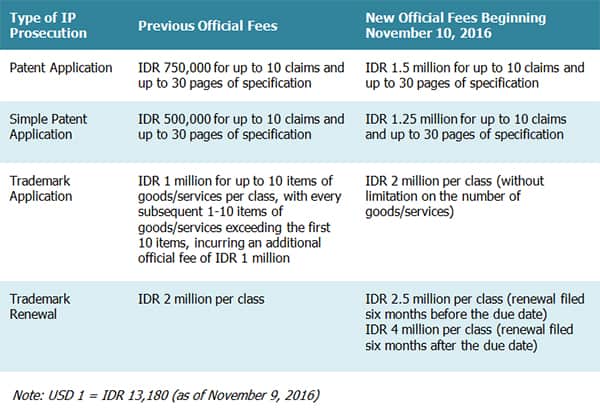
Significantly, the official filing fee for trademark applications is now calculated based on the number of classes, regardless of whether the application is filed on a single-class or multiple-class basis.

New Trademark Law

The Indonesian Parliament approved Indonesia’s new Trademark Law on October 27 this year, and it will come into effect on or before November 26, 2016. The new Trademark Law introduces a number of significant changes to the registration, protection, and enforcement of trademarks in Indonesia. This includes the following key changes:

  • In an opposition, the two-month publication stage will take place before the substantive examination stage, unlike before, where it took place after substantive examination. All trademarks that pass an initial formality examination will proceed directly to the publication stage. There will be no further publication after the substantive examination.
  • A pending trademark application will be assignable, whereas previously only registered trademarks could be assigned.
  • A renewal application can be filed either 6 months before the renewal due date or 6 months after the due date (with a penalty fee). Past practice only allowed the renewal to be filed within 12 months before the due date.
  • Nontraditional trademarks, including three-dimensional trademarks, sound marks, and holograms, will be introduced.
  • The criminal penalty for trademark infringement will be increased.

We will provide a more detailed analysis of the new Trademark Law in our upcoming issue of Informed Counsel, Tilleke & Gibbins’ quarterly law journal.

If you have any questions about Indonesia’s new official fees or the amended Trademark Law, please contact us at [email protected] or +6221 2971 8088.


RELATED INSIGHTS​ 

October 3, 2025
In Thailand, the rise in online intellectual property infringement has prompted authorities to strengthen enforcement efforts, including the use of website-blocking orders under Section 20(3) of the Computer Crime Act B.E. 2560 (2017) (CCA). This provision authorizes the Ministry of Digital Economy and Society (MDES), with court approval, to block or remove computer data that constitutes a criminal offence under IP law. Since its implementation, the procedure has undergone several developments, which is an encouraging sign of progress. Website-blocking procedure In practice, website-blocking orders under Section 20(3) of the CCA are primarily used for copyright and trademark infringement. While such orders are legally applicable to patent infringement, their use remains challenging due to the difficulty of proving infringement through administrative procedures. The website-blocking procedure begins when an IP owner identifies online infringing content. For copyright infringement, which is considered a compoundable offence, the IP owner is required to first file a police report with the specialized police unit known as the Economic Crime Suppression Division (ECD) prior to filing the website-blocking application with the Department of Intellectual Property (DIP). For trademark infringement cases, the application can be filed directly with the DIP without a prior police report. The DIP reviews the evidence and, if infringement is confirmed, forwards it to the MDES for further consideration. If the case is deemed valid, the MDES requests a court order to block the infringing website. Once granted, the MDES notifies the internet service providers (ISPs) to block access to the specified website. Website blocking procedure in Thailand Recent advancements in website-blocking actions Seamless collaboration through digital integration. Thailand has made significant progress in digitizing its website-blocking procedures to improve efficiency and transparency. At present, all website-blocking applications and supporting evidence must be submitted in electronic format. These systems have significantly reduced processing
September 24, 2025
Online shopping in Thailand is more accessible than ever, with global platforms, local social media shops, and entertainment-driven social commerce enabling instant purchases. However, this convenience comes with rising concerns over digital intellectual property (IP) infringement, including counterfeit goods, pirated content, and unauthorized brand usage. At first glance, online platforms appear to offer quick solutions. Most major e-commerce sites, social media channels, and social commerce platforms provide “notice and takedown” systems, where IP owners can file complaints and request the removal of listings that infringe IP rights, such as trademarks and copyrights. These tools are certainly useful, as seeing a fake product vanish from a platform feels like progress. But the reality is less reassuring. The counterfeit goods themselves remain in warehouses, markets, or shops, ready to be resold. Sellers whose accounts are taken down often return within days under new names or accounts. In other words, a takedown is like cutting weeds without pulling out the roots: they always grow back. While notice and takedown tools are widely available and can be managed internally by most IP owners, their impact is often short-lived. IP owners seeking more effective, lasting protection need to take a more strategic and multilayered approach. The same applies to online piracy. Unauthorized streaming websites that offer free access to movies, TV shows, or sports broadcasts have become widespread in Thailand. To combat this, rightsholders can request website blocking under the Computer Crime Act, through the Ministry of Digital Economy and Society and the courts. Once requests are approved, internet service providers are ordered to block access to infringing sites. Blocking orders can be effective in disrupting large-scale piracy operations, but they also face limitations—pirate sites frequently reappear under new domains. Strategic Protection Whether the infringing material is physical counterfeit goods or intangible streaming content,
September 4, 2025
On June 6, 2025, the Superior People’s Court in Hanoi overturned a non-use cancellation decision by the Intellectual Property Office of Vietnam, a rare and impactful occurrence. In a ruling that may help clarify the enforcement of Vietnam’s IP Law, the court held that valid trademark use can be established through commercial arrangements where the brand owner maintains actual control over the use of the mark, and is not confined to relationships governed by a so-called “formal license agreement. Background: Cross-Border Use, Local Challenge A Singapore company owns a well-known brand of consumer products that has gained recognition across Southeast Asia. In recent years, the brand has been targeted by several unauthorized trademark filings in Vietnam. In one such instance, a local Vietnamese trading company—previously linked to the production and export of counterfeit goods to neighboring countries—filed a non-use cancellation against the Singapore company’s mark and sought to register it under its own name. If the cancellation had been upheld, it would have enabled a complete hijacking of the brand. The IP holder operates in Vietnam through a structured cross-border supply chain. Under an agreement between two related foreign entities, one of which managed regional operations, production orders were placed through a designated Vietnamese company. While the Vietnamese manufacturer was not a party to the agreement, its role in using the mark was recognized and governed by internal and commercial documentation. The Vietnamese manufacturer lawfully obtained the necessary permits, regulatory approvals, and customs clearances for producing the goods in Vietnam. These activities were supported by banking records and internal communications, evidencing active, continuous use of the mark in Vietnam. However, the IP Office concluded that this use did not meet the statutory criteria because the Vietnamese manufacturer did not have a direct license agreement with the brand owner, as
August 25, 2025
Indonesia’s current regulations on franchises, as stipulated under Government Regulation No. 35/2024 on Franchising and its implementing regulation, Ministry of Trade (MOT) Regulation No. 71/2019 regarding Implementation of Franchising, highlight fundamental changes in franchise registration. These changes have introduced additional complexities and challenges in the franchise registration procedure, making it more difficult for franchise owners to navigate the process. New procedure Franchise applications are still submitted through the Online Single Submission (OSS) portal of the Capital Investment Coordinating Board (BKPM). However, the new procedure requires each applicant, including foreign franchisors, to have an OSS account and a business registration number (NIB) issued by BKPM. An application for franchise registration must be submitted under the applicant’s own account—submissions can no longer be made through the account of a consultant. Once a franchise application is submitted, the authority will distribute the submission to the MOT—the authorized ministry for franchise registration. Any notification or decision upon the registration made by the MOT will be available in the OSS system. Applicants should regularly monitor the status of the franchise application because no notifications will be sent to applicants to alert them of any deficiency. Here is the summary of the new procedure for franchisors: Notable Requirements The disclosure document, or prospectus, is the key focus for the MOT in examining a franchise registration for a franchisor. This document is subject to thorough scrutiny by the MOT to ensure that all mandatory information meets the requirements set in the franchise regulations. The current regulations specifically require that the mandatory clause “business system” in the prospectus cover operational standards and procedures, which should include human resource management, administration, operational management, standard operating methods, business location selection, business premises design, employee requirements, and marketing strategies. Other clauses that are equally important to pay attention to are: