
You are using an outdated browser and your browsing experience will not be optimal. Please update to the latest version of Microsoft Edge, Google Chrome or Mozilla Firefox. Install Microsoft Edge

August 6, 2026

Green Packaging, Gray Areas: The Challenges of Protecting Minimalist Packaging Under Thai IP Law

Introduction: A Trademark Paradox in Sustainable Packaging

Walk into any Thai supermarket, and the label-free water bottle is no longer a novelty. Thailand’s packaging market, valued at approximately USD 15.68 billion in 2025, is shifting toward minimalist, plastic-light designs as ESG pressures reshape how brands present their products. The country generated roughly 5.68 million tons of plastic waste in 2021, with a recycling rate of only 19 percent, and regulators are now considering rules that would allow label-free bottled water relying on embossing, laser printing, or QR codes instead of wrap-around labels. As packaging itself becomes the brand identifier, a paradox emerges: designs built to say the least often struggle hardest for protection under Thai intellectual property law.

The Trademark Barrier: When Shape Is Not Enough

Section 7, paragraph 2(10) of the Thai Trademark Act deems a shape distinctive only if it is not the natural form of the goods, is not necessary to achieve a technical result, and does not add value to the goods. The Department of Intellectual Property’s 2022 examination guidelines apply this test conservatively, as the following examples illustrate.
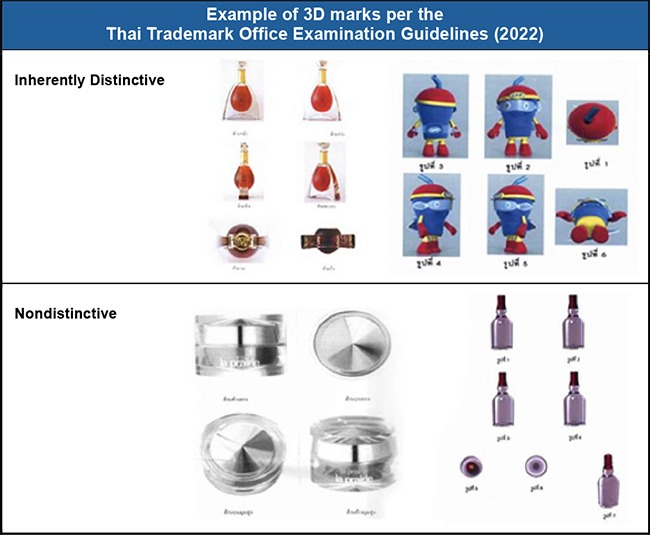
A plain water bottle relying on subtle contours to signal its brand is typically read as just another bottle, not a source identifier. Acquired distinctiveness offers a theoretical escape route, but it demands extensive evidence of sales, advertising, and consumer recognition—an especially heavy burden for new entrants whose minimalist packaging has not yet achieved market prominence. The result is a structural bias against precisely the design innovation that sustainability goals are meant to encourage.

Design Patents: A Partial, Imperfect Substitute

Design patent protection, covering a product’s shape, configuration, or ornamentation, appears to offer an alternative route. In practice, it is constrained by the same forces driving the minimalist trend. Because many brands converge on similar solutions—clear PET bottles, label-free surfaces, simple paperboard—new designs often “so nearly resemble” existing ones that they fail the novelty requirement under the Thai Patent Act. Even where novelty is established, protection lasts only ten years from filing, ill-suited to the indefinite life cycle of a brand identity that trademarks can offer. Narrow claim scope compounds the problem: because minimalist designs differ from competitors only in subtle details, rivals can make cosmetic tweaks and avoid infringement altogether.

A Layered Strategy for Now

Given these gaps, Thai practitioners should treat trademark and design patent filings as complementary layers rather than mutually exclusive options. Registration attempts can be supplemented with unfair competition claims for passing off, which remain available under Section 46 of the Trademark Act and Section 420 of the Civil and Commercial Code even where registration is refused. Contemporaneous evidence of consumer recognition—social media engagement, packaging redesign campaigns, and sales data tied to the new design—should be compiled from launch rather than assembled only once a dispute arises. Combining registered rights with common law remedies and a documented evidentiary record offers the most realistic protection available under the current framework.

Conclusion

The tension between Thailand’s IP framework and its sustainable packaging boom is unlikely to be resolved through litigation alone. The DIP’s examination guidelines predate the scale of today’s minimalist packaging trend and warrant revisiting, particularly in how consumer-perception evidence is weighed against abstract notions of “natural form” and “functionality.” Until that recalibration occurs, brands investing in green packaging should treat IP protection as a portfolio exercise: pursuing registration where possible, building an evidentiary record for acquired distinctiveness, and relying on passing-off remedies to fill the gaps. Minimalist packaging is not disappearing from Thai shelves; the law protecting it needs to catch up.


This article was prepare with the assistance of Tilleke & Gibbins intern Phuripat Kaewklom. It was originally published by the International Association for the Protection of Intellectual Property (AIPPI).

RELATED INSIGHTS​ 

March 31, 2026
Vietnam’s most recent amendment of the Law on Intellectual Property (amended IP Law), passed by the National Assembly on December 10, 2025, and effective from April 1, 2026, represents one of the most significant updates to the IP Law in recent years. This amendment modernizes the IP framework, moving a step closer to international standards, while addressing the realities of Vietnam’s booming digital economy, e-commerce growth, and increasing foreign investment, which is crucial for Vietnam’s objective of complete economic transformation. For trademark practitioners, brand owners, and businesses, the changes are largely positive, as they promise faster processes, stronger enforcement tools—especially for online actions—and better commercialization options. However, they also introduce stricter requirements and a need for proactive preparation. Below are some of the most noteworthy changes in the amended IP Law related to trademarks. Significantly Shortened Timelines and Introduction of Fast-Track Examination The statutory timelines under the amended IP Law have been notably reduced: Substantive examination for trademarks is shortened from 9 months to 5 months (from the publication date). The publication period is shortened from 2 months to 1 month. A new fast-track mechanism allows substantive examination in as little as 3 months for qualifying applications (e.g., marks in actual use, facing infringement threats, or meeting government-specified criteria; details to be clarified in implementing regulations). The opposition period is shortened from 5 months to 3 months from publication. This is arguably the most welcome change. Vietnam’s IP Office has long faced criticism for lengthy backlogs, often stretching the trademark registration process to 18–24 months or more. The new timelines bring Vietnam closer to efficient systems. The fast-track option is particularly smart for high-value or urgent cases such as counterfeit threats on e-commerce platforms. However, careful preparation is mandatory for flawless applications from the start to maximize fast-track eligibility.
March 16, 2026
Indonesia’s Ministry of Law has introduced a new framework for patent applications that tightens filing requirements and introduces formal mechanisms for accelerated examination. Minister of Law Regulation No. 6 of 2026 on Patent Applications, which was issued on January 13, 2026, and took effect on February 23, 2026, serves as the implementing regulation for Law No. 65 of 2024 on Patents. It replaces the previous patent application framework (under Minister of Law and Human Rights Regulation No. 38 of 2018, as amended by Regulation No. 13 of 2021), which was considered no longer aligned with current legal, institutional, and technological developments. The regulation also reflects the institutional restructuring of the Ministry of Law and Human Rights into the Ministry of Law. Patent applications filed on or after February 23, 2026, must fully comply with the new regulation. Applications that were filed before this date will continue to be examined and processed under the previous regulation, pursuant to transitional provisions. Substantive Changes Definition of Invention The definition of “Invention” now explicitly includes systems, methods, and uses, in addition to products and processes. This expansion creates broader protection opportunities, particularly for software-enabled, digital, and method-based technologies, although it may also result in closer scrutiny during substantive examination. Excess Claims Fee Excess claims fees must now be paid at the time of filing. Failure to pay excess claims fees at filing results in the application being deemed withdrawn. There is no longer an option to defer payment to the substantive examination stage. This amendment forces applicants to face higher upfront costs. Patent claim strategy must be finalized prior to filing, reducing flexibility at later stages. Procedural and System Changes Fully Electronic Filing Patent applications must be filed electronically via the Directorate General of Intellectual Property (DGIP) online filing system. Assisted filings to
March 13, 2026
For decades, intellectual property rights holders seeking to eliminate counterfeit goods from the Thai market have relied primarily on criminal raid actions to seize infringing products and hold infringers accountable. The deterrent value of this approach is typically threefold: imposing criminal liability on infringers, removing counterfeit goods from circulation, and subjecting violators to imprisonment and fines. However, these outcomes often fall short of fulfilling brand owners’ broader objectives. In many cases, those prosecuted are merely staff or intermediaries rather than the principals orchestrating the infringing operations. Moreover, any fines imposed are remitted to the Thai government—not to the rights holders who have suffered commercial harm and invested substantial resources in investigation and coordination with law enforcement authorities. As in other jurisdictions worldwide, rights holders seeking monetary compensation for IP infringement in Thailand have traditionally pursued separate civil litigation. Before initiating such proceedings, a brand owner must gather sufficient evidence to establish both the infringement and the resulting damages. Notably, Thai law does not recognize punitive damages; courts award only actual damages proven by the claimant. In the absence of seized infringing goods, the damages awarded in such cases are typically minimal. This all leaves rights holders with limited recourse despite possibly having suffered significant commercial injury. In 2005, Thailand amended its Criminal Procedure Code to introduce Section 44/1, which enables rights holders to claim damages within criminal proceedings at the Intellectual Property and International Trade Court prior to the evidentiary hearing. In practice, this mechanism allows an injured party to submit a petition for civil damages directly within the criminal case initiated by the public prosecutor. Historically, rights holders in Thailand have been reluctant to use Section 44/1 because the compensation awarded by courts was often insufficient to justify the effort. However, recent years have seen a notable shift
March 13, 2026
Vietnam’s Law on Intellectual Property (IP Law) has undergone continuous amendment in recent years, with the latest amendment issued at the end of 2025. Among the amended and supplemented provisions, the regulation that has perhaps attracted the most attention is a provision relating to the use of protected IP objects by artificial intelligence (AI) systems. Specifically, Article 7 of the 2025 IP Law introduces a completely new Clause 5, which reads in full as follows: “Organizations and individuals are permitted to use texts and data relating to intellectual property objects that have been lawfully published, and which the public is allowed to access, for the purposes of scientific research, experimentation, and training of artificial intelligence systems, provided that such use will not unreasonably affect the legitimate rights and interests of the authors and intellectual property rights holders in accordance with this Law. With respect to texts and data that are objects protected by copyright and related rights, the use of the texts and data as set forth herein must also be in accordance with the regulations of the Government.” Analyzing this newly added provision in the context of how it was conceived, as well as the challenges that still lie ahead, can provide some interesting insights. From Aspirations to Flight in Science and Technology From the end of 2024 and throughout 2025—the 50th anniversary of the country’s reunification—Vietnam witnessed numerous sweeping changes in many areas, including legislative development. It could be said that no sessions of the National Assembly have ever adopted as many laws, resolutions, and major policies as this one. The aspirations of the highest-level leadership have been concretized into major law and policy projects, which were drafted, developed, and passed at record speed. All of this was aimed at building a foundation for Vietnam to achieve