
You are using an outdated browser and your browsing experience will not be optimal. Please update to the latest version of Microsoft Edge, Google Chrome or Mozilla Firefox. Install Microsoft Edge

August 6, 2026

Green Packaging, Gray Areas: The Challenges of Protecting Minimalist Packaging Under Thai IP Law

Introduction: A Trademark Paradox in Sustainable Packaging

Walk into any Thai supermarket, and the label-free water bottle is no longer a novelty. Thailand’s packaging market, valued at approximately USD 15.68 billion in 2025, is shifting toward minimalist, plastic-light designs as ESG pressures reshape how brands present their products. The country generated roughly 5.68 million tons of plastic waste in 2021, with a recycling rate of only 19 percent, and regulators are now considering rules that would allow label-free bottled water relying on embossing, laser printing, or QR codes instead of wrap-around labels. As packaging itself becomes the brand identifier, a paradox emerges: designs built to say the least often struggle hardest for protection under Thai intellectual property law.

The Trademark Barrier: When Shape Is Not Enough

Section 7, paragraph 2(10) of the Thai Trademark Act deems a shape distinctive only if it is not the natural form of the goods, is not necessary to achieve a technical result, and does not add value to the goods. The Department of Intellectual Property’s 2022 examination guidelines apply this test conservatively, as the following examples illustrate.
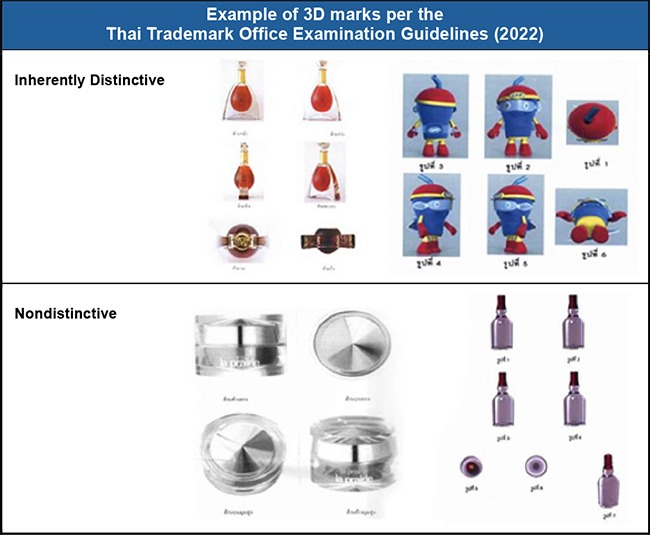
A plain water bottle relying on subtle contours to signal its brand is typically read as just another bottle, not a source identifier. Acquired distinctiveness offers a theoretical escape route, but it demands extensive evidence of sales, advertising, and consumer recognition—an especially heavy burden for new entrants whose minimalist packaging has not yet achieved market prominence. The result is a structural bias against precisely the design innovation that sustainability goals are meant to encourage.

Design Patents: A Partial, Imperfect Substitute

Design patent protection, covering a product’s shape, configuration, or ornamentation, appears to offer an alternative route. In practice, it is constrained by the same forces driving the minimalist trend. Because many brands converge on similar solutions—clear PET bottles, label-free surfaces, simple paperboard—new designs often “so nearly resemble” existing ones that they fail the novelty requirement under the Thai Patent Act. Even where novelty is established, protection lasts only ten years from filing, ill-suited to the indefinite life cycle of a brand identity that trademarks can offer. Narrow claim scope compounds the problem: because minimalist designs differ from competitors only in subtle details, rivals can make cosmetic tweaks and avoid infringement altogether.

A Layered Strategy for Now

Given these gaps, Thai practitioners should treat trademark and design patent filings as complementary layers rather than mutually exclusive options. Registration attempts can be supplemented with unfair competition claims for passing off, which remain available under Section 46 of the Trademark Act and Section 420 of the Civil and Commercial Code even where registration is refused. Contemporaneous evidence of consumer recognition—social media engagement, packaging redesign campaigns, and sales data tied to the new design—should be compiled from launch rather than assembled only once a dispute arises. Combining registered rights with common law remedies and a documented evidentiary record offers the most realistic protection available under the current framework.

Conclusion

The tension between Thailand’s IP framework and its sustainable packaging boom is unlikely to be resolved through litigation alone. The DIP’s examination guidelines predate the scale of today’s minimalist packaging trend and warrant revisiting, particularly in how consumer-perception evidence is weighed against abstract notions of “natural form” and “functionality.” Until that recalibration occurs, brands investing in green packaging should treat IP protection as a portfolio exercise: pursuing registration where possible, building an evidentiary record for acquired distinctiveness, and relying on passing-off remedies to fill the gaps. Minimalist packaging is not disappearing from Thai shelves; the law protecting it needs to catch up.


This article was prepare with the assistance of Tilleke & Gibbins intern Phuripat Kaewklom. It was originally published by the International Association for the Protection of Intellectual Property (AIPPI).

RELATED INSIGHTS​ 

March 10, 2026
Indonesia’s trademark prosecution process has been significantly streamlined with Ministry of Law Regulation No. 5 of 2026 (MOLR 5/2026) coming into effect on February 23, 2026. In straightforward cases without opposition, applicants may now see their trademarks proceed to registration within three months from filing—a substantial improvement over previous practice. The regulation also introduces detailed procedures for recording changes of name and address and for transferring rights over pending applications. It enhances the role of the Ministry of Law’s regional offices in assisting local individuals and SMEs, adds provisions governing force majeure situations, implements new requirements for collective trademarks, and formalizes several practices already in place. Substantive Examination Acceleration The most significant change under MOLR 5/2026 concerns substantive examination. The regulation now explicitly requires that applications be published within 15 days of filing, followed by a two-month publication period. Oppositions must be filed only within this window; late submissions will not be processed, even if the system accepts payment. The new regulation requires the Trademark Office (TMO) to forward copies of any opposition to applicants within 14 days of receipt. If no opposition is filed, substantive examination begins immediately after the publication period ends and will be completed within 30 days. If an opposition is filed, the examination is to be finalized within 90 days of the counterstatement filing date. These timelines enable unopposed applications to move from close of publication to final decision in roughly one month. If an application is provisionally refused during ex officio examination, the applicant has 30 working days from the date of notification to file a response. However, the regulation does not specify the timeline for subsequent reexamination after the response is filed. In recent practice, the TMO has been completing reexamination within approximately two to three months. Ownership Recordals May Pause Substantive
March 6, 2026
Myanmar’s Trademark Law 2019 introduced a modern framework for the registration, enforcement, and protection of trademarks. However, due to the high volume of applications filed during the soft-opening period of the Intellectual Property Department (IPD), marks submitted from 2022 onward remain pending as the IPD works its way through the applications filed in 2021, which it has been publishing on a monthly basis since May 1, 2024. During this period, businesses should adopt proactive strategies to protect their brands, monitor conflicting marks, and ensure a smooth registration process. Practical Steps for Safeguarding Pending Marks While a pending application does not confer full trademark rights, brand owners can take several practical steps to strengthen their position: Monitor IPD publications. Businesses should regularly review the IPD’s monthly gazette to identify any identical or confusingly similar marks at an early stage and prepare timely oppositions in accordance with the Trademark Law’s provisions allowing “any interested party” to file an objection to a trademark application. Monitor market activity. Early detection of potential infringement enables swift action, such as cease-and-desist letters and opposition proceedings. Businesses should monitor competitors, distributors, and retailers for unauthorized use of their marks. Collect evidence of use. Maintaining evidence of use strengthens claims of distinctiveness and supports enforcement efforts. Businesses should keep records of commercial activities, distribution, brand promotion and development, marketing communications, product packaging and labeling, and sales demonstrating brand recognition in Myanmar and internationally, particularly in Southeast Asian markets. Although the Trademark Law 2019 establishes a first-to-file system, evidence of use provides considerable practical support for distinctiveness claims and enforcement actions. Pursue Interim Enforcement Options. A pending trademark application can be relied upon to oppose or refuse other marks on absolute and/or relative grounds of refusal. In addition, marks with established reputations may be protected under passing-off principles
February 27, 2026
On January 26, 2026, Vietnam’s Ministry of Finance issued Circular No. 06/2026/TT-BTC (Circular 06), amending and supplementing Circular No. 13/2015/TT-BTC, which provides guidance on dossiers and procedures for customs recordal and customs supervision in relation to intellectual property rights (IPR). Circular 06 has an effective date of March 1, 2026. Some notable points of Circular 06 include the following: Simplified Documentation for Customs Recordal Applications Circular 06 reduces some documentary requirements for IPR owners: A power of attorney is no longer required to be legalized. Applicants are no longer required to submit title or registration certificates if such documents are issued in digital form. In such cases, it is sufficient to declare comprehensive information on the relevant IPR, enabling customs authorities to verify the information through publicly accessible databases. In practice, this amendment is particularly beneficial for international trademark registrations designating Vietnam. IPR owners may no longer need to obtain a confirmation letter from the Intellectual Property Office of Vietnam regarding the validity of a trademark registration in Vietnam. Instead, they may rely on registration status information available from the World Intellectual Property Organization (WIPO) database, reflecting that the international registration has been granted protection in Vietnam. Clearer Mechanism for Ex Officio Suspension of Suspected Infringing Goods Although ex officio suspension has been referenced in earlier regulations, Circular 06 provides clearer guidance on the circumstances and procedures under which customs may proactively suspend customs procedures for consignments suspected of being counterfeit or pirated goods. Accordingly, customs authorities may initiate the suspension of clearance without waiting for a formal request from IPR owners. Enhanced Supervision of Imported/Exported Goods in E-Commerce Circular 06 also supplements provisions on the inspection of imported and exported goods transacted through e-commerce channels. Customs authorities may apply risk management measures to assess goods traded via e-commerce
February 26, 2026
Thailand is preparing to offer new tools for intellectual property enforcement as the Electronic Transactions Development Agency (ETDA) recently released for public consultation a draft notification requiring social media platforms to verify user identities and conduct know-your-customer (KYC) checks on advertisers. The draft Notification of the Electronic Transactions Commission on Measures to Prevent Technological Crimes for Social Media Service Providers, which is to be issued under the Emergency Decree on Measures for the Prevention and Suppression of Technological Crimes B.E. 2566 (2023), as amended in 2025, primarily aims to combat online fraud and technology-related crimes. However, its new obligations also provide IP owners with valuable tools to identify anonymous infringers. Key Regulatory Mandates The draft notification imposes several verification requirements on social media platforms operating in Thailand. These requirements also strengthen IP rights holders’ ability to identify anonymous infringers, as platforms must: Verify user identities through registered phone numbers and link all accounts to verifiable identities. Conduct KYC checks on advertisers, including individuals, companies, and any third-party payers. Perform heightened identity checks for high-risk or repeat offenders before publishing advertisements. Promptly remove content flagged by the Anti-Technology Crime Division and prescreen advertisements for prohibited or high-risk content. How IP Owners Can Use This Notification for Enforcement The phone number–based verification requirement enables IP owners to work more effectively with enforcement authorities in tracing individuals or entities responsible for infringing content. The comprehensive advertiser KYC obligations, including mandatory disclosure of third-party payment sources, create a clear audit trail even when bad actors attempt to obscure their identity through intermediaries or shell accounts. This traceability is essential for pursuing damages and dismantling organized counterfeit operations. The ETDA is now considering adjustments to the draft notification after receiving comments during the public consultation period, which ended on February 2, 2026. Following finalization