
You are using an outdated browser and your browsing experience will not be optimal. Please update to the latest version of Microsoft Edge, Google Chrome or Mozilla Firefox. Install Microsoft Edge

August 6, 2026

Green Packaging, Gray Areas: The Challenges of Protecting Minimalist Packaging Under Thai IP Law

Introduction: A Trademark Paradox in Sustainable Packaging

Walk into any Thai supermarket, and the label-free water bottle is no longer a novelty. Thailand’s packaging market, valued at approximately USD 15.68 billion in 2025, is shifting toward minimalist, plastic-light designs as ESG pressures reshape how brands present their products. The country generated roughly 5.68 million tons of plastic waste in 2021, with a recycling rate of only 19 percent, and regulators are now considering rules that would allow label-free bottled water relying on embossing, laser printing, or QR codes instead of wrap-around labels. As packaging itself becomes the brand identifier, a paradox emerges: designs built to say the least often struggle hardest for protection under Thai intellectual property law.

The Trademark Barrier: When Shape Is Not Enough

Section 7, paragraph 2(10) of the Thai Trademark Act deems a shape distinctive only if it is not the natural form of the goods, is not necessary to achieve a technical result, and does not add value to the goods. The Department of Intellectual Property’s 2022 examination guidelines apply this test conservatively, as the following examples illustrate.
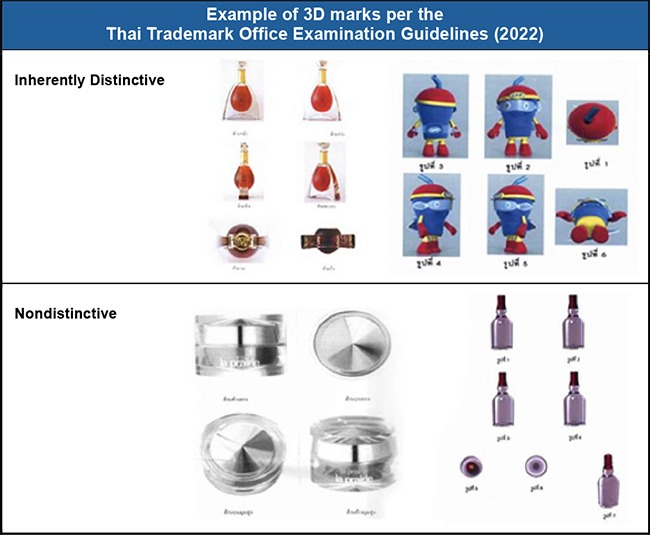
A plain water bottle relying on subtle contours to signal its brand is typically read as just another bottle, not a source identifier. Acquired distinctiveness offers a theoretical escape route, but it demands extensive evidence of sales, advertising, and consumer recognition—an especially heavy burden for new entrants whose minimalist packaging has not yet achieved market prominence. The result is a structural bias against precisely the design innovation that sustainability goals are meant to encourage.

Design Patents: A Partial, Imperfect Substitute

Design patent protection, covering a product’s shape, configuration, or ornamentation, appears to offer an alternative route. In practice, it is constrained by the same forces driving the minimalist trend. Because many brands converge on similar solutions—clear PET bottles, label-free surfaces, simple paperboard—new designs often “so nearly resemble” existing ones that they fail the novelty requirement under the Thai Patent Act. Even where novelty is established, protection lasts only ten years from filing, ill-suited to the indefinite life cycle of a brand identity that trademarks can offer. Narrow claim scope compounds the problem: because minimalist designs differ from competitors only in subtle details, rivals can make cosmetic tweaks and avoid infringement altogether.

A Layered Strategy for Now

Given these gaps, Thai practitioners should treat trademark and design patent filings as complementary layers rather than mutually exclusive options. Registration attempts can be supplemented with unfair competition claims for passing off, which remain available under Section 46 of the Trademark Act and Section 420 of the Civil and Commercial Code even where registration is refused. Contemporaneous evidence of consumer recognition—social media engagement, packaging redesign campaigns, and sales data tied to the new design—should be compiled from launch rather than assembled only once a dispute arises. Combining registered rights with common law remedies and a documented evidentiary record offers the most realistic protection available under the current framework.

Conclusion

The tension between Thailand’s IP framework and its sustainable packaging boom is unlikely to be resolved through litigation alone. The DIP’s examination guidelines predate the scale of today’s minimalist packaging trend and warrant revisiting, particularly in how consumer-perception evidence is weighed against abstract notions of “natural form” and “functionality.” Until that recalibration occurs, brands investing in green packaging should treat IP protection as a portfolio exercise: pursuing registration where possible, building an evidentiary record for acquired distinctiveness, and relying on passing-off remedies to fill the gaps. Minimalist packaging is not disappearing from Thai shelves; the law protecting it needs to catch up.


This article was prepare with the assistance of Tilleke & Gibbins intern Phuripat Kaewklom. It was originally published by the International Association for the Protection of Intellectual Property (AIPPI).

RELATED INSIGHTS​ 

August 7, 2024
A recent case at the Myanmar Competition Commission has set a significant precedent in the country’s approach to unfair competition practices. The case, involving a Thai manufacturer of cement grout and tile adhesive products and a local Myanmar producer, highlighted the Commission’s willingness to address issues of deceptive marketing and unfair competition. Background The case centered around a Thai manufacturer who has been distributing their cement grout and tile adhesive products in Myanmar for many years through local distribution agents. The company had established a well-known brand and a strong reputation for quality in the Myanmar market. In recent years, the Thai company discovered that a local individual in Myanmar was manufacturing and selling similar products with packaging nearly identical to their own. The local producer was using the same mark device, color, and packaging design themes, and the products contained deceptive information. Legal Proceedings After an initial cease-and-desist letter failed to resolve the issue, a complaint was submitted to the Myanmar Competition Commission. The case was notable because the Commission typically does not address issues of copying designs, marks, colors, or packaging themes. However, the complaint emphasized that the local individual was misleading customers and competing unfairly by using deceptive information and copying distinctive designs and themes. Lawyers from Tilleke & Gibbins, representing the Thai manufacturer, provided extensive documentation proving their client’s long-standing presence in the Myanmar market and the local individual’s deceptive practices. The Commission’s Investigation Committee conducted a thorough investigation, including market surveys and hearings involving both parties. Commission’s Decision After nearly a year of deliberation, on July 4, 2024, the Decision-Making Committee of the Myanmar Competition Commission ruled in favor of the Thai manufacturer. The decision required the local individual to: Immediately cease the production and distribution of cement grout and tile adhesive products bearing
July 31, 2024
On the afternoon of 19 April 2024, a cramped courtroom at the People’s Court of Hanoi was the setting for the first criminal trial of a case of copyright and related rights infringement in Vietnam, regarding the act of illegal streaming of English Premier League football matches on online platforms. This case is expected to open the door for the criminal prosecution of other cases of copyright and related rights infringement on the internet, an area that has faced numerous difficulties over the past two decades. First criminal case of illegal streaming Vietnamese criminal law has long had provisions in place for criminal handling of copyright infringement crimes, specifically in Article 131 of the 1999 Penal Code. However, more than 20 years after this law took effect, and even though Vietnam enacted the 2015 Penal Code with subsequent amendments, these regulations have remained mainly a law on paper only, and many significant and serious cases causing great frustration for rights holders and society have not been criminally prosecuted. The case in question was initiated by a denunciation of the BestBuyIPTV subscription service by the Football Association Premier League Limited (the “Premier League”) and the Alliance for Creativity and Entertainment (“ACE”), a coalition of global entertainment companies and film studios dedicated to combating digital piracy and copyright infringement. BestBuyIPTV had illegally streamed Premier League matches and other protected works without authorization of the rights holders. In 2023, after an extensive investigation, the Cybersecurity and High-Tech Crime Prevention Division (PA05) and the Police Department for Investigating Corruption, Smuggling, and Economic Crimes (PC03) of the Hanoi police brought a case for criminal copyright infringement, pursuant to Article 225 of the 2015 Penal Code, against the offender, an individual named Le Hai Nam, consolidating the dossiers for the People’s Procuracy to indict this
July 24, 2024
Experts from Tilleke & Gibbins’ intellectual property team have contributed an updated Intellectual Property Transactions in Vietnam to Thomson Reuters Practical Law, a high-level comparative overview of  laws and regulations across multiple jurisdictions. Intellectual Property Transactions focuses on business-related aspects of intellectual property, such as the value of intellectual assets in M&A transactions, and the licensing of IP portfolios. Key topics covered in the chapter include: IP assignment: Basis and formalities for assignments of patents, utility models, trademarks, copyright, design rights, trade secrets, confidential information, and domain names. IP licensing: Scope and formalities for licensing patents, utility models, trademarks, copyright, design rights, and trade secrets. Research and development collaborations. IP audits. IP aspects of M&A: Due diligence, warranties/indemnities, and transfer of IPRs. Employee and consultant agreements. Practical Law, a legal reference resource from Thomson Reuters, publishes a range of guides for hundreds of jurisdictions and practice areas. The Intellectual Property Transactions Global Guide is a valuable resource for legal practitioners, covering numerous jurisdictions worldwide. To view the latest version of the Intellectual Property Transactions in Vietnam overview, please visit the Practical Law website and enroll in the free Practical Law trial to gain full access.
July 24, 2024
Intellectual property specialists from Tilleke & Gibbins in Thailand have contributed an updated Intellectual Property Transactions in Thailand overview for Thomson Reuters Practical Law, an online publication that provides comprehensive legal guides for jurisdictions worldwide. The Thailand overview was authored by Darani Vachanavuttivong, managing partner of Tilleke & Gibbins and managing director of the firm’s regional IP practice; Titikaan Ungbhakorn, senior associate and patent agent; and San Chaithiraphant, senior associate. The chapter delivers a high-level examination of critical aspects of IP law, including IP assignment and licensing, research and development collaborations, IP in mergers and acquisitions (M&A), securing loans with intellectual property rights, settlement agreements, employee-related IP issues, competition law, taxation, and non-tariff trade barriers. Key topics covered in the chapter include: IP assignment: Basis and formalities for assignments of patents, utility models, trademarks, copyright, design rights, trade secrets, confidential information, and domain names. IP licensing: Scope and formalities for licensing patents, utility models, trademarks, copyright, design rights, and trade secrets. Research and development collaborations: Management of improvements, derivatives, and joint ownership of IP. IP aspects of M&A: Due diligence and critical considerations during mergers and acquisitions. Practical Law, a legal reference resource from Thomson Reuters, publishes a range of guides for hundreds of jurisdictions and practice areas. The Intellectual Property Transactions Global Guide is a valuable resource for legal practitioners, covering numerous jurisdictions worldwide. To view the latest version of the Intellectual Property Transactions in Thailand overview, please visit the Practical Law website and enroll in the free Practical Law trial to gain full access.