
You are using an outdated browser and your browsing experience will not be optimal. Please update to the latest version of Microsoft Edge, Google Chrome or Mozilla Firefox. Install Microsoft Edge

August 6, 2026

Green Packaging, Gray Areas: The Challenges of Protecting Minimalist Packaging Under Thai IP Law

Introduction: A Trademark Paradox in Sustainable Packaging

Walk into any Thai supermarket, and the label-free water bottle is no longer a novelty. Thailand’s packaging market, valued at approximately USD 15.68 billion in 2025, is shifting toward minimalist, plastic-light designs as ESG pressures reshape how brands present their products. The country generated roughly 5.68 million tons of plastic waste in 2021, with a recycling rate of only 19 percent, and regulators are now considering rules that would allow label-free bottled water relying on embossing, laser printing, or QR codes instead of wrap-around labels. As packaging itself becomes the brand identifier, a paradox emerges: designs built to say the least often struggle hardest for protection under Thai intellectual property law.

The Trademark Barrier: When Shape Is Not Enough

Section 7, paragraph 2(10) of the Thai Trademark Act deems a shape distinctive only if it is not the natural form of the goods, is not necessary to achieve a technical result, and does not add value to the goods. The Department of Intellectual Property’s 2022 examination guidelines apply this test conservatively, as the following examples illustrate.
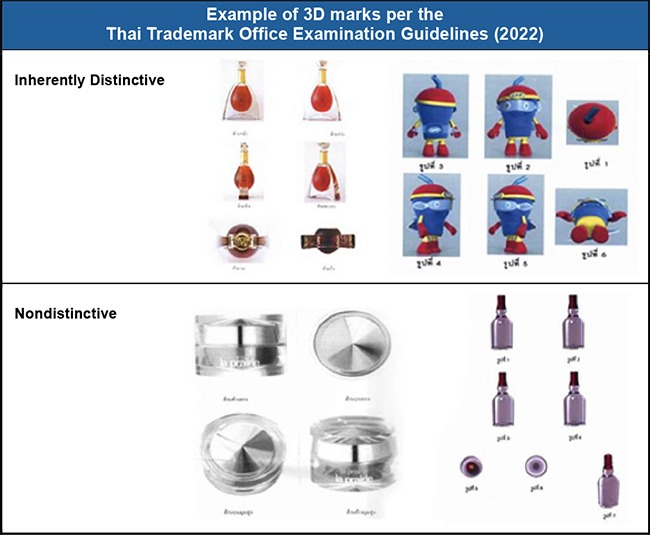
A plain water bottle relying on subtle contours to signal its brand is typically read as just another bottle, not a source identifier. Acquired distinctiveness offers a theoretical escape route, but it demands extensive evidence of sales, advertising, and consumer recognition—an especially heavy burden for new entrants whose minimalist packaging has not yet achieved market prominence. The result is a structural bias against precisely the design innovation that sustainability goals are meant to encourage.

Design Patents: A Partial, Imperfect Substitute

Design patent protection, covering a product’s shape, configuration, or ornamentation, appears to offer an alternative route. In practice, it is constrained by the same forces driving the minimalist trend. Because many brands converge on similar solutions—clear PET bottles, label-free surfaces, simple paperboard—new designs often “so nearly resemble” existing ones that they fail the novelty requirement under the Thai Patent Act. Even where novelty is established, protection lasts only ten years from filing, ill-suited to the indefinite life cycle of a brand identity that trademarks can offer. Narrow claim scope compounds the problem: because minimalist designs differ from competitors only in subtle details, rivals can make cosmetic tweaks and avoid infringement altogether.

A Layered Strategy for Now

Given these gaps, Thai practitioners should treat trademark and design patent filings as complementary layers rather than mutually exclusive options. Registration attempts can be supplemented with unfair competition claims for passing off, which remain available under Section 46 of the Trademark Act and Section 420 of the Civil and Commercial Code even where registration is refused. Contemporaneous evidence of consumer recognition—social media engagement, packaging redesign campaigns, and sales data tied to the new design—should be compiled from launch rather than assembled only once a dispute arises. Combining registered rights with common law remedies and a documented evidentiary record offers the most realistic protection available under the current framework.

Conclusion

The tension between Thailand’s IP framework and its sustainable packaging boom is unlikely to be resolved through litigation alone. The DIP’s examination guidelines predate the scale of today’s minimalist packaging trend and warrant revisiting, particularly in how consumer-perception evidence is weighed against abstract notions of “natural form” and “functionality.” Until that recalibration occurs, brands investing in green packaging should treat IP protection as a portfolio exercise: pursuing registration where possible, building an evidentiary record for acquired distinctiveness, and relying on passing-off remedies to fill the gaps. Minimalist packaging is not disappearing from Thai shelves; the law protecting it needs to catch up.


This article was prepare with the assistance of Tilleke & Gibbins intern Phuripat Kaewklom. It was originally published by the International Association for the Protection of Intellectual Property (AIPPI).

RELATED INSIGHTS​ 

July 22, 2024
Appeals of unfavorable decisions on protection in the IP field are very common in Vietnam. In 2023, there were 845 appeals filed at the IP Office, including 780 trademark appeals. In most cases, however, applicants view the appeal procedure as almost a last resort, as the lengthy examination process can lead to serious delays in appeal settlement. In fact, it can take four to seven years, or even longer, for an appeal to be resolved, and a disappointingly low number of cases are settled each year, despite the towering number of appeals pending. Nonetheless, there are reasons for optimism. Inspection and Appeal Department On 1 July 2024, the IP Office issued Decision No. 575/QD-SHTT promulgating the Regulations on Organization and Operation of the Inspection and Appeal Department – formerly the Enforcement and Appeal Department – whose functions include, among others, advising and assisting the Director General of the IP Office in resolving appeals related to the process of establishing IP rights. The Inspection and Appeal Department has the duty to handle appeals and denunciations related to the process of establishing IP rights, as well as requests for termination and cancellation of the validity of registrations. In addition, it can provide expert opinions, and appoint knowledgeable personnel to participate in the IP Office’s Advisory Council to settle appeals. While the renamed department’s responsibilities do not differ greatly, on paper, from those of the previous Enforcement and Appeal Department, the issuance of new regulations indicates the IP Office’s renewed focus on the importance of improving the appeal procedure. Scope of IP appeals expanded In addition, in November 2023, the Ministry of Science and Technology issued Circular No. 23/2023/TT-BKHCN (“Circular 23”) providing further guidance for implementation of the amended 2022 IP Law and its subordinate legislation. Article 35 of Circular 23 has
July 5, 2024
The landscape of intellectual property (IP) has transformed alongside advancements in technology, transitioning from traditional methods to modern online approaches. A growing number of IP infringers are moving their illegal activities to the online sphere, particularly through the sale of counterfeit goods on their websites, social media, or e-commerce platforms. In response to these shifting pressures, Thailand implemented the Computer-Related Crime Act B.E. 2550 (CCA) on July 18, 2007, and amended it in 2017, aiming to enhance the effectiveness of combating online infringement by empowering government officials to request that the court block computer data (called “website-blocking”) that infringes upon other parties’ intellectual property rights, as per section 20(3) of the CCA. From 2018 to May 2024, Thailand’s Criminal Court and Central Intellectual Property and International Trade Court have issued 53 orders to block more than 1,779 infringing URLs. One significant recent development is the Criminal Court’s establishment of the Technology Crime Division, which has been operating since April 1, 2024. Its purpose is to address criminal offenses that occur through electronic means, which should then be handled in an effective and prompt manner by judges who have expertise on technological crimes. In addition, several current measures to combat technology crime, including section 20(3) of the CCA, require court orders for the prevention of electronic criminal offenses or online infringement. The Technology Crime Division has the jurisdiction to consider and grant these orders, which will help expedite the approval process and ensure review by specialized judges. Scope of the Technology Crime Division The announcement of the establishment of the Technology Crime Division within the Criminal Court was published in the Government Gazette on March 18, 2024, with operations commencing on April 1, 2024. The Technology Crime Division is empowered to: Consider and adjudicate technology crime cases, except cases falling
June 25, 2024
Attorneys from Tilleke & Gibbins’ office in Phnom Penh have prepared Intellectual Property in Cambodia, a comprehensive resource for understanding, protecting, and commercializing intellectual property (IP) in the country. This guide provides detailed information on various aspects of IP rights, including: Trademarks: Procedures and requirements for registration, maintenance, and enforcement. Patents: Information on obtaining patent protection, including the application process and legal requirements. Industrial designs: Steps for registering and protecting design innovations. Utility models: Guidelines for securing protection for new technical solutions. Copyrights: Details on copyright protection, registration, and enforcement. Geographical indications: Information on protecting products with specific geographical origins. The guide is designed to offer practical insights into the registration processes, legal frameworks, and enforcement mechanisms relevant to IP in Cambodia. It aims to serve as a valuable tool for businesses, legal practitioners, and individuals involved in the creation and protection of intellectual property. For more details, access the full Intellectual Property in Cambodia guide by clicking the button below.
June 25, 2024
Attorneys from Tilleke & Gibbins’ offices in Vietnam have prepared Intellectual Property in Vietnam, a comprehensive resource for understanding, protecting, and commercializing intellectual property (IP) in the country. This guide provides detailed information on various aspects of IP rights, including: Trademarks: Procedures and requirements for registration, maintenance, and enforcement. Patents: Information on obtaining patent protection, including the application process and legal requirements. Industrial designs: Steps for registering and protecting design innovations. Utility models: Guidelines for securing protection for new technical solutions. Copyrights: Details on copyright protection, registration, and enforcement. Geographical indications: Information on protecting products with specific geographical origins. The guide is designed to offer practical insights into the registration processes, legal frameworks, and enforcement mechanisms relevant to IP in Vietnam. It aims to serve as a valuable tool for businesses, legal practitioners, and individuals involved in the creation and protection of intellectual property. For more details, access the full Intellectual Property in Vietnam guide by clicking the button below.