
You are using an outdated browser and your browsing experience will not be optimal. Please update to the latest version of Microsoft Edge, Google Chrome or Mozilla Firefox. Install Microsoft Edge

August 6, 2026

Green Packaging, Gray Areas: The Challenges of Protecting Minimalist Packaging Under Thai IP Law

Introduction: A Trademark Paradox in Sustainable Packaging

Walk into any Thai supermarket, and the label-free water bottle is no longer a novelty. Thailand’s packaging market, valued at approximately USD 15.68 billion in 2025, is shifting toward minimalist, plastic-light designs as ESG pressures reshape how brands present their products. The country generated roughly 5.68 million tons of plastic waste in 2021, with a recycling rate of only 19 percent, and regulators are now considering rules that would allow label-free bottled water relying on embossing, laser printing, or QR codes instead of wrap-around labels. As packaging itself becomes the brand identifier, a paradox emerges: designs built to say the least often struggle hardest for protection under Thai intellectual property law.

The Trademark Barrier: When Shape Is Not Enough

Section 7, paragraph 2(10) of the Thai Trademark Act deems a shape distinctive only if it is not the natural form of the goods, is not necessary to achieve a technical result, and does not add value to the goods. The Department of Intellectual Property’s 2022 examination guidelines apply this test conservatively, as the following examples illustrate.
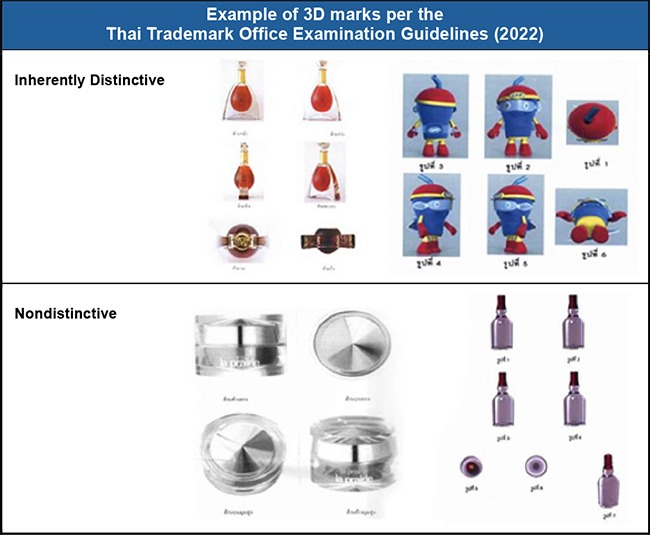
A plain water bottle relying on subtle contours to signal its brand is typically read as just another bottle, not a source identifier. Acquired distinctiveness offers a theoretical escape route, but it demands extensive evidence of sales, advertising, and consumer recognition—an especially heavy burden for new entrants whose minimalist packaging has not yet achieved market prominence. The result is a structural bias against precisely the design innovation that sustainability goals are meant to encourage.

Design Patents: A Partial, Imperfect Substitute

Design patent protection, covering a product’s shape, configuration, or ornamentation, appears to offer an alternative route. In practice, it is constrained by the same forces driving the minimalist trend. Because many brands converge on similar solutions—clear PET bottles, label-free surfaces, simple paperboard—new designs often “so nearly resemble” existing ones that they fail the novelty requirement under the Thai Patent Act. Even where novelty is established, protection lasts only ten years from filing, ill-suited to the indefinite life cycle of a brand identity that trademarks can offer. Narrow claim scope compounds the problem: because minimalist designs differ from competitors only in subtle details, rivals can make cosmetic tweaks and avoid infringement altogether.

A Layered Strategy for Now

Given these gaps, Thai practitioners should treat trademark and design patent filings as complementary layers rather than mutually exclusive options. Registration attempts can be supplemented with unfair competition claims for passing off, which remain available under Section 46 of the Trademark Act and Section 420 of the Civil and Commercial Code even where registration is refused. Contemporaneous evidence of consumer recognition—social media engagement, packaging redesign campaigns, and sales data tied to the new design—should be compiled from launch rather than assembled only once a dispute arises. Combining registered rights with common law remedies and a documented evidentiary record offers the most realistic protection available under the current framework.

Conclusion

The tension between Thailand’s IP framework and its sustainable packaging boom is unlikely to be resolved through litigation alone. The DIP’s examination guidelines predate the scale of today’s minimalist packaging trend and warrant revisiting, particularly in how consumer-perception evidence is weighed against abstract notions of “natural form” and “functionality.” Until that recalibration occurs, brands investing in green packaging should treat IP protection as a portfolio exercise: pursuing registration where possible, building an evidentiary record for acquired distinctiveness, and relying on passing-off remedies to fill the gaps. Minimalist packaging is not disappearing from Thai shelves; the law protecting it needs to catch up.


This article was prepare with the assistance of Tilleke & Gibbins intern Phuripat Kaewklom. It was originally published by the International Association for the Protection of Intellectual Property (AIPPI).

RELATED INSIGHTS​ 

September 9, 2024
The popularity of the franchise business model has been growing rapidly in Southeast Asia in recent years, with some of the world’s top brands becoming common sights in the commercial districts and shopping malls of major regional cities in Cambodia, Indonesia, Laos, Myanmar, Thailand, and Vietnam. While for most countries in this part of the world, franchising has not been explicitly mentioned in legislation, well prepared franchise business operations can comfortably adapt to each country’s regulatory framework, and the growth is poised to continue even as the global retail sector redesigns and redoubles its efforts in the wake of the COVID-19 outbreak. In fact, the franchise business model, which is both global and hyper-local at once, is one of the most promising solutions that entrepreneurs are turning to in their quest to overcome the challenges of the new economic reality. The Regional Guide to Franchising Law in Southeast Asia provides key, up-to-date insights into the legal frameworks regulating franchise operations in these Southeast Asian countries, and helps brand owners understand the most relevant laws, authorities, and procedures for their business. Some of the essential topics covered for each jurisdiction include considerations in negotiating and designing franchise agreements, protecting intellectual property rights, and important information on judicial and arbitral procedures should a dispute arise between franchisor and franchisee. Practitioners from Tilleke & Gibbins’ offices in Cambodia, Indonesia, Laos, Myanmar, Thailand, and Vietnam contributed to guide—not only by providing legal expertise on the laws and mechanisms applicable in each jurisdiction, but also by examining strategies for establishing and running resilient franchise operations in Southeast Asia. The full guide can be accessed as a PDF through the button below.
August 30, 2024
As in many other countries, registered trademarks in Indonesia that are not used for a given period of time can be canceled. A recent decision (Decision No. 144/PUU-XXI/2023) from the country’s Constitutional Court has extended the non-use cancellation period from three years to five years, applicable from July 30, 2024. This ruling could have a major impact on trademark holders in the country. Background of the Case Article 74 of Indonesia’s Trademark Law of 2016 specifies that trademarks can be canceled if they go unused in the trade of goods or services for three consecutive years from the date of registration or last use. This provision is aligned with the Paris Convention and the TRIPs Agreement. On October 27, 2023, an Indonesian individual named Ricky Thio asked the Constitutional Court to examine the constitutionality of Article 74, arguing that it opened a pathway for third parties to eliminate trademarks owned by small and medium-sized enterprises (SMEs), and did not provide certainty to his registered trademark in terms of the period of protection. Additionally, he argued that the period of three consecutive years was burdensome for SMEs, and asked the court to void Article 74 and add force majeure circumstances—such as Covid-19—as an exemption to non-use cancellation. Mr. Thio submitted this request while he was defending his trademark registration from a non-use cancellation request filed by Zhejiang Dahua Technology Co., Ltd. In his defense to that cancellation request, Mr. Thio explained that the non-use of the trademark was due to the Covid-19 pandemic. The cancellation case followed a different judicial pathway, and was under appeal before the Supreme Court at the time Mr. Thio filed his request for judicial review with the Constitutional Court. Mr. Thio’s case also attracted the submission of an amicus brief—a relatively new trend in Indonesia—from
August 30, 2024
In 2023, Vietnam’s Intellectual Property Rights Infringement Prevention Cooperation Program reported that 776 cases of IPR infringement were resolved nationwide. Of these, 546 were addressed through administrative measures, while criminal proceedings were initiated in just five cases. These statistics clearly show that administrative measures overwhelmingly dominate the response to counterfeit goods, with criminal actions being relatively rare. This raises an intriguing question: Why do IPR holders prefer administrative routes over criminal measures in Vietnam? And what challenges and obstacles make criminal enforcement less commonly pursued in these cases? Overlapping legal provisions Under Vietnam’s Penal Code, two key offenses address counterfeit goods: Manufacturing and trading in counterfeit goods under Article 192. Manufacturing and trading in industrial property rights-infringing goods under Article 226. Both provisions regulate counterfeit goods, yet they suffer from a lack of clear definitions and guidelines for application. Article 192 does not explicitly define “counterfeit goods”. Instead, authorities refer to Article 3.7 of Decree No. 98/2020/ND-CP, as amended, which outlines several categories of counterfeit goods, including: (i) utility counterfeits (goods not meeting normal expectations of usage or function), (ii) substandard goods, (iii) counterfeit goods based on misrepresentation, and (iv) counterfeit stamps, labels, and packaging. Meanwhile, Article 226 specifically deals with counterfeit goods that infringe trademark rights. These “trademark-counterfeit goods” are defined under Article 213.2 of the IP Law as goods or packaging bearing trademarks or signs that are identical or confusingly similar to protected trademarks for the same goods, used without the trademark owner’s permission. In this regard, “counterfeit goods” and “trademark-counterfeit goods” are treated as distinct, non-overlapping concepts, each corresponding to a separate offense. However, in practice, there is often a gray area where the two overlap. Many cases involve infringing goods that meet the criteria for both categories, allowing authorities to apply both regulations simultaneously. For
August 30, 2024
With the emergence of online marketplaces and e-commerce platforms, consumers have transformed their ways of engaging in transactions, gaining unprecedented convenience and access to a vast array of products. These platforms allow small businesses and individual entrepreneurs to reach a wider audience in an increasingly competitive market. Challenges in Tracing Online Infringers The growth of these online marketplaces and e-commerce platforms has also given rise to challenges, particularly in locating the actual identity of online infringers and combating intellectual property infringement activities. Online infringers often take advantage of anonymity to offer counterfeit products for sale on their platforms. Not only do these online infringing activities violate the rights of IP owners, but they also involve the sale of counterfeit products that are often manufactured with inferior quality and may pose significant risks to consumers’ health and safety. In today’s modern world, tracing the actual identity of online infringers proves challenging, as infringers adopt numerous methods to conceal their identity. The most frequently used method is using a fake name and address when dispatching parcels to consumers, making it difficult to verify the seller’s identity and the location of the sender on the parcel package. Some infringers exploit cash-on-delivery logistics services to prevent the disclosure of their identity, such as bank account numbers and bank account owner names, which would typically be required for direct payments. Instead, the shipping company collects the payment on their behalf, allowing the infringers to remain anonymous and making it more difficult to find their actual identity. Thailand’s New Regulations on Cash-on-Delivery Logistics Services Recently, the Committee on Contracts of Thailand’s Consumer Protection Board announced the Notification regarding Stipulation of Cash-on-Delivery Logistics Services as a Controlled-Receipt Business B.E. 2567 (2024) under the Consumer Protection Act B.E. 2522 (1979) in the Thai Royal Gazette dated July