
You are using an outdated browser and your browsing experience will not be optimal. Please update to the latest version of Microsoft Edge, Google Chrome or Mozilla Firefox. Install Microsoft Edge

August 6, 2026

Green Packaging, Gray Areas: The Challenges of Protecting Minimalist Packaging Under Thai IP Law

Introduction: A Trademark Paradox in Sustainable Packaging

Walk into any Thai supermarket, and the label-free water bottle is no longer a novelty. Thailand’s packaging market, valued at approximately USD 15.68 billion in 2025, is shifting toward minimalist, plastic-light designs as ESG pressures reshape how brands present their products. The country generated roughly 5.68 million tons of plastic waste in 2021, with a recycling rate of only 19 percent, and regulators are now considering rules that would allow label-free bottled water relying on embossing, laser printing, or QR codes instead of wrap-around labels. As packaging itself becomes the brand identifier, a paradox emerges: designs built to say the least often struggle hardest for protection under Thai intellectual property law.

The Trademark Barrier: When Shape Is Not Enough

Section 7, paragraph 2(10) of the Thai Trademark Act deems a shape distinctive only if it is not the natural form of the goods, is not necessary to achieve a technical result, and does not add value to the goods. The Department of Intellectual Property’s 2022 examination guidelines apply this test conservatively, as the following examples illustrate.
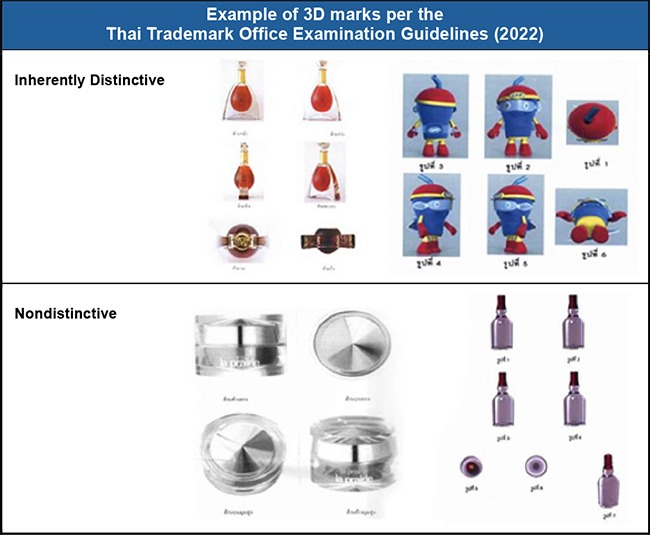
A plain water bottle relying on subtle contours to signal its brand is typically read as just another bottle, not a source identifier. Acquired distinctiveness offers a theoretical escape route, but it demands extensive evidence of sales, advertising, and consumer recognition—an especially heavy burden for new entrants whose minimalist packaging has not yet achieved market prominence. The result is a structural bias against precisely the design innovation that sustainability goals are meant to encourage.

Design Patents: A Partial, Imperfect Substitute

Design patent protection, covering a product’s shape, configuration, or ornamentation, appears to offer an alternative route. In practice, it is constrained by the same forces driving the minimalist trend. Because many brands converge on similar solutions—clear PET bottles, label-free surfaces, simple paperboard—new designs often “so nearly resemble” existing ones that they fail the novelty requirement under the Thai Patent Act. Even where novelty is established, protection lasts only ten years from filing, ill-suited to the indefinite life cycle of a brand identity that trademarks can offer. Narrow claim scope compounds the problem: because minimalist designs differ from competitors only in subtle details, rivals can make cosmetic tweaks and avoid infringement altogether.

A Layered Strategy for Now

Given these gaps, Thai practitioners should treat trademark and design patent filings as complementary layers rather than mutually exclusive options. Registration attempts can be supplemented with unfair competition claims for passing off, which remain available under Section 46 of the Trademark Act and Section 420 of the Civil and Commercial Code even where registration is refused. Contemporaneous evidence of consumer recognition—social media engagement, packaging redesign campaigns, and sales data tied to the new design—should be compiled from launch rather than assembled only once a dispute arises. Combining registered rights with common law remedies and a documented evidentiary record offers the most realistic protection available under the current framework.

Conclusion

The tension between Thailand’s IP framework and its sustainable packaging boom is unlikely to be resolved through litigation alone. The DIP’s examination guidelines predate the scale of today’s minimalist packaging trend and warrant revisiting, particularly in how consumer-perception evidence is weighed against abstract notions of “natural form” and “functionality.” Until that recalibration occurs, brands investing in green packaging should treat IP protection as a portfolio exercise: pursuing registration where possible, building an evidentiary record for acquired distinctiveness, and relying on passing-off remedies to fill the gaps. Minimalist packaging is not disappearing from Thai shelves; the law protecting it needs to catch up.


This article was prepare with the assistance of Tilleke & Gibbins intern Phuripat Kaewklom. It was originally published by the International Association for the Protection of Intellectual Property (AIPPI).

RELATED INSIGHTS​ 

March 6, 2025
Vietnam’s government is currently undergoing a significant restructuring, consolidating and eliminating various agencies with the aim of streamlining operations and increasing efficiency. The restructuring will bring notable changes to the country’s intellectual property (IP) landscape. We discuss below key developments that may influence IP protection and enforcement in Vietnam in the coming years. Mergers of Ministries One of the most notable changes in the restructuring is the merger of several ministries, including the Ministry of Information and Communications (MIC) and the Ministry of Science and Technology (MOST). Vietnam’s Intellectual Property Office is a unit under MOST; therefore, this merger is expected to impact various aspects of IP administration and enforcement. With the newly merged ministry—which is expected to retain the name of MOST—actively supporting the development of the digital economy, further advancements in digital tools for IP administration and prosecution are anticipated. This could include enhancements in e-filing, online procedures, and digital payment systems, contributing to greater accessibility and efficiency in IP-related services. Domain name disputes can also expect to see a more coordinated approach under the new ministry. Previously, jurisdiction over domain name disputes was divided between MIC and MOST, sometimes leading to procedural complexities. With both areas now under a single ministry, these matters are expected to be handled more seamlessly, potentially with a model aligned with the Uniform Domain Name Dispute Resolution Policy (UDRP). Structural Changes in Inspection Authorities The restructuring also affects inspection authorities responsible for IP enforcement, particularly those under MOST and the Ministry of Culture, Sports, and Tourism (MOCST). These changes may cause temporary delays in administrative enforcement actions: The MOST Inspectorate, which handles industrial property violations, may experience slower enforcement during the transition. The MOCST Inspectorate, responsible for copyright enforcement, may face similar disruptions. However, these delays are expected to be temporary,
February 3, 2025
Thailand’s aim of hosting entertainment complexes that include casinos is moving forward with the cabinet’s approval in principle of the draft Entertainment Complex Business Act on January 13, 2025. In fact, Thailand has studied the pros and cons of allowing the operation of entertainment complexes since March 2019. Though the initial surge of global interest died down during the COVID-19 pandemic, the country renewed its efforts with the recent draft law. This is part of the government’s aim of bringing parts of the informal economy (or shadow economy) and the underground economy—estimated to be more than 50% of Thailand’s GDP—into the revenue system. While many authors have provided analyses of the bill’s contents, this article explores how the enforcement of the Entertainment Complex Bill after its passage would relate to various aspects of intellectual property (IP) in the casino business in the context of Thai law. Below are some examples of the potential effects of the draft legislation on IP rights in Thailand. Public Order and Public Policy Under Thai law, contradiction of public order, good morality, or public policy is grounds for denying IP protection. With the eventual passage and enforcement of the Entertainment Complex Bill, IP rights related to gaming that used to be regarded as contrary to the public order and received no protection under the current law would become eligible for legal protection and considered registrable under the law. This is similar to what happened recently with cannabis in Thailand. Legalization of cannabis opened up pathways for trademark and patent protection in this industry. IP in the casino industry encompasses a wide range of assets, including patents, trademarks, copyrights, and trade secrets. These IP rights protect the unique features of casino games, gaming machines, software, and branding elements. For instance, in Thailand patents can cover
January 29, 2025
The fourth round of negotiations of the EU-Thailand Free Trade Agreement (FTA) wrapped up in Bangkok in November 2024. Now that the latest summary report is out, it is worth highlighting some of the intellectual property (IP)-related changes we might see once the chapter is complete. Copyright If Thailand were to agree to follow the EU proposal, we would see the term of protection for copyright extended. Currently under Thai law, protection is the life of the author plus fifty years. This is twenty years less than the EU proposal. It seems that copyright is one area the two sides have yet to agree on, and it is no wonder as agreeing to follow Thai law would deprive authors from the EU of an additional twenty years of protection post-death. On the other hand, Thailand agreeing to the EU proposal would likely result in legislative change in the country to align domestic law with the FTA. We may also see more robust and streamlined collective management organizations (CMOs) in Thailand. The current proposal calls for each party to promote cooperation between their CMOs, which would extend to transparency over their running, including revenue and representation agreements. Thailand does currently have CMOs within the territory, and the Department of Intellectual Property (DIP) has a voluntary CMO code. However, it is unclear whether existing practice will be sufficient for EU rightsholders. CMOs have been an area that is difficult to regulate as there has been a balancing act between tightening the examination of reporting and not wanting to limit the freedom of rightsholders and how they commercialize their IP. Trademarks There is a fair amount of overlap between the Trademark Act in Thailand and the EU proposals. However, it is unclear to what degree the existing laws would satisfy the requests