
You are using an outdated browser and your browsing experience will not be optimal. Please update to the latest version of Microsoft Edge, Google Chrome or Mozilla Firefox. Install Microsoft Edge

August 6, 2026

Green Packaging, Gray Areas: The Challenges of Protecting Minimalist Packaging Under Thai IP Law

Introduction: A Trademark Paradox in Sustainable Packaging

Walk into any Thai supermarket, and the label-free water bottle is no longer a novelty. Thailand’s packaging market, valued at approximately USD 15.68 billion in 2025, is shifting toward minimalist, plastic-light designs as ESG pressures reshape how brands present their products. The country generated roughly 5.68 million tons of plastic waste in 2021, with a recycling rate of only 19 percent, and regulators are now considering rules that would allow label-free bottled water relying on embossing, laser printing, or QR codes instead of wrap-around labels. As packaging itself becomes the brand identifier, a paradox emerges: designs built to say the least often struggle hardest for protection under Thai intellectual property law.

The Trademark Barrier: When Shape Is Not Enough

Section 7, paragraph 2(10) of the Thai Trademark Act deems a shape distinctive only if it is not the natural form of the goods, is not necessary to achieve a technical result, and does not add value to the goods. The Department of Intellectual Property’s 2022 examination guidelines apply this test conservatively, as the following examples illustrate.
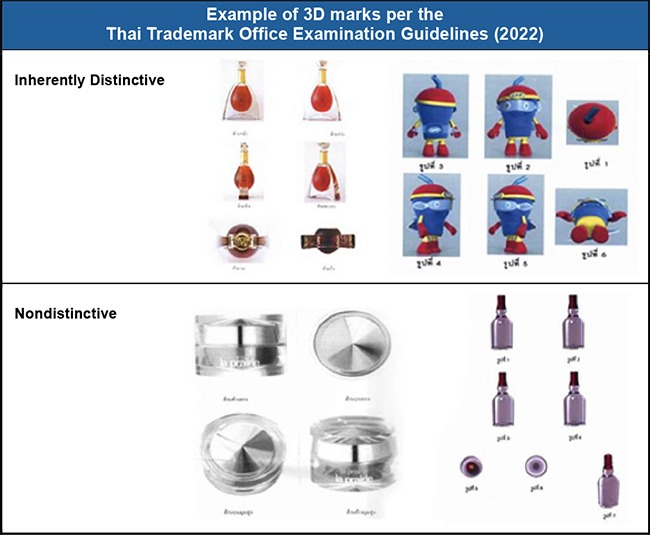
A plain water bottle relying on subtle contours to signal its brand is typically read as just another bottle, not a source identifier. Acquired distinctiveness offers a theoretical escape route, but it demands extensive evidence of sales, advertising, and consumer recognition—an especially heavy burden for new entrants whose minimalist packaging has not yet achieved market prominence. The result is a structural bias against precisely the design innovation that sustainability goals are meant to encourage.

Design Patents: A Partial, Imperfect Substitute

Design patent protection, covering a product’s shape, configuration, or ornamentation, appears to offer an alternative route. In practice, it is constrained by the same forces driving the minimalist trend. Because many brands converge on similar solutions—clear PET bottles, label-free surfaces, simple paperboard—new designs often “so nearly resemble” existing ones that they fail the novelty requirement under the Thai Patent Act. Even where novelty is established, protection lasts only ten years from filing, ill-suited to the indefinite life cycle of a brand identity that trademarks can offer. Narrow claim scope compounds the problem: because minimalist designs differ from competitors only in subtle details, rivals can make cosmetic tweaks and avoid infringement altogether.

A Layered Strategy for Now

Given these gaps, Thai practitioners should treat trademark and design patent filings as complementary layers rather than mutually exclusive options. Registration attempts can be supplemented with unfair competition claims for passing off, which remain available under Section 46 of the Trademark Act and Section 420 of the Civil and Commercial Code even where registration is refused. Contemporaneous evidence of consumer recognition—social media engagement, packaging redesign campaigns, and sales data tied to the new design—should be compiled from launch rather than assembled only once a dispute arises. Combining registered rights with common law remedies and a documented evidentiary record offers the most realistic protection available under the current framework.

Conclusion

The tension between Thailand’s IP framework and its sustainable packaging boom is unlikely to be resolved through litigation alone. The DIP’s examination guidelines predate the scale of today’s minimalist packaging trend and warrant revisiting, particularly in how consumer-perception evidence is weighed against abstract notions of “natural form” and “functionality.” Until that recalibration occurs, brands investing in green packaging should treat IP protection as a portfolio exercise: pursuing registration where possible, building an evidentiary record for acquired distinctiveness, and relying on passing-off remedies to fill the gaps. Minimalist packaging is not disappearing from Thai shelves; the law protecting it needs to catch up.


This article was prepare with the assistance of Tilleke & Gibbins intern Phuripat Kaewklom. It was originally published by the International Association for the Protection of Intellectual Property (AIPPI).

RELATED INSIGHTS​ 

January 21, 2025
A proposal to establish a specialized Intellectual Property Court in Vietnam has been a topic of significant interest among IP practitioners for the past 20 years. It was thus a major breakthrough when the new Law on the Organization of People’s Courts was ratified in 2024, stipulating in Article 4.1(dd) that the Vietnamese court system would include a specialized first-instance IP Court. The new law took effect on January 1, 2025, replacing the Law on the Organization of People’s Courts of 2014, A groundbreaking law This breakthrough can be viewed from multiple perspectives. First of all, in terms of organization, this is the first time, after numerous considerations, that Vietnam has officially recognized the importance of the IP field and the need to establish a specialized adjudicative body due to the field’s unique nature. The establishment of a specialized first-instance IP Court is expected to lead to fundamental changes in the practice of developing and applying IP law. While the establishment of IP rights such as trademarks, patents, and plant varieties is managed by administrative agencies such as the Intellectual Property Office, the Copyright Office, and the Crop Production Department, which seem unlikely to change their functions and tasks, there could be significant changes in the enforcement of these rights, which has been a persistent issue in Vietnam’s IP law system. Thus far, in practice, the enforcement of IP rights in Vietnam has relied overwhelmingly on administrative measures over civil measures. Civil measures, typically involving court proceedings under which the matter will be submitted to a court for settlement, are not appealing to disputing parties, especially IP rights owners. The absence of a specialized court has led to many IP cases being handled by judges without any knowledge or experience in this specialized field, resulting in confusion, misconceptions about
December 20, 2024
With intellectual property playing an ever-increasing role in economic development, the need to harness, promote, and protect ASEAN innovation remains urgent as integration progresses. Among its objectives, the ASEAN Economic Community aims to transform the region into a hub of innovation and competitiveness and ensure that the region remains an active participant in the international IP community. With ASEAN member states increasing IP generation and further committing to global IP regimes, the region is increasingly looking toward sophisticated IP ownership and holding structures. IP Holding Companies ASEAN-based companies continue to centralize ownership of their IP assets in offshore holding and licensing vehicles—an approach multinational companies headquartered elsewhere have been using for a number of years. IP-intensive companies look to locate their IP portfolios in low-tax jurisdictions with strong IP registration and protection laws. The company then licenses the IP to operating companies in the group or to third-party licensees, franchisees, agents, distributors, and other partners in return for royalties or license fees. These special-purpose vehicles are typically referred to as IP holding companies. IP holding companies are popular because they can help corporations minimize tax, gain tax benefits or concessions, protect IP from bankruptcy or other claims against the parent company, and focus management attention on the IP portfolio as an income generator. Tax and IP Holding Companies Tax is the primary reason most companies park their IP in separate IP holding vehicles. Sometimes, companies choose to establish their IP holding company in a no-tax, low-tax, or preferred-tax jurisdiction close to their home country. The selected jurisdiction should also be a country with a large and well-established tax treaty network. Double taxation treaties are key considerations in jurisdiction shopping. If the IP assets need to be pledged as security for future borrowings or if they are to be included
December 20, 2024
Closing out the year, Thailand’s Department of Intellectual Property (DIP) has gifted green innovators with a chance to take a faster route for examining their patent and petty patent applications under the “Target Patent Fast-Track” program. This route prioritizes environmentally sustainable inventions, and significantly accelerates the preliminary and substantive examinations of selected applications at no additional official fee. The program was publicly announced on December 2, 2024, in the DIP Notification on the Expansion of Technological Fields under the Target Patent Fast-Track Program, which took effect on December 15, 2024. The expedited process is open to both Thai and foreign applicants, provided the requirements in the notification are met. Under the fast-track program, a first office action for qualifying applications can be expected within 6 months during the preliminary examination stage. These applications will also be issued a first office action within just 12 months in the substantive examination period after publication. The DIP begins accepting formal requests for selection to participate in the program from January 1, 2025, onward. Each applicant can submit only one application per fast-track patent program per month, as selected applications cannot belong to the same applicant. No more than 10 applications per month will be chosen to participate in the fast-track route, with the results being announced on the 5th of every following month. To be eligible for selection, applications must comply with all the fast-track requirements specified in the recent DIP notification, particularly: The patent or petty patent application must have been filed with the DIP for at least three months, or a substantive examination request has already been filed in the case of patent applications. Each application must contain no more than 10 claims throughout its participation in the program. The application must be electronically filed in Thailand first or through
December 18, 2024
The EU-Thailand Free Trade Agreement is drawing a lot of interest as the fourth round recently concluded in Bangkok. Despite negotiations starting in 2013, there was a ten-year pause before we saw the first round of negotiations end in September 2023. The initial plan was for four rounds of negotiations, with the free trade agreement (FTA) finalized in 2025. However, following the fourth round it is clear that the negotiations are still ongoing. Now, the question is: how much closer are the EU and Thailand to concluding their FTA? The EU initially submitted 13 chapter proposals for the FTA, followed by a further 12, and these became the springboard for the negotiations. Given the complexity of agreeing on an accord of this size, there will probably be additional proposals submitted in 2025. These chapters have seen sector-specific negotiation groups formed, and although it has been difficult to truly gauge the status, steady progress has been made in each. Arguably one of the biggest points of discussion pertains to the customs process for imports and exports. Both sides aim to align their practices in relation to rules of origin and custom rates, with preferential tariff treatments offered to goods originating from Thailand and the EU, as well as talks of eliminating or reducing relevant taxes. The desire for a faster customs clearance can be seen in EU proposals for clearance of goods on arrival. Although there has been progress in agreeing to a more simplified customs process, more work needs to be done before we hear news of the agreed-upon fees and charges, or confirmation of what goods would be allowed temporary admission. When we consider customs clearance, it is important to also examine what this FTA could mean for rightsholders. One piece of good news is that it appears