
You are using an outdated browser and your browsing experience will not be optimal. Please update to the latest version of Microsoft Edge, Google Chrome or Mozilla Firefox. Install Microsoft Edge

August 6, 2026

Green Packaging, Gray Areas: The Challenges of Protecting Minimalist Packaging Under Thai IP Law

Introduction: A Trademark Paradox in Sustainable Packaging

Walk into any Thai supermarket, and the label-free water bottle is no longer a novelty. Thailand’s packaging market, valued at approximately USD 15.68 billion in 2025, is shifting toward minimalist, plastic-light designs as ESG pressures reshape how brands present their products. The country generated roughly 5.68 million tons of plastic waste in 2021, with a recycling rate of only 19 percent, and regulators are now considering rules that would allow label-free bottled water relying on embossing, laser printing, or QR codes instead of wrap-around labels. As packaging itself becomes the brand identifier, a paradox emerges: designs built to say the least often struggle hardest for protection under Thai intellectual property law.

The Trademark Barrier: When Shape Is Not Enough

Section 7, paragraph 2(10) of the Thai Trademark Act deems a shape distinctive only if it is not the natural form of the goods, is not necessary to achieve a technical result, and does not add value to the goods. The Department of Intellectual Property’s 2022 examination guidelines apply this test conservatively, as the following examples illustrate.
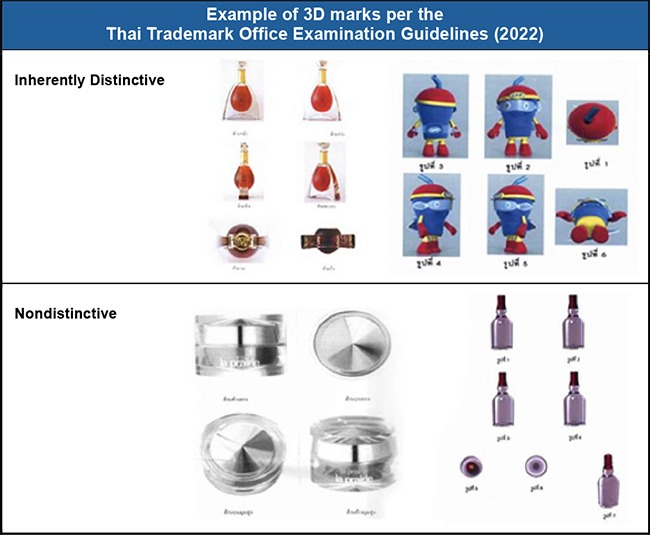
A plain water bottle relying on subtle contours to signal its brand is typically read as just another bottle, not a source identifier. Acquired distinctiveness offers a theoretical escape route, but it demands extensive evidence of sales, advertising, and consumer recognition—an especially heavy burden for new entrants whose minimalist packaging has not yet achieved market prominence. The result is a structural bias against precisely the design innovation that sustainability goals are meant to encourage.

Design Patents: A Partial, Imperfect Substitute

Design patent protection, covering a product’s shape, configuration, or ornamentation, appears to offer an alternative route. In practice, it is constrained by the same forces driving the minimalist trend. Because many brands converge on similar solutions—clear PET bottles, label-free surfaces, simple paperboard—new designs often “so nearly resemble” existing ones that they fail the novelty requirement under the Thai Patent Act. Even where novelty is established, protection lasts only ten years from filing, ill-suited to the indefinite life cycle of a brand identity that trademarks can offer. Narrow claim scope compounds the problem: because minimalist designs differ from competitors only in subtle details, rivals can make cosmetic tweaks and avoid infringement altogether.

A Layered Strategy for Now

Given these gaps, Thai practitioners should treat trademark and design patent filings as complementary layers rather than mutually exclusive options. Registration attempts can be supplemented with unfair competition claims for passing off, which remain available under Section 46 of the Trademark Act and Section 420 of the Civil and Commercial Code even where registration is refused. Contemporaneous evidence of consumer recognition—social media engagement, packaging redesign campaigns, and sales data tied to the new design—should be compiled from launch rather than assembled only once a dispute arises. Combining registered rights with common law remedies and a documented evidentiary record offers the most realistic protection available under the current framework.

Conclusion

The tension between Thailand’s IP framework and its sustainable packaging boom is unlikely to be resolved through litigation alone. The DIP’s examination guidelines predate the scale of today’s minimalist packaging trend and warrant revisiting, particularly in how consumer-perception evidence is weighed against abstract notions of “natural form” and “functionality.” Until that recalibration occurs, brands investing in green packaging should treat IP protection as a portfolio exercise: pursuing registration where possible, building an evidentiary record for acquired distinctiveness, and relying on passing-off remedies to fill the gaps. Minimalist packaging is not disappearing from Thai shelves; the law protecting it needs to catch up.


This article was prepare with the assistance of Tilleke & Gibbins intern Phuripat Kaewklom. It was originally published by the International Association for the Protection of Intellectual Property (AIPPI).

RELATED INSIGHTS​ 

April 29, 2026
Across the region, local brands have become key drivers of economic growth, cultural identity, and innovation, and Myanmar is no exception. From traditional products and creative industries to modern startups and small and medium‑sized enterprises (SMEs), Myanmar’s local brands are increasingly shaping domestic markets. However, as local brands grow, they also face higher risks of imitation, misuse, and unfair competition. In this context, protecting brand identity, creativity, and innovation through proper intellectual property (IP) strategies is essential to ensure that Myanmar’s homegrown businesses can grow sustainably, compete confidently, and retain the value of what they create. The Key IP Laws for Local Brands In 2019, Myanmar enacted a comprehensive suite of four IP laws, aligning the nation’s IP enforcement framework with international standards. Trademark Law 2019: This law introduced the “first-to-file” system into the country, with trademark rights primarily obtained through registration with the Intellectual Property Department (IPD). Trademarks protect brand names, logos, and other signs that distinguish goods or services. Registration grants the exclusive rights to use the mark and to prevent others from using identical or confusingly similar marks. Each registration lasts for 10 years from the filing date and can be renewed for subsequent 10-year periods. Copyright Law 2019: Copyright, which arises automatically upon creation, protects literary, artistic, musical, and audiovisual works, including software, advertisements, artwork, and social media content. While registration with the IPD is not mandatory under this law, it can be helpful for establishing evidence and supporting any future enforcement. The terms of protection for economic rights associated with copyrights vary depending on the type of work involved. In contrast, the protection for moral rights lasts indefinitely—continuing even after the author’s death. Industrial Design Law 2019: Under this law, any industrial design that is new and independently created can be filed with the
April 21, 2026
Vietnam continues to refine its intellectual property framework to align with the 2025 amendments to the Law on Intellectual Property (IP Law). On March 31, 2026, the government issued Decree 100/2026/ND-CP (Decree 100), which substantially amends Decree 65/2023/ND-CP detailing the implementation of the IP Law (Decree 65). On the same day, the Ministry of Science and Technology released Circular 10/2026/TT-BKHCN (Circular 10), providing detailed procedural guidance and new forms. Both instruments took effect on April 1, 2026, along with the amended IP Law. While the updates touch on every IP right, trademark owners and brand strategists will find several practical and forward-looking changes that directly affect filing strategy, examination timelines, portfolio management, and enforcement readiness. 1. Fast-Track Substantive Examination for Eligible Applications One of the most business-friendly innovations is the new fast-track substantive examination pathway for applications meeting specified eligibility criteria. Successful fast-track applications enjoy a shortened substantive examination period of three months. This offers a significant competitive edge for tech-driven or regulated-sector brands. If the mark is identical or similar to a mark in another person’s trademark application with an earlier filing date in the case of a priority application that has not yet been processed, the fast-track process will return to the ordinary process. However, the law does not touch on cases where marks under fast-track examination face office action due to other reasons (i.e. lack of distinctiveness, confusingly similar to others’ copyright, trade name, industrial design, etc.) 2. AI-Generated Trademarks Receive Clear Protection Pathway Decree 100 explicitly addresses the use of artificial intelligence (AI) in IP creation, amending Article 10a of Decree 65 to confirm that trademarks created with AI systems are fully protectable, provided they meet the standard requirements of registration. Trademarks face no additional “human authorship” hurdle (unlike patents or industrial designs). Brand owners
April 20, 2026
Myanmar’s industrial design registration regime has been steadily gaining momentum since the country officially began accepting applications under the Industrial Design Law of 2019. The Industrial Design Division of Myanmar’s Intellectual Property Department (IPD) has actively advanced examination and registration procedures, and as of March 2026, approximately 300 industrial design applications have been published in the IPD’s publicly accessible database—a meaningful milestone in the development of Myanmar’s emerging intellectual property framework. This figure reflects only published applications; additional filings remain pending and will be published after the conclusion of ongoing examination. Filing Requirements in Practice Compliance with a defined set of mandatory requirements is the foundation for filing a valid design application. These mandatory particulars must be provided at the time of filing in order to establish a filing date. These include the applicant’s and creator’s identifying details, a notarized appointment of representative form, the Locarno Classification of the associated product, and a set of graphic representations of the design across multiple standard views. Applicants must also provide a written description of the design and, where applicable, information relating to any priority claim or request for deferred publication. Filing fees are payable at the time of submission. Beyond these core requirements, applicants typically need to provide supplementary documentation, either at the time of filing or in response to a formality examination. This may include evidence of the applicant’s legal entitlement to the design—particularly where the applicant and creator are different parties—as well as supporting corporate and authorization documents. Where priority rights are claimed, the relevant documents must generally be submitted within three months of the Myanmar filing date, with certified English translations required for any non-English priority applications. The supplementary requirements may vary depending on the nature of the application and the examiner’s requests during the formality examination process.
April 3, 2026
On March 16, 2026, Vietnam’s Ministry of Public Security released a draft version of a new Decree on the Prevention and Combating of Cybercrime and High-Tech Crime to replace the currently effective Decree 25/2014/ND-CP. In the draft, the ministry has proposed a comprehensive regulatory framework aimed at addressing violations occurring within the cybersecurity domain, including measures related to intellectual property. Acts of Online IP Infringement Article 9 of the draft decree notably introduces specific provisions addressing online intellectual property infringement, with detailed lists of acts considered to constitute infringement in the online environment. Copyright and related rights infringement includes: Uploading or sharing works, performances, sound recordings, video recordings, broadcasts, computer programs, software, research, documents, theses, or other intellectual creations on digital platforms without the consent of the rights holder. Unauthorized livestreaming of copyrighted television programs, sporting events, or artistic performances. Uploading, sharing, storing, transmitting, or providing links to infringing works or digital content via websites, social networks, applications, or digital platforms. Providing or using software, tools, devices, or access codes to circumvent technological protection measures or evade lawful control mechanisms implemented by rights holders. Using artificial intelligence (AI) tools to replicate the ideas or structure of another person’s work without significant new creativity or without proper attribution, thereby causing damage to the original author. Industrial property infringement includes: Manufacturing, trading, advertising, or distributing counterfeit goods bearing counterfeit trademarks, geographical indications, or industrial designs, as well as goods infringing industrial property rights through online platforms. Unauthorized registration, appropriation, or use of domain names, account names, or digital identifiers that create confusion regarding the rights holder or the origin of goods or services. Producing, using, or offering for sale products containing all or part of a patented invention via online platforms. Advertising or introducing products with technical features or characteristics identical