
You are using an outdated browser and your browsing experience will not be optimal. Please update to the latest version of Microsoft Edge, Google Chrome or Mozilla Firefox. Install Microsoft Edge

August 6, 2026

Green Packaging, Gray Areas: The Challenges of Protecting Minimalist Packaging Under Thai IP Law

Introduction: A Trademark Paradox in Sustainable Packaging

Walk into any Thai supermarket, and the label-free water bottle is no longer a novelty. Thailand’s packaging market, valued at approximately USD 15.68 billion in 2025, is shifting toward minimalist, plastic-light designs as ESG pressures reshape how brands present their products. The country generated roughly 5.68 million tons of plastic waste in 2021, with a recycling rate of only 19 percent, and regulators are now considering rules that would allow label-free bottled water relying on embossing, laser printing, or QR codes instead of wrap-around labels. As packaging itself becomes the brand identifier, a paradox emerges: designs built to say the least often struggle hardest for protection under Thai intellectual property law.

The Trademark Barrier: When Shape Is Not Enough

Section 7, paragraph 2(10) of the Thai Trademark Act deems a shape distinctive only if it is not the natural form of the goods, is not necessary to achieve a technical result, and does not add value to the goods. The Department of Intellectual Property’s 2022 examination guidelines apply this test conservatively, as the following examples illustrate.
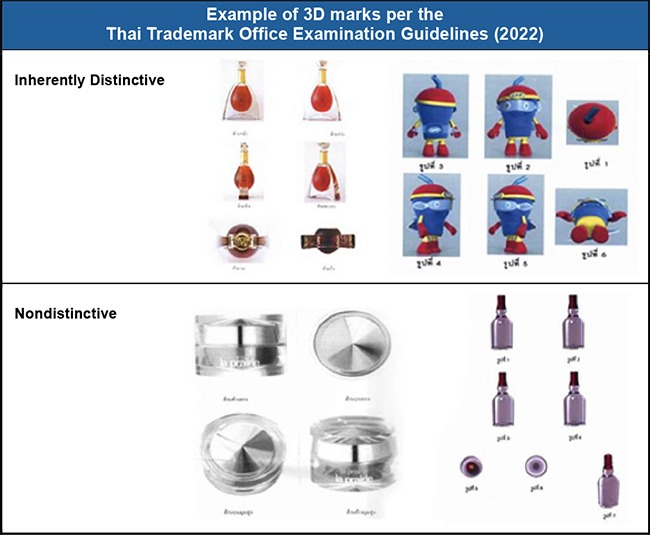
A plain water bottle relying on subtle contours to signal its brand is typically read as just another bottle, not a source identifier. Acquired distinctiveness offers a theoretical escape route, but it demands extensive evidence of sales, advertising, and consumer recognition—an especially heavy burden for new entrants whose minimalist packaging has not yet achieved market prominence. The result is a structural bias against precisely the design innovation that sustainability goals are meant to encourage.

Design Patents: A Partial, Imperfect Substitute

Design patent protection, covering a product’s shape, configuration, or ornamentation, appears to offer an alternative route. In practice, it is constrained by the same forces driving the minimalist trend. Because many brands converge on similar solutions—clear PET bottles, label-free surfaces, simple paperboard—new designs often “so nearly resemble” existing ones that they fail the novelty requirement under the Thai Patent Act. Even where novelty is established, protection lasts only ten years from filing, ill-suited to the indefinite life cycle of a brand identity that trademarks can offer. Narrow claim scope compounds the problem: because minimalist designs differ from competitors only in subtle details, rivals can make cosmetic tweaks and avoid infringement altogether.

A Layered Strategy for Now

Given these gaps, Thai practitioners should treat trademark and design patent filings as complementary layers rather than mutually exclusive options. Registration attempts can be supplemented with unfair competition claims for passing off, which remain available under Section 46 of the Trademark Act and Section 420 of the Civil and Commercial Code even where registration is refused. Contemporaneous evidence of consumer recognition—social media engagement, packaging redesign campaigns, and sales data tied to the new design—should be compiled from launch rather than assembled only once a dispute arises. Combining registered rights with common law remedies and a documented evidentiary record offers the most realistic protection available under the current framework.

Conclusion

The tension between Thailand’s IP framework and its sustainable packaging boom is unlikely to be resolved through litigation alone. The DIP’s examination guidelines predate the scale of today’s minimalist packaging trend and warrant revisiting, particularly in how consumer-perception evidence is weighed against abstract notions of “natural form” and “functionality.” Until that recalibration occurs, brands investing in green packaging should treat IP protection as a portfolio exercise: pursuing registration where possible, building an evidentiary record for acquired distinctiveness, and relying on passing-off remedies to fill the gaps. Minimalist packaging is not disappearing from Thai shelves; the law protecting it needs to catch up.


This article was prepare with the assistance of Tilleke & Gibbins intern Phuripat Kaewklom. It was originally published by the International Association for the Protection of Intellectual Property (AIPPI).

RELATED INSIGHTS​ 

May 2, 2024
On May 1, 2024, Myanmar’s Intellectual Property Department (IPD) issued its first publication of trademark applications under the country’s 2019 Trademark Law. Parties are now able to oppose any of the applied-for marks in the publication, which is accessible from the IPD’s website, in accordance with stipulations of Myanmar law. This is a substantial development showing progress toward the registration of marks under the Trademark Law. The online publication of the applications provides the details of each mark, applicant, and representative. In addition, it discloses relevant information such as disclaimers, color claims, mark translations or transliterations, applicable priority dates, as well as specifications of goods and services under the Nice Classification. Any person (individual or legal entity) can file an opposition against an applied-for mark within 60 days of publication by citing significant absolute or relative grounds as specified in the relevant sections of the Trademark Law. Oppositions must use the official form specified in the Trademark Rules, and the filing fee is MMK 150,000 per mark (regardless of the number of classes) plus a MMK 300 bank charge. Anyone, including interested parties or their local representatives, can file the opposition at the IPD. If an opposition is not filed within the stipulated 60-day period, the IPD will proceed with the trademark registration without conducting any substantive examination for similarity or priority. Thus, mark owners, rights holders, and other interested parties should closely monitor the IPD’s publication of applied-for marks so they can take any necessary actions and potentially file oppositions to protect their rights and interests. There has not yet been any official announcement on how often these publications will be issued. For more information on the IPD’s mark publication activities, or on any aspect of protecting intellectual property in Myanmar, please contact Tilleke & Gibbins at [email protected].
April 22, 2024
Trademark disputes in Thailand have undergone a significant transformation with the recent implementation of streamlined procedures aimed at expediting legal proceedings. This article explores the traditional process for resolving noncomplex trademark cases and introduces the latest regulatory amendments designed to enhance efficiency within the Thai legal framework. Traditional Process Overview The trademark registration process in Thailand involves several steps, including filing, examination, and granting registration. If the trademark registrar rejects an application on substantive grounds, applicants can appeal to the Board of Trademarks. If the board upholds the registrar’s decision, applicants can then pursue a civil suit with the Central Intellectual Property and International Trade Court (IP&IT Court) to revoke the trademark registrar’s and the board’s orders. Previous Regulations and Practice Historically, civil cases concerning trademark registrations followed standard procedures outlined in Thailand’s Civil Procedure Code, with specific adaptations for intellectual property matters under the Act for the Establishment of and Procedure for Intellectual Property and International Trade Court B.E. 2539 (1996). Proceedings entailed various stages, including settlement of issues, evidence hearing, and judgment hearing, culminating in the opportunity for appeal. New Regulations and Practice In 2023, a pivotal development emerged with the issuance of Regulation for Intellectual Property and International Trade Cases B.E. 2566 (2023). This regulatory update introduced section 18, which deals with cases related to the revocation or appeal of Board of Trademarks decisions, such as those concerning trademark nondistinctiveness or opposition cases against Thailand’s Department of Intellectual Property. Section 18 grants the IP&IT Court the authority to order parties to submit documents and evidence without the need for witness examination, thereby streamlining proceedings. Below is a comparison of the trademark procedures for cases related to the revocation or appeal of Board of Trademarks decisions: Traditional Approach Streamlined Approach Implementation and Implications In practice, the implementation
April 17, 2024
Intellectual property rights holders pursuing legal actions in Vietnam have faced various challenges related to document formality in recent years. For example, in two different disputes at the Ho Chi Minh City Court, we have seen the judge request the claimants to re-prepare the civil dossier due to a lack of documentation proving the authorization of the signer—despite the fact that the cases had been ongoing for long time. Meanwhile, many domain names have been unable to be registered and transferred in recent months. Third-party representatives cannot handle the work as they normally would, as Vietnam’s domain name authority has required all documents to be signed by the domain name holders themselves, instead of the law firms representing them. Such demands have created unnecessary complexities and obstacles for IP holders seeking to protect their rights in Vietnam. Legal Formalities in the Court System Vietnam’s judicial landscape presents unique hurdles for IP holders to enforce their rights. One significant challenge is the requirement for the claimant’s legal representative (typically the CEO/president), as explicitly displayed on the company’s business license, to sign all documents related to a lawsuit. This requirement clashes with the operational practices of many foreign companies, where multiple individuals may have the authority to represent the company. It is extremely impractical, especially in a large multinational conglomerate, for the CEO/president to personally execute all documents and transactions. Instead, authorized staff within these organizations, such as department heads or general counsel, typically handle these tasks. In this situation, Vietnamese courts often demand additional documentation to prove the officers’ authority, necessitating specific authorization documents that may not always be readily available. The courts sometimes remain unconvinced by declarations from the CEO/president affirming the authorization of these officers, and despite such assurances, they may still demand tangible proof of authorization, adding
March 25, 2024
Attorneys from Tilleke & Gibbins in Vietnam have provided an updated Vietnam chapter for Fashion Law 2024, a guide to law surrounding the business of fashion in jurisdictions around the world. The guide, which covers 20 key jurisdictions in the global fashion industry, offers insights into local legal frameworks for a range of issues, such as brand enforcement and protection, e-commerce and marketing, and sustainability. The Vietnam chapter of Fashion Law 2024 provides detailed information on the following topics: Main intellectual property rights for fashion products Contractual arrangements in manufacturing, distribution, and advertising Regulations and enforcement of online marketing Unfair competition rules and judicial interpretation Specific regulations on sustainability and ESG in fashion Special import and export rules for fashion products The full Vietnam chapter is available for free through the button below and on the Global Legal Post website. Tilleke & Gibbins also contributed the Thailand chapter to the guide.