You are using an outdated browser and your browsing experience will not be optimal. Please update to the latest version of Microsoft Edge, Google Chrome or Mozilla Firefox. Install Microsoft Edge

December 22, 2020

Further Extension for E-Tax Filing and Payment in Thailand

On December 15, 2020, Thailand’s Revenue Department (RD) announced a further extension for e-tax filing and payment until January 31, 2024.

The RD’s announcement is meant to support the government’s Thailand 4.0 policy by encouraging use of the online system for filing and paying taxes. The RD has been promoting the use of e-tax filing and payment since 2012 by granting eight-day extensions to anyone who submits online, rather than using traditional paper filing. Initially, this eight-day extension program was due to expire on January 31, 2021, but the RD has now further extended it for another three years, until January 31, 2024.

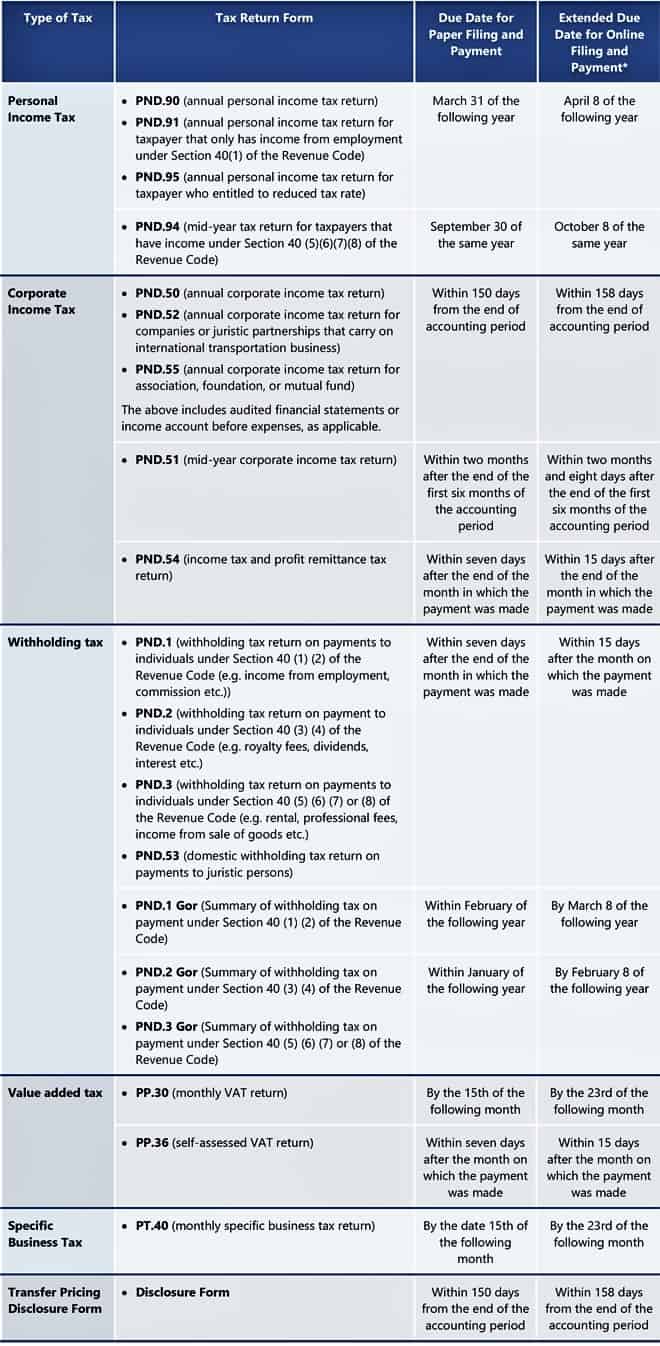
Tax Filing and Payment Schedule for Eligible Tax Returns

* Notification of the Ministry of Finance Re: Extension of Period for Tax Return Filing and Tax Payment via Internet System (No.3) dated December 15, 2020.

It should be noted that tax returns and supplemental tax returns must be submitted via the e-filing system to qualify for the eight-day extension. If a taxpayer has submitted their tax return in paper form, they will not be entitled to the extension even if they resubmit via e-filing system. The reverse is also true—a tax payer who submits via the e-filing system, and resubmits in paper form, will not be eligible for the eight-day extension.

For personal income tax payments set up as three instalments, the first instalment can be paid together with the e-filing and that tax payment is also entitled to eight-day extension.  The second instalment can be paid within one month after the extended due date of the first instalment, and the third instalment can be paid within one month after the due date for the second instalment.

For more information about these tax filing extensions, or any aspect of tax law in Thailand, please contact Varapa Aurat at [email protected].

RELATED INSIGHTS​ 

June 9, 2021
Lawyers from Tilleke & Gibbins in Bangkok have updated the Thailand section of the Digital Business Global Guide, a Q&A-style guide from Thomson Reuters Practical Law that provides detailed information on the regulatory environment surrounding digital business operations in 38 countries around the world. The Thailand overview covers the following main topics: Regulatory overview Setting up and running a business online Cybersecurity, data privacy, and data protection implications Linking Domain names Jurisdiction and governing law Advertising/marketing Tax Protecting an online business Liability for products/services supplied online Insurance Reform Practical Law, produced by Thomson Reuters, is the world’s leading legal know-how resource for business lawyers, publishing a huge range of guides covering hundreds of jurisdictions and practice areas. The full Digital Business in Thailand: Overview is available on the Practical Law website.
March 2, 2021
Like many countries, Thailand requires stamp duty to be paid on the execution of certain legal instruments. A liable person who fails to pay stamp duty on a required instrument can be subject to a maximum surcharge of six times the applicable stamp duty, and an instrument on which stamp duty has not been paid will not be admissible as evidence in civil cases (that is, it will have limited legal weight and enforceability). Before July 2019, there were three methods for paying stamp duty: Affixing adhesive stamps on the instrument (and canceling it by the liable person in order to make sure that the adhesive stamp duty cannot be reused); Having a stamp impressed on the paper instrument; or Filing a prescribed form and paying the duty by cash or cashiers cheque at an area revenue office. In addition to paying the correct amount of stamp duty, the law also requires that stamp duty on certain instruments be paid using a specific prescribed method from the list above. Failure to use the prescribed method would be considered as that the stamp duty not having been paid. For example, a hire-of-work instrument is subject to stamp duty, but if the remuneration stated within the agreement is at least THB 1,000,000 (approximately USD 33,500), the stamp duty must be paid by filing a prescribed form and paying by cash or cashier’s cheque at an area revenue office. Affixing adhesive stamp duty is not allowed in that circumstance. E-Stamp Duty In June 2019, the Revenue Department introduced a fourth method of paying stamp duty, allowing online payments in specific circumstances (e-Stamp Duty). After the launch of the e-Stamp Duty system, the Revenue Department issued a notification (Notification of the Director-General of Revenue concerning Stamp Duty (No. 58)) requiring stamp duty on
February 23, 2021
As many are already aware, following the change of government in Myanmar on February 1, 2021, a draft Cyber Security Law was proposed which attracted widespread criticism. However, less attention has been paid to significant amendments to two existing laws, some of which have a similar effect to parts of the draft Cyber Security Law. In other words, while the draft Cyber Security Law has not progressed further and is under public scrutiny, significant elements of it have found their way into law in Myanmar by other routes. Because these amendments are already law, it is very important that individuals and businesses in Myanmar understand their implications. Amendments to the Law Protecting the Privacy and Security of Citizens The Law Protecting the Privacy and Security of Citizens (2017), or the “Privacy Law,” was amended on February 13, 2021, less than two weeks after the military government came into power. These amendments chiefly address the power of the government to conduct searches, seizures, and arrests; to extend detention without judicial oversight; and to carry out broad surveillance and investigation activities that could intrude on individual privacy. The amendments accomplish this by suspending various sections of the Privacy Law for as long as the State Administration Council (the military body now governing Myanmar) is in power. The suspended sections include the following: Section 5: Search, seizure, and arrest without civilian observation The relevant part of Section 5 of the Privacy Law states, “The responsible authorities shall … when acting in accordance with existing law, not enter into a person’s residence or a room used as a residence, or a building, compound or building in a compound, for the purpose of search, seizure, or arrest, unless accompanied by minimum of two witnesses who should comprise Ward or Village Tract Administrators…”. The suspension