You are using an outdated browser and your browsing experience will not be optimal. Please update to the latest version of Microsoft Edge, Google Chrome or Mozilla Firefox. Install Microsoft Edge

December 22, 2020

Further Extension for E-Tax Filing and Payment in Thailand

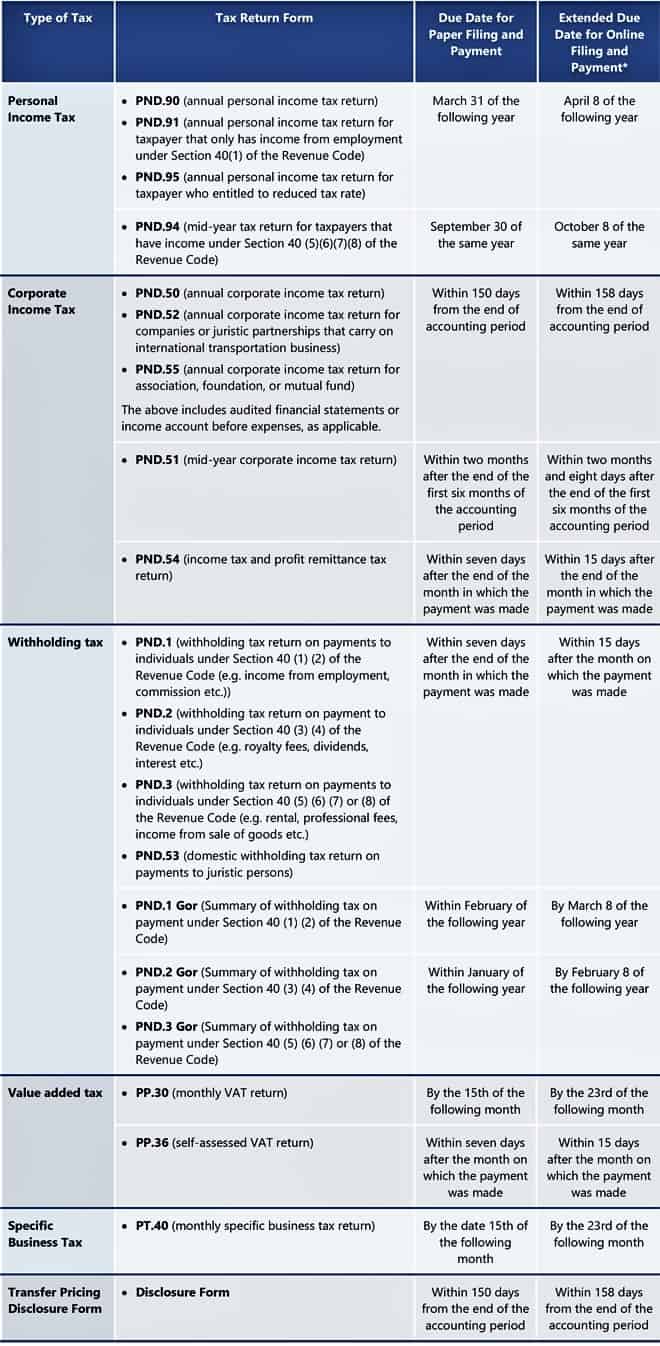
On December 15, 2020, Thailand’s Revenue Department (RD) announced a further extension for e-tax filing and payment until January 31, 2024.

The RD’s announcement is meant to support the government’s Thailand 4.0 policy by encouraging use of the online system for filing and paying taxes. The RD has been promoting the use of e-tax filing and payment since 2012 by granting eight-day extensions to anyone who submits online, rather than using traditional paper filing. Initially, this eight-day extension program was due to expire on January 31, 2021, but the RD has now further extended it for another three years, until January 31, 2024.

Tax Filing and Payment Schedule for Eligible Tax Returns

* Notification of the Ministry of Finance Re: Extension of Period for Tax Return Filing and Tax Payment via Internet System (No.3) dated December 15, 2020.

It should be noted that tax returns and supplemental tax returns must be submitted via the e-filing system to qualify for the eight-day extension. If a taxpayer has submitted their tax return in paper form, they will not be entitled to the extension even if they resubmit via e-filing system. The reverse is also true—a tax payer who submits via the e-filing system, and resubmits in paper form, will not be eligible for the eight-day extension.

For personal income tax payments set up as three instalments, the first instalment can be paid together with the e-filing and that tax payment is also entitled to eight-day extension.  The second instalment can be paid within one month after the extended due date of the first instalment, and the third instalment can be paid within one month after the due date for the second instalment.

For more information about these tax filing extensions, or any aspect of tax law in Thailand, please contact Varapa Aurat at [email protected].

RELATED INSIGHTS​ 

February 22, 2021
Following the recent imposition of sanctions on Myanmar individuals and companies by the US, the UK and Canada have now imposed new sanctions. As with the US sanctions, these new measures impact UK and Canadian citizens and companies, and non-UK and non-Canadian companies and citizens with interests in those jurisdictions. The EU has indicated that it is planning to issue similar sanctions in the near future. New UK Sanctions In addition to the 16 individuals already sanctioned by the UK government, on February 18, 2021, the UK government announced that three individuals have been sanctioned for serious human rights violations and are now subject to asset freezes and travel bans. The full list of Myanmar individuals and companies sanctioned by the UK is available on the website of the Office of Financial Sanctions Implementation. Breaches of UK financial sanctions are criminal offences punishable in the UK by up to 7 years imprisonment and heavy fines. New Canadian Sanctions Also on February 18, timed to coincide with the UK sanctions, new Canadian sanctions were imposed on nine individuals. As with the UK, Canada already had a number of individuals in the Myanmar military on its sanctions list, and the new additions bring the total number of individuals sanctioned by Canada to 54. All assets of these individuals in Canada are now frozen, and they are banned from travelling to Canada. Canadian businesses or entities may not do business with any of the 54 individuals. Full details of the impact of the sanctions are available on the Government of Canada’s website, as is a database of the Myanmar individuals and companies subject to them. Breach of Canadian sanctions carries with it up to 5 years’ imprisonment in Canada and/or a large fine. Other Countries The EU is reportedly drawing up sanctions
February 12, 2021
On January 29, 2021, Thailand’s Revenue Department published the Notification of the Director-General of the Revenue Department Re: Income Tax (No. 400), which prescribes the criteria, methods, and conditions for Revenue Department officials on how to assess income and adjust expenses for transactions between related parties (as defined in Section 71 bis of the Revenue Code) that engage in intercompany transactions where conditions between the two parties in their commercial or financial relations differ from those that would be made between independent parties (i.e., where the transaction is not an “arms length” transaction). Those who are familiar with international transfer pricing standard practices will note that the measures under the notification generally follow the concept of chapters II, III, VI and VII of the OECD Transfer Pricing Guidelines for Multinational Enterprises and Tax Administrations. The key elements of the notification are summarized below. Accepted Transfer Pricing Methods The notification recognizes the following as accepted transfer pricing methods: Comparable Uncontrolled Price Method Resale Price Method Cost Plus Method Transactional Net Margin Method Transactional Profit Split Method The notification also requires that the arm’s length result of an intercompany transaction (i.e. the controlled transaction) must be determined using the most appropriate transfer pricing method. If none of the above transfer pricing methods is appropriate for the tested controlled transaction, the company may apply an alternate pricing method to the transaction by notifying the Director General of Revenue in writing, within the relevant accounting period, and describing the reason for doing so. Selection of the Most Appropriate Transfer Pricing Method  There is no formal order of preference for the use of the five accepted pricing methods. However, the notification requires the selection process to take account of the following factors: The respective strengths and weakness of the recognized methods; The appropriateness of
February 9, 2021
On January 26, 2021, the Thai government passed a resolution to reduce the government fees that are generally collected for the registration of a sale and mortgage of immovable property. The details of this were subsequently set out in two notifications issued by the Ministry of Interior and published in the Government Gazette on February 2, 2021, taking effect the following day. The notifications will remain in effect through December 31, 2021. These two notifications, which are part of the government’s relief efforts to soften the economic fallout of the COVID-19 pandemic, specify that government fees for the registration of a sale and mortgage of immovable property are reduced to 0.01% of the official assessed sale price (reduced from 2%) and 0.01% of the mortgage amount (reduced from 1%). In order to qualify for the reduced rates, the sale and mortgage must be registered at the same time, and the sale price and mortgage amount must not exceed THB 3 million (approximately USD 100,000). The reduced rates only apply to the sale and mortgage of detached houses, semi-detached houses, row houses, commercial buildings, and condominium units, and they must be sold by a licensed developer or authorized government authority. For more information on these notifications, or on any aspect of the Thai government’s COVID-19 relief measures, please contact Tilleke & Gibbins at [email protected] or +66 2056 5555.