
You are using an outdated browser and your browsing experience will not be optimal. Please update to the latest version of Microsoft Edge, Google Chrome or Mozilla Firefox. Install Microsoft Edge

August 26, 2021

Domain Name Disputes in Thailand: How to Deal with the Pitfalls of the Country’s Domain Registration Policy

World Trademark Review

Background

In Thailand, bad-faith domain name registrations can present a unique challenge to brand owners.

According to the current domain registration policy, Thai domain names can be based on the registered name of a company or organization, or on a registered trademark, depending on the domain name category. When Thailand’s domain name registrar, the Thai Network Information Centre Foundation (THNIC), considers applications for new domain names, it examines only whether the applicant meets these criteria – and not whether the application has been led in bad faith, such as when a registered company uses someone else’s registered trademark without authorization.

Domain name registration in Thailand is a first-to-file system, so if all criteria are met, THNIC must allow registration. There are no opposition or cancellation proceedings, making it impossible for an interested person, as well as THNIC itself, to invalidate a Thai-registered domain name.

Disputes between two legitimate owners

Disputes sometimes arise between trademark owners and Thai-registered companies, such as third-party companies, local distributors, or even authorized trademark licensees who exploit the policy gap identified above.

For instance, in a recent case a brand owner found that its Thailand distributor had been able to register a company name containing its registered trademark, and subsequently register such name as a domain name, without the trademark owner’s consent. Fortunately, the two parties had a strong existing business relationship as supplier and distributor; through amicable negotiation, the local distributor agreed to withdraw the disputed domain name. However, if both parties had insisted on their legitimate rights over the disputed name, the case would have had to proceed to court, as THNIC does not get involved in such disputes and offers no dispute resolution mechanisms.

Navigating the options

Trademark owners facing such a dispute have two options: initiating proceedings with the Intellectual Property and International Trade Court (IP & IT Court) or negotiating with the domain name holder. The pros and cons of each solution are identified below:
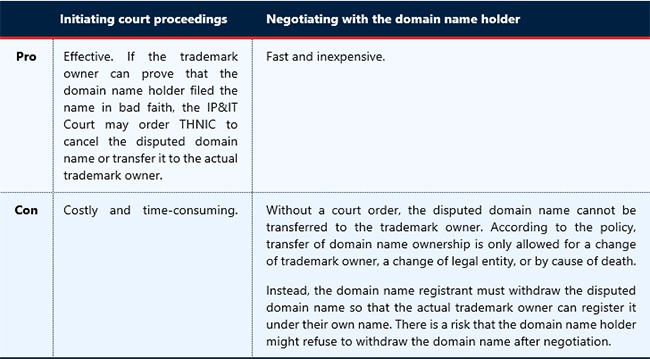
Of course, the best course of action for brand owners is to take proactive steps that minimize the risk of falling victim to a bad-faith domain name registration in Thailand. One way to do this is by reviewing trademark portfolios, selecting highly important registered trademarks, and registering and maintaining those as domain names to prevent unauthorized parties from registering the names. Another way to guard against bad-faith actions is simply by staying vigilant. Many companies have their trademarks actively monitored to detect unauthorized activity. Expanding this to also cover domain names can alert the brand owner to potential problems before they become serious threats.

Comment

Regulatory laws and gaps can be very frustrating—and damaging—to businesses, but knowing the law and understanding its potential pitfalls can help companies deal strategically with the challenges.


RELATED INSIGHTS​ 

July 27, 2026
A new decree on penalties for violations related to the crypto asset market creates compliance risks for offshore crypto asset exchanges in Vietnam that do not hold, and practically cannot obtain, a Vietnamese license, and for Vietnamese users who continue to transact on those platforms. Decree No. 284/2026/ND-CP (Decree 284), issued by the government of Vietnam on July 16, 2026, formally establishes an administrative penalty framework for violations related to crypto assets and the crypto asset market. The decree takes effect on September 1, 2026, and will remain in force for the duration of the five-year pilot program under Resolution No. 05/2025/NQ-CP, which is scheduled to end in September 2030. Direct Penalties on Vietnamese Users The most immediate commercial risk to offshore platforms is that their Vietnamese users now face direct personal liability for using their exchanges. Vietnamese users who trade crypto assets outside of a Ministry of Finance-licensed service provider face fines of up to VND 50 million (approximately USD 1,900). Vietnamese users trading in crypto assets that are offered or issued to foreign users face higher penalties of up to VND 100 million (approximately USD 3,800). It is expected that Vietnamese users will be more willing to migrate away from offshore platforms now that there is a risk of real enforcement against them. Penalties on Unlicensed Service Providers Violations of providing crypto asset services or advertising crypto-related services without a license face fines of up to VND 200 million (approximately USD 7,700). Operating a crypto asset trading market without proper authorization falls within the same highest penalty bands. Organizations that violate issuance, provision, or disclosure rules may face fines of up to VND 200 million. Although the maximum administrative fine per violation is capped at VND 200 million for organizations and VND 100 million for individuals, these
July 21, 2026
Thailand’s Ministry of Digital Economy and Society (MDES) published a notification establishing an expedited court-ordered takedown mechanism for online content in cases of “urgent necessity.” The notification, which was issued on July 17, 2026, under the Computer Crime Act B.E. 2550 (2007), as amended, took effect the following day. It significantly expands the categories of content subject to rapid government-initiated removal. Content Categories Subject to Takedown The notification defines “urgent necessity” (section 20, paragraph 5, of the Computer Crime Act) as circumstances where any delay in suppressing computer data may impact national security, religion, the monarchy, good morals, social culture, or public order. In this regard, it establishes four broad categories of content: Computer Crime Act offenses. National security offenses. IP and other criminal offenses, where it is contrary to public order or good morals and a competent officer has requested its suppression. Content contrary to public order or good morals, a broad residual category encompassing 14 subcategories approved by the Computer Data Screening Committee. The fourth category is the most expansive. Its 14 subcategories include: Content defaming, mocking, satirizing, or devaluing the monarchy. Online gambling advertising or facilitation. Offering illegal firearms for sale. Offering baraku (hookah) products or e-cigarettes for sale. Offering cannabis inflorescences or processed cannabis products for sale. Advertising or soliciting prostitution. Content inciting violence, hatred, or social division. Unauthorized overseas employment advertising. Offering boiled kratom juice for sale. Online sale or advertising of alcoholic beverages. Content satirizing or degrading Buddhism. Money lending at interest rates exceeding legally prescribed limits. Advertising or disseminating information about surrogacy services. Forgery of documents, cards, or official documents. Enforcement Procedure In cases of urgent necessity, a competent official assigned by the MDES permanent secretary must file a petition with supporting evidence to the court with jurisdiction, requesting an order to
July 20, 2026
On July 16, 2026, Thailand’s Personal Data Protection Committee (PDPC) published a notification in the Government Gazette establishing detailed rules governing data subjects’ right of access under section 30 of the Personal Data Protection Act B.E. 2562 (2019) (PDPA). The notification will take effect 60 days after publication—mid-September 2026—giving data controllers a limited window to bring their processes into compliance. Scope The notification covers requests to access or obtain copies of personal data and requests for disclosure of the source of data collected without consent. Data subjects may exercise their rights directly or through authorized representatives. Key Requirements Important requirements set by the notification include the following: Required request channels. Controllers must provide at least two request channels: direct submission at the business location and registered mail. Electronic channels are optional but, if offered, may also be used for fulfilling requests. Request contents. Requests must be in writing or in electronic form and include the data subject’s name, the preferred access method, details of the data requested, and the requester’s signature. Controllers may request additional identifying information as needed. Identity and authority verification. Controllers may require official identity documents for verification. Authorized representatives must provide authorization documents and identity documents for both the data subject and the representative. Alternative verification methods (e.g., digital authentication) are permitted if they do not unreasonably obstruct data subjects’ rights. Review and response timelines. Controllers must review requests within 15 days. If the request is incomplete, the controller must notify the requester and allow at least 15 days to correct deficiencies. If not corrected, the request may be treated as abandoned. Once verified, controllers must fulfill requests within 30 days, extendable by another 30 days for large-volume or complex requests with notice to the requester. Methods for providing access or copies. Controllers may fulfill
July 16, 2026
Thailand’s Office of the Personal Data Protection Committee (PDPC) published a series of draft guidance documents for public consultation on July 7, 2026. Issued under the Personal Data Protection Act B.E. 2562 (2019) (PDPA), the drafts address a range of compliance issues and offer insight into the regulator’s current enforcement priorities. This article examines two of those drafts: one on lawful bases for processing personal data, and another on marketing and direct marketing. Together, they reflect the Office of the PDPC’s evolving expectations on lawful-basis selection, accountability, and the use of personal data in marketing. Organizations operating in Thailand should assess the practical implications now, before the guidance is finalized. Lawful Bases: A Structured Selection Process The draft guidance on lawful bases introduces a systematic five-step process for selecting an appropriate lawful basis for each processing activity. Organizations are expected to: Identify the processing activity involved. Assess the appropriate lawful basis. Evaluate whether the data is necessary for the processing. Conduct a legitimate interest assessment (LIA) where applicable. Ensure transparency through privacy notices. The guidance provides practical explanations and examples for each lawful basis under section 24 of the PDPA—including archiving, research, statistics, vital interests, contractual necessity, legal obligation, public task, legitimate interests, and consent—as well as the bases applicable to sensitive personal data under section 26. The aim is to promote more consistent and accurate lawful-basis selection across public- and private-sector organizations. A recurring theme throughout the guidance is that organizations should select the lawful basis that most accurately reflects the actual purpose and circumstances of the processing activity. The guidance cautions against treating consent as a default or catch-all basis where another lawful basis is more appropriate. For processing based on legitimate interests, organizations should conduct and document an LIA. Processing involving sensitive personal data may require