
You are using an outdated browser and your browsing experience will not be optimal. Please update to the latest version of Microsoft Edge, Google Chrome or Mozilla Firefox. Install Microsoft Edge

April 20, 2020

Current Requirements for Persons Traveling to Cambodia During the COVID-19 Pandemic

In order to prevent imported cases of COVID-19, on March 27, 2020, Cambodia’s Ministry of Foreign Affairs and International Cooperation imposed new requirements on foreigners entering Cambodia. These requirements are applicable to all foreigners, unless there is ban in effect for foreigners from specific countries. These legal requirements are effective from 23:59 of March 30, 2020.

Therefore, any foreigner considering a trip to Cambodia during this time should note the below requirements, plan appropriately and consider how they may impact their trip.
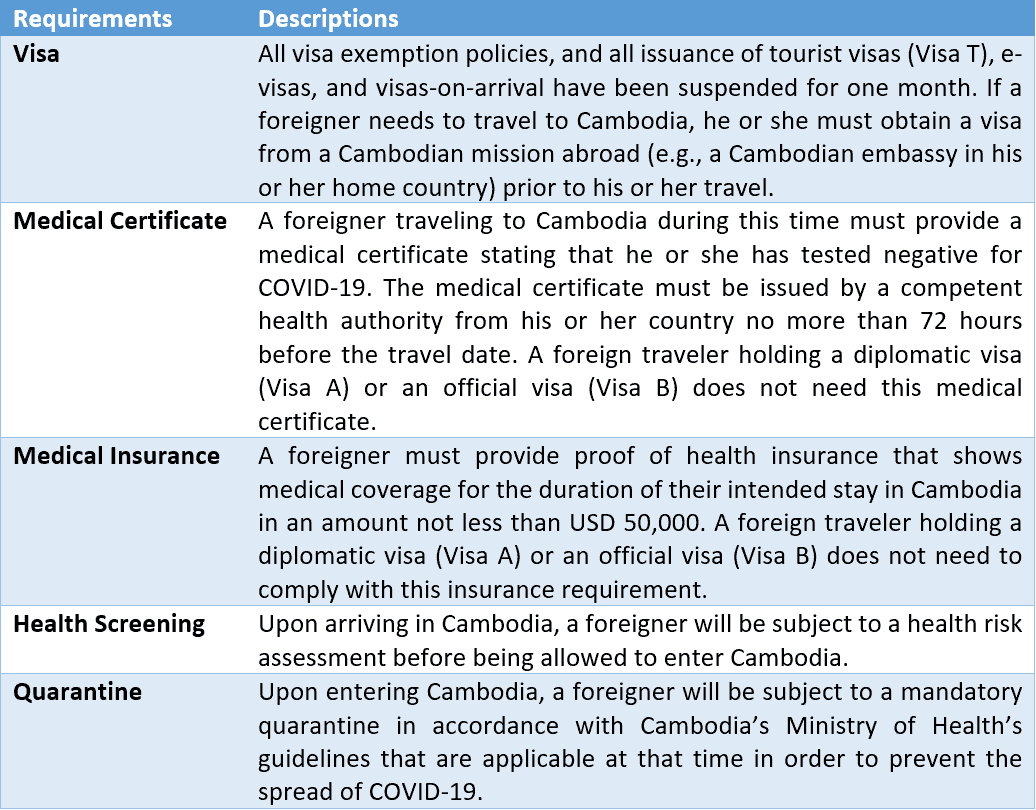
Cambodia’s Ministry of Foreign Affairs and International Cooperation notes that these requirements are temporary. The Cambodian government will review them regularly based on the current COVID-19 situation.

We would like to highlight that these travel requirements are in addition to the travel bans imposed earlier on travelers from the following six countries: France, Germany, Iran, Italy, Spain and the US as noted in our previous alert. These travel bans have been extended indefinitely until further notice, according to the Ministry of Foreign Affairs and International Cooperation’s letter on April 16, 2020.

RELATED INSIGHTS​ 

May 9, 2025
On May 6, 2025, Cambodia’s Ministry of Labour and Vocational Training (MLVT) issued Prakas No. 113/25, introducing new obligations for enterprise owners and directors regarding the use and maintenance of enterprise payroll books. Under this prakas, enterprise owners or directors are required to: Utilize and maintain the enterprise payroll book in accordance with the official template provided by the MLVT. Make the enterprise payroll book available to labor inspectors for annotations related to compliance with labor laws and regulations. Review and adjust (if necessary) internal practices based on any findings, recommendations, and restrictions issued by labor inspectors during inspections. The official enterprise payroll book template can be downloaded via the ministry’s Labor Automated Central Management System (LACMS). Additional requirements include: Retention of supporting documents related to the payroll book at the enterprise’s head office to facilitate inspections. Preservation of completed payroll books for a minimum of three years after their closure. Downloading a new payroll book from the LACMS once the current one is fully used. Labor inspectors are authorized to conduct inspections of the payroll book and related documentation at any time. Noncompliance with the provisions of Prakas No. 113/25 may result in significant monetary penalties, as stipulated in Cambodia’s Labour Law. This prakas also repeals Prakas No. 268, dated October 11, 2001, and any provisions in related regulations that conflict with Prakas No. 113/25. All enterprises are strongly advised to comply with the new requirements and begin using the updated enterprise payroll book template from the LACMS to avoid potential penalties.
May 2, 2025
Attorneys from Tilleke & Gibbins have updated the latest edition of Doing Business in Thailand, a Q&A-style guide from Thomson Reuters Practical Law that offers an overview of key legal considerations for companies operating in jurisdictions worldwide. The contribution outlines the country’s legal and regulatory framework for foreign investment and business operations and reflects the latest legislative developments. The chapter addresses the following core topics: Legal system: Structure of the courts and the codified nature of Thai law. Foreign investment: Business restrictions under the Foreign Business Act, sector-specific regulations, exchange control rules, and investment incentives. Business vehicles: Overview of partnerships, private and public limited companies, and other legal entities. Employment: Labor protections, employment contracts, foreign worker requirements, and termination procedures. Tax: Corporate and personal income tax, indirect taxes, and tax obligations for residents and non-residents. Intellectual property: Registration and enforcement of patents, trademarks, designs, and copyrights. Data protection: Key provisions of the Personal Data Protection Act and related compliance obligations. Competition law: Regulatory framework under the Trade Competition Act. Anti-bribery and corruption: Relevant legislation and enforcement mechanisms. E-commerce and digital business: Legal regime for online transactions and digital platforms. Marketing and advertising: Consumer protection laws and regulations affecting advertising and marketing practices. Product regulation and liability: Safety standards, liability regimes, and roles of enforcement authorities. Practical Law, a legal reference resource from Thomson Reuters, publishes a range of guides for hundreds of jurisdictions and practice areas. The insurance and reinsurance guide is a valuable resource for legal practitioners, covering numerous jurisdictions worldwide. To view the latest version of the guide, please visit the Practical Law website and enroll in the free Practical Law trial to gain full access.
April 29, 2025
To foster foreign investment and attract leading international universities to establish campuses in Vietnam, the government has recently adopted several regulations, including Decree No. 124/2025 on foreign cooperation and investment in the field of education, Decree No. 125/2024 on regulatory requirements for educational investment and operation, and Decision No. 452/QD-TTg approving the Planning of the Network of University and Teaching Institutions for the Period 2021–2030, with a Vision to 2050 (the “University Network Plan”). However, foreign investors and private higher educational institutions must still navigate regulatory complexities, build strong academic reputations, and ensure financial sustainability to compete effectively in an increasingly competitive landscape. Below are highlights of recent developments in university-related regulations that may open new opportunities for foreign investment in Vietnam. Adopting the University Network Plan The University Network Plan encourages the development of private higher education institutions (“HEIs”), especially not-for-profit ones, and welcomes top foreign HEIs to open their own foreign branch campuses (“FBCs”) in Vietnam, with the following targets. Until 2030: Encouraging new establishment and expansion of the network of private HEIs (including their branch campuses) and FBCs of top foreign HEIs, especially those offering training majors of science, engineering, and technology. Developing regional HEI networks along economic corridors centered on large cities—not only the traditional economic hubs of Hanoi and Ho Chi Minh City, but also other provinces and cities throughout the country such as Hai Phong, Nghe An (Vinh), Thanh Hoa, Hue, Da Nang, Khanh Hoa (Nha Trang), Binh Đinh (Quy Nhon), Dak Lak (Buon Ma Thuot), Lam Dong (Da Lat), Binh Duong, and Can Tho. Vision to 2050: Increasing the number and proportion of private HEIs, especially not-for-profit ones. Having private HEIs account for about 50% of learners. Requirements for Foreign Investment in Higher Education Foreign investors can engage in higher education business
April 29, 2025
Tilleke & Gibbins recently assisted Bitmain, a leading manufacturer of cryptocurrency mining hardware, in successful cancellation action lawsuits against BITMAIN and ANTMINER trademarks that were unlawfully registered by a local party in Indonesia. Background Founded in 2013, Bitmain is a leading manufacturer of digital currency mining servers, marketed under their BITMAIN and ANTMINER brands. The company has maintained a strong global market share, with customers in over 100 countries and regions. In Indonesia, Bitmain has held the BITMAIN trademark registration in classes 35, 36, 41, and 42 since 2018. However, the company was unable to register the trademark in other classes because a local party had already registered the mark in the desired classes. Bitmain also discovered that their ANTMINER brand had been registered by the same local party, which impeded Bitmain’s application to register the ANTMINER trademark in Indonesia. Bitmain had been using these trademarks and products worldwide long before the local party’s registration in Indonesia, and had also secured trademark registrations in various countries. However, the local party exploited Indonesia’s first-to-file principle, securing the BITMAIN and ANTMINER trademarks before Bitmain could file. This was a classic example of trademark squatting, where a party registers a foreign trademark in a jurisdiction where the original owner has not yet filed, with the intent to profit from the brand’s success. Initial Approach Upon discovering that the local party had made these trademark applications, Bitmain found that one of these applications was still in the publication period. We advised and assisted Bitmain to file opposition against the application, but this opposition was subsequently refused because the local party had already obtained identical BITMAIN trademarks in other classes. Consequently, the application was registered in the Trademark Office database. Following the unfavorable opposition decision, we initially worked with Bitmain to seek a mutually