
You are using an outdated browser and your browsing experience will not be optimal. Please update to the latest version of Microsoft Edge, Google Chrome or Mozilla Firefox. Install Microsoft Edge

April 20, 2020

Current Requirements for Persons Traveling to Cambodia During the COVID-19 Pandemic

In order to prevent imported cases of COVID-19, on March 27, 2020, Cambodia’s Ministry of Foreign Affairs and International Cooperation imposed new requirements on foreigners entering Cambodia. These requirements are applicable to all foreigners, unless there is ban in effect for foreigners from specific countries. These legal requirements are effective from 23:59 of March 30, 2020.

Therefore, any foreigner considering a trip to Cambodia during this time should note the below requirements, plan appropriately and consider how they may impact their trip.
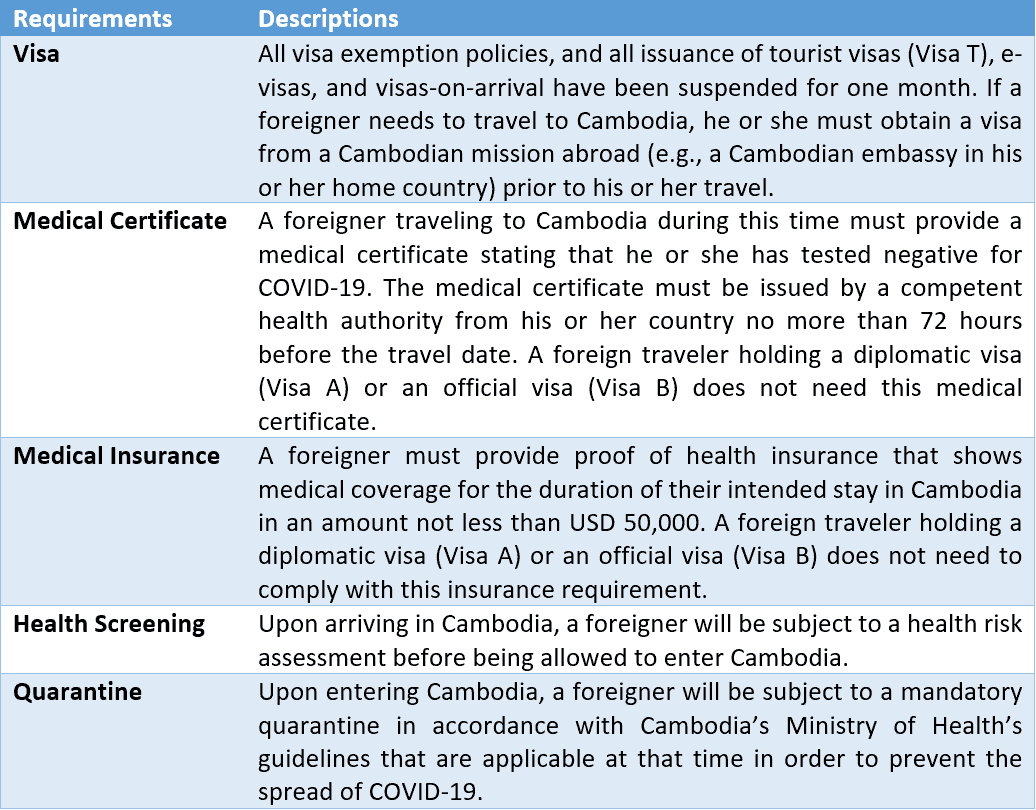
Cambodia’s Ministry of Foreign Affairs and International Cooperation notes that these requirements are temporary. The Cambodian government will review them regularly based on the current COVID-19 situation.

We would like to highlight that these travel requirements are in addition to the travel bans imposed earlier on travelers from the following six countries: France, Germany, Iran, Italy, Spain and the US as noted in our previous alert. These travel bans have been extended indefinitely until further notice, according to the Ministry of Foreign Affairs and International Cooperation’s letter on April 16, 2020.

RELATED INSIGHTS​ 

April 28, 2025
While Thailand’s Foreign Business Act B.E. 2542 (1999) (FBA) has been in place for over two decades, the issue of nominee arrangements remains a hot topic—especially as authorities continue to crack down on businesses that use Thai nationals to hold shares in violation of foreign ownership restrictions under the FBA. The FBA was enacted to limit foreign parties (which includes foreign individuals, offshore legal entities, and foreign majority-owned companies in Thailand) ability to conduct certain business activities in Thailand without authorization. This legal restriction has led many business operators to use nominees to operate their businesses. Similar to many other countries, nominee arrangements are illegal in Thailand. The FBA expressly prohibits foreigners from using Thai nationals to hold shares on their behalf in a way that enables them to own and operate reserved businesses under the law. Engaging in such arrangements (including conducting a business without the necessary license under the FBA) can result in severe penalties, including imprisonment, fines, and the forced dissolution of the business. The authorities, particularly the Ministry of Commerce and the Department of Special Investigation, continue to actively pursue cases involving suspected nominees. The FBA categorizes businesses into three lists, each outlining different levels of restrictions on foreign ownership and participation: List 1: Foreign business operators are strictly prohibited from engaging in any of the business activities on list 1, such as media outlets (newspapers, radio, and television), rice farming, forestry, extraction of Thai medicinal herbs, and land trading. List 2: Foreign business operators must obtain a foreign business license (FBL) from the Department of Business Development (DBD) and secure approval from the Thai cabinet to engage in a business activity on list 2. In addition, the company must be at least 40% Thai-owned (this may be reduced to 25% with special approval from
April 25, 2025
Vietnam is on the cusp of a major judicial reform with significant implications for intellectual property (IP) litigators. A draft law, expected to be passed in mid-2025, will restructure the court system into a three-tiered judicial hierarchy while retaining the current two-tiered trial structure. The reforms include the anticipated establishment of a specialized IP court and a reallocation of jurisdiction that may fundamentally change how and where IP disputes are resolved. From 63 to 34: Fewer Provinces, Fewer Courts – But Wider Reach Under the new model, the judiciary will be organized into three levels: (i) the Supreme People’s Court, with three newly established appellate courts in Hanoi, Da Nang, and Ho Chi Minh City, (ii) the 34 provincial-level People’s Courts (following a reduction from 63 provinces to 34 due to administrative consolidation), and (iii) a newly created tier of regional-level courts (tòa án khu vực) that will replace the existing district-level courts. Each regional court will encompass several district-level courts within a province. The number of regional courts in each province will be determined based on the number of districts following a planned reduction. While the number of provincial-level courts will decrease, the newly established regional-level courts will be granted expanded jurisdiction. Notably, these courts will have first-instance jurisdiction over a broad range of civil, commercial, and administrative matters. In criminal cases, they will handle offenses punishable by up to 20 years’ imprisonment, while more serious crimes will remain under the jurisdiction of provincial-level courts. For IP litigators, this likely means that first-instance cases, especially civil infringement disputes, will shift from the provincial level to the lower regional level. These regional courts will become the new battleground for IP enforcement. Same Two-Tier Adjudication, Different Game Board While the judicial structure is evolving, the core adjudicative framework remains unchanged:
April 22, 2025
Thailand’s Immigration Bureau has announced the launch of the Thailand Digital Arrival Card (TDAC) as part of ongoing efforts to improve entry procedures and streamline immigration processing. Effective May 1, 2025, all foreign nationals with any type of visa entering Thailand by any means will be required to complete the TDAC online prior to arrival. This requirement does not apply to individuals transiting or transferring through Thailand without passing through immigration control, or to those entering with a border pass. Foreign nationals planning to enter Thailand must complete and submit their TDAC within the three days prior to their arrival date. The form, which collects passport information, personal details, travel information (e.g., flight number), Thai accommodation information, and a health declaration—can be filled out in English online at https://tdac.immigration.go.th. Once the form is submitted, an acknowledgment will be sent to the email address entered on the form. This acknowledgment must be presented at the immigration checkpoint in Thailand along with travel documents for verification. The Thai government strongly encourages all foreign passport holders to complete the TDAC ahead of their departure to prevent any entry delays or issues at the checkpoint.
April 18, 2025
On March 31, 2025, Cambodia’s Ministry of Labour and Vocational Training (MLVT) issued Notification 009/25, which grants an extension for the renewal of foreign workers’ work permits and employment books in 2025. This extension is to ensure that those who have not yet applied for the renewal of their work permits are provided with sufficient time to complete the application process, as there have been delays in the submission of work permit extension requests. The new deadline for the submission of renewal applications for work permits and employment books is April 30, 2025. Applications and renewals must be processed via the MLVT’s online Foreign Workforce Centralized Management System before the specified deadline. Failure to extend the validity of work permits and employment books for foreign workers before the deadline may result in significant monetary penalties for both employers and foreign nationals. All foreign workers should renew their work permits and employment books within the extended deadline to ensure continued validity for working in Cambodia.