
You are using an outdated browser and your browsing experience will not be optimal. Please update to the latest version of Microsoft Edge, Google Chrome or Mozilla Firefox. Install Microsoft Edge

April 20, 2020

Current Requirements for Persons Traveling to Cambodia During the COVID-19 Pandemic

In order to prevent imported cases of COVID-19, on March 27, 2020, Cambodia’s Ministry of Foreign Affairs and International Cooperation imposed new requirements on foreigners entering Cambodia. These requirements are applicable to all foreigners, unless there is ban in effect for foreigners from specific countries. These legal requirements are effective from 23:59 of March 30, 2020.

Therefore, any foreigner considering a trip to Cambodia during this time should note the below requirements, plan appropriately and consider how they may impact their trip.
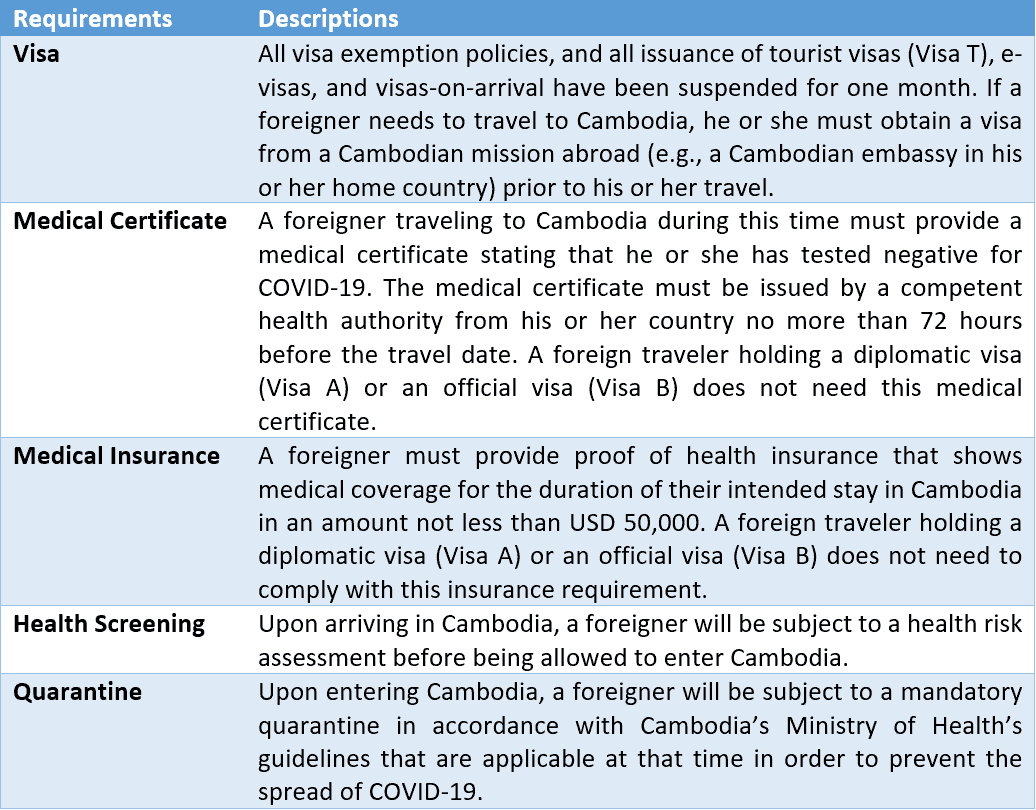
Cambodia’s Ministry of Foreign Affairs and International Cooperation notes that these requirements are temporary. The Cambodian government will review them regularly based on the current COVID-19 situation.

We would like to highlight that these travel requirements are in addition to the travel bans imposed earlier on travelers from the following six countries: France, Germany, Iran, Italy, Spain and the US as noted in our previous alert. These travel bans have been extended indefinitely until further notice, according to the Ministry of Foreign Affairs and International Cooperation’s letter on April 16, 2020.

RELATED INSIGHTS​ 

January 29, 2026
Following the recent enactment of a comprehensive legal framework addressing sexual harassment, Thailand has launched a fast-track judicial process enabling victims of online sexual harassment to obtain court orders suspending and removing obscene content from the internet. On January 26, 2026, the Office of the Judiciary introduced the “Take It Down” procedure through the Court Integral Online Service (CIOS) platform, providing victims with their first direct, expedited pathway to halt the spread of online content that violates the new legal provisions against sexual harassment. This new remedy stems from section 284/4 of the Penal Code, introduced through the Act Amending the Penal Code (No. 30) B.E. 2568, which took effect on December 30, 2025. Under section 284/4, an injured person or a competent official may petition the court to suspend dissemination of violating data and remove the data from computer systems within a court-specified period. The court may also direct system controllers, service providers, or competent authorities to carry out the order and report back within 15 days. Filing through the CIOS Platform The CIOS platform serves as the primary electronic channel for these petitions. Key features include: Individuals can file online without appearing in person and may submit petitions at any time the system is available. Users must complete digital identity verification via the ThaID application to access the CIOS. Petitions under section 284/4 are limited to requests to suspend or remove violating content. Claims for monetary damages must be pursued separately, including via separate proceedings or prefiling mediation. Streamlined Review Process The submission workflow is end-to-end electronic, and the system provides step-by-step guidance. After submission, court staff review the petition before presenting it to a judge for consideration. The court may conduct an online inquiry to obtain additional information, and in-person attendance is required only if deemed
January 26, 2026
Tilleke & Gibbins has contributed an updated Vietnam chapter to Foreign Investment Review 2026, a recently published global guide to the legal and regulatory environment for foreign investment in 25 jurisdictions worldwide. Published and distributed by Lexology Panoramic, the guide discusses law and policy on oversight of foreign investment, regulatory frameworks, procedural requirements, and other important stipulations for foreign investors. The Vietnam chapter was prepared by Kien Trung Trinh, a partner in the Tilleke & Gibbins’ Hanoi office, Dung Thi Phuong Le, an associate in the firm’s office in Ho Chi Minh City, Nguyen Thi Huong Nguyen, associate in Hanoi, and Ngan Thuc Nguyen, paralegal in Ho Chi Minh City. The Vietnam chapter covers the following topics: Law and Policy: Government policies and practices, main laws and their scope of application (including details on investment promotional measures), definitions, rules for state-owned enterprises and sovereign wealth funds, relevant authorities and oversight, and national interest provisions. Procedure: Jurisdictional thresholds, national interest clearance, securing approval, the review process for competition clearance and associated penalties, involvement of authorities, facilitation of clearance, and post-closing regulatory powers. Substantive assessment: Substantive tests for clearance, authorities’ consultation with other countries and other relevant parties, transactional prohibitions and objections, mitigating arrangements and challenges to a decision, and protection of confidential information. Recent cases, updates, and trends: Relevant recent case law, key recent and ongoing developments. A PDF of the Vietnam chapter can be accessed through the button below. Tilleke & Gibbins also contributed the Cambodia, Laos, and Myanmar chapters to Foreign Investment Review 2026. Readers can also gain 30 days of complementary access to the full Foreign Investment Review 2026 guide and the rest of Lexology Panoramic’s varied offerings through this link.
January 26, 2026
Tilleke & Gibbins has contributed an updated Myanmar chapter to the recently published Foreign Investment Review 2026, a global guide to the legal and regulatory environment for foreign investment in 25 jurisdictions worldwide. Published and distributed by Lexology Panoramic, the guide discusses law and policy on oversight of foreign investment, regulatory frameworks, procedural requirements, and other important concerns for foreign investors. The Myanmar chapter was prepared by Nwe Oo and Aye Thuzar Hlaing, senior associates in Tilleke & Gibbins’ office in Yangon. The Myanmar chapter covers the following topics: Law and Policy: Government policies and practices, main laws and their scope of application (including details on investment promotional measures), definitions, rules for state-owned enterprises and sovereign wealth funds, relevant authorities and oversight, and national interest provisions. Procedure: Jurisdictional thresholds, national interest clearance, securing approval, the review process for competition clearance and associated penalties, involvement of authorities, facilitation of clearance, and post-closing regulatory powers. Substantive assessment: Substantive tests for clearance, authorities’ consultation with other countries and other relevant parties, transactional prohibitions and objections, mitigating arrangements and challenges to a decision, and protection of confidential information. Recent cases, updates, and trends: Relevant recent case law, key recent and ongoing developments. A PDF of the Myanmar chapter can be downloaded through the button below. Tilleke & Gibbins also contributed the Cambodia, Laos, and Vietnam chapters to Foreign Investment Review 2026. Readers can also gain 30 days of complementary access to the full Foreign Investment Review 2026 guide and the rest of Lexology Panoramic’s varied offerings through this link.
January 26, 2026
Prisna Sungwanna, head of Tilleke & Gibbins’ office in Vientiane, and Sayphin Singsouvong, associate, provided an updated Laos chapter for Foreign Investment Review 2026, a global guide to the legal and regulatory environment for foreign investment in 25 jurisdictions worldwide. Published and distributed by Lexology Panoramic, the guide discusses law and policy on oversight of foreign investment, regulatory frameworks, procedural requirements, and other important considerations for foreign investors. The Laos chapter aims to give investors an understanding of what to expect when establishing operations and operating in the Lao market, covering: Law and Policy: Government policies and practices, main laws and their scope of application (including details on investment promotional measures), definitions, rules for state-owned enterprises and sovereign wealth funds, relevant authorities and oversight, and national interest provisions. Procedure: Jurisdictional thresholds, national interest clearance, securing approval, the review process for competition clearance and associated penalties, involvement of authorities, facilitation of clearance, and post-closing regulatory powers. Substantive assessment: Substantive tests for clearance, authorities’ consultation with other countries and other relevant parties, transactional prohibitions and objections, mitigating arrangements and challenges to a decision, and protection of confidential information. Recent cases, updates, and trends: Relevant recent case law, key recent and ongoing developments. A PDF of the Laos chapter can be accessed through the button below. Tilleke & Gibbins also contributed the Cambodia, Myanmar, and Vietnam chapters to Foreign Investment Review 2026. Readers can also gain 30 days of complementary access to the full Foreign Investment Review 2026 guide and the rest of Lexology Panoramic’s varied offerings through this link.