
You are using an outdated browser and your browsing experience will not be optimal. Please update to the latest version of Microsoft Edge, Google Chrome or Mozilla Firefox. Install Microsoft Edge

April 20, 2020

Current Requirements for Persons Traveling to Cambodia During the COVID-19 Pandemic

In order to prevent imported cases of COVID-19, on March 27, 2020, Cambodia’s Ministry of Foreign Affairs and International Cooperation imposed new requirements on foreigners entering Cambodia. These requirements are applicable to all foreigners, unless there is ban in effect for foreigners from specific countries. These legal requirements are effective from 23:59 of March 30, 2020.

Therefore, any foreigner considering a trip to Cambodia during this time should note the below requirements, plan appropriately and consider how they may impact their trip.
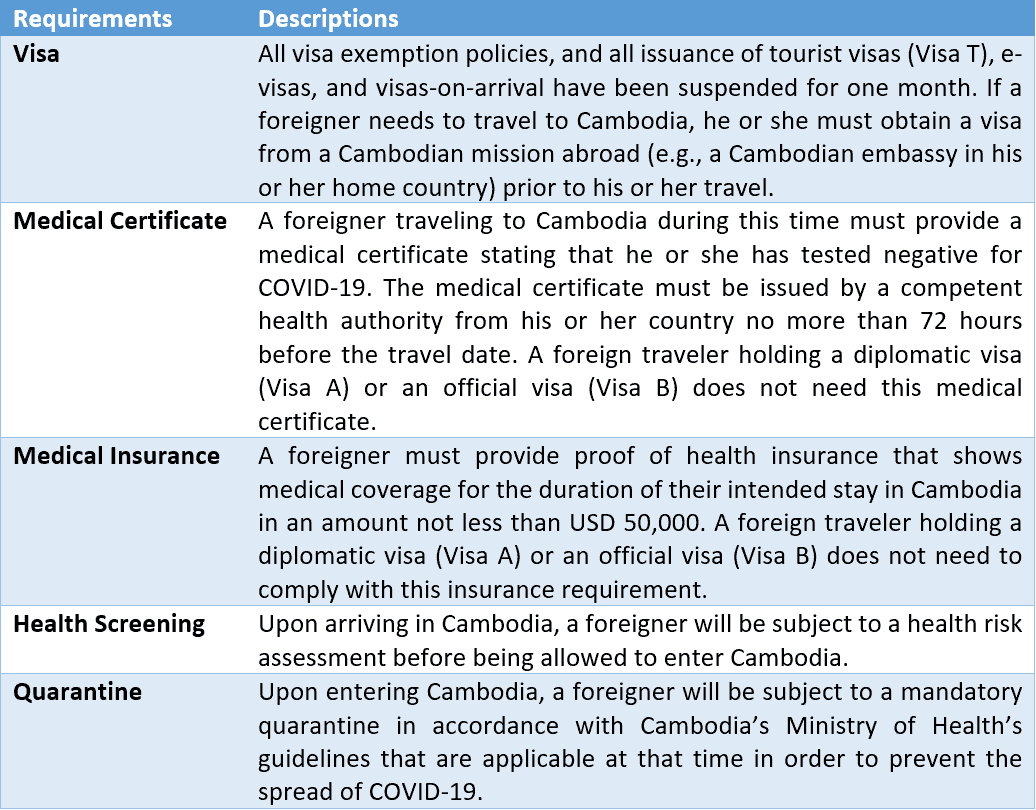
Cambodia’s Ministry of Foreign Affairs and International Cooperation notes that these requirements are temporary. The Cambodian government will review them regularly based on the current COVID-19 situation.

We would like to highlight that these travel requirements are in addition to the travel bans imposed earlier on travelers from the following six countries: France, Germany, Iran, Italy, Spain and the US as noted in our previous alert. These travel bans have been extended indefinitely until further notice, according to the Ministry of Foreign Affairs and International Cooperation’s letter on April 16, 2020.

RELATED INSIGHTS​ 

January 26, 2026
Tilleke & Gibbins has contributed an updated Cambodia chapter to Foreign Investment Review 2026, a global guide to the legal and regulatory environment for foreign investment in 25 jurisdictions around the world. Published and distributed by Lexology Panoramic, the guide is focused on law and policy regarding foreign investment oversight, regulatory frameworks, procedural requirements, and other notable concerns for foreign investors. The updated Cambodia chapter was prepared by Jay Cohen, partner and director of Tilleke & Gibbins’ Phnom Penh office, and Nitikar Nith, associate. The chapter focuses most closely on the law and policy section, which explains the government’s policies and practices regarding foreign direct investment, the main investment laws and their scope, and the relevant authorities responsible for regulating mergers, acquisitions, and other business transactions. The chapter also brings up key recent developments, such as the prospect of Cambodia establishing a competition regulator. A PDF of the Cambodia chapter can be downloaded through the button below. Tilleke & Gibbins also provided the Laos, Myanmar, and Vietnam chapters to Foreign Investment Review 2026. Readers can also gain 30 days of complementary access to the full Foreign Investment Review 2026 guide and the rest of Lexology Panoramic’s varied offerings through this link.
January 26, 2026
Myanmar’s Private Security Services Law, enacted on February 18, 2025, together with its implementing Directive on Applications for a Private Security Services License or Permit issued on June 18, 2025, establishes the country’s first comprehensive regulatory framework for both commercial private security service providers and companies that employ in-house security personnel. The framework applies to both Myanmar and foreign entities. For foreign investors and multinational operators, the new regime introduces strict licensing requirements, local content rules, and various approvals that must be carefully considered as part of business planning and compliance processes. Regulatory Authority and Structure The governing authority under the Private Security Services Law is the Private Security Services Central Supervisory Committee, formed with the minister of the Ministry of Home Affairs (MOHA) as chairperson, the chief of the Myanmar Police Force as vice-chairperson, and members from other high-ranking officials from relevant ministries, such as Transport and Communications, Defense, Planning and Finance, Investment and Foreign Economic Relations, Legal Affairs, Immigration and Population, Labor, and Commerce. This Central Committee is the highest regulatory authority and has the power to adopt policies, approve or reject applications for licenses and permits, and decide appeals against administrative actions taken by Supervisory Committees, which operate under the Central Committee at the state and regional level. They are responsible for processing applications, verifying compliance with statutory requirements, submitting applications to the Central Committee with remarks, and issuing licenses and permits once approved. Supervisory Committees also monitor compliance by license or permit holders and impose administrative penalties for noncompliance, while the Central Committee exercises final decision-making authority. License Requirements for Security Service Providers To apply for a private security services license, companies must be registered under the Myanmar Companies Law. Foreign companies may also operate a private security services business in Myanmar, subject to compliance
January 21, 2026
Spurred by global geopolitics and Canada’s Indo-Pacific Strategy, which aims to forge deeper ties with ASEAN, Canadian companies have been showing growing interest in Thailand and Southeast Asia in recent years. To understand the opportunities offered by the region, we sat down with Andrew Stoutley, a Toronto native and the chief operating officer of Tilleke & Gibbins, a leading Southeast Asian regional law firm with over 130 years of history in Thailand. Q: Why are Canadian companies looking at Thailand and Southeast Asia right now? A: Two reasons stand out. First, diversification has moved up the agenda. Many Canadian companies want options outside North America due to tariff volatility and policy uncertainty in the United States, as well as questions around the next Canada–United States–Mexico Agreement mandatory joint review. At the same time, the shift of global production from China to Southeast Asia is accelerating, driven by rising costs, geopolitics, and the need to avoid overreliance on a single market. As a result, Canadian companies are looking for a second production base or a regional hub, and Thailand and its neighbors are natural choices given their manufacturing depth, location, and established supply chains. Second, Canada’s own efforts in the region are gaining traction. The Indo-Pacific Strategy has led to more on-the-ground support, including larger trade missions, upgraded diplomatic posts, and new financing options. Export Development Canada (EDC) now has a presence in Bangkok, giving Canadian companies a direct line to financing and insurance in Thailand. There’s also steady progress on trade frameworks like the recently signed Canada–Indonesia Comprehensive Economic Partnership Agreement (which will come into effect pending domestic procedures), ongoing negotiations of a Canada–ASEAN FTA, and the exciting announcement about the launch of negotiations of a Canada–Thailand FTA. Together, these developments have the potential to make it much easier
January 20, 2026
Arbitrations seated in Thailand are governed principally by the Arbitration Act B.E. 2545 (2002) and, where applicable, the rules of institutions such as the Thailand Arbitration Center (THAC) and the Thai Arbitration Institute (TAI). While these instruments set the core procedural structure, they are not comprehensive. To fill in these procedural gaps, arbitral tribunals often look to the Thai Civil Procedure Code (CPC) and apply its principles when the Arbitration Act or institutional rules are silent. This hybrid system is familiar to local practitioners but can surprise international parties who expect a more self-contained arbitral procedure. Examples of How CPC Principles Are Applied Evidence Management: Section 25 of the Arbitration Act requires equal treatment of the parties and guarantees each side a full opportunity to present its case. At the same time, it grants tribunals broad discretion to conduct proceedings “as it deems appropriate” and expressly suggests that arbitrators may apply the CPC evidence rules where appropriate. In practice, tribunals frequently apply CPC evidence rules when addressing: submission of evidence lists, late or additional evidence, questions of admissibility and relevance, and assessment of witness and expert testimony. Amendments to Pleadings: Because the Arbitration Act and institutional rules provide limited guidance on amending pleadings, tribunals often rely on CPC principles when parties seek to amend a statement of claim or defense. Amendments may be permitted if they are sought in a timely manner, do not unfairly prejudice the opposing party, do not cause undue delay, and do not alter the nature of the dispute. These conditions closely mirror the standards applied by Thai courts under the CPC. Subpoenas and Court Assistance: Arbitral tribunals seated in Thailand generally do not have inherent subpoena powers. Section 33 of the Arbitration Act fills this gap by permitting the tribunal, an individual arbitrator, or a