
You are using an outdated browser and your browsing experience will not be optimal. Please update to the latest version of Microsoft Edge, Google Chrome or Mozilla Firefox. Install Microsoft Edge

April 20, 2020

Current Requirements for Persons Traveling to Cambodia During the COVID-19 Pandemic

In order to prevent imported cases of COVID-19, on March 27, 2020, Cambodia’s Ministry of Foreign Affairs and International Cooperation imposed new requirements on foreigners entering Cambodia. These requirements are applicable to all foreigners, unless there is ban in effect for foreigners from specific countries. These legal requirements are effective from 23:59 of March 30, 2020.

Therefore, any foreigner considering a trip to Cambodia during this time should note the below requirements, plan appropriately and consider how they may impact their trip.
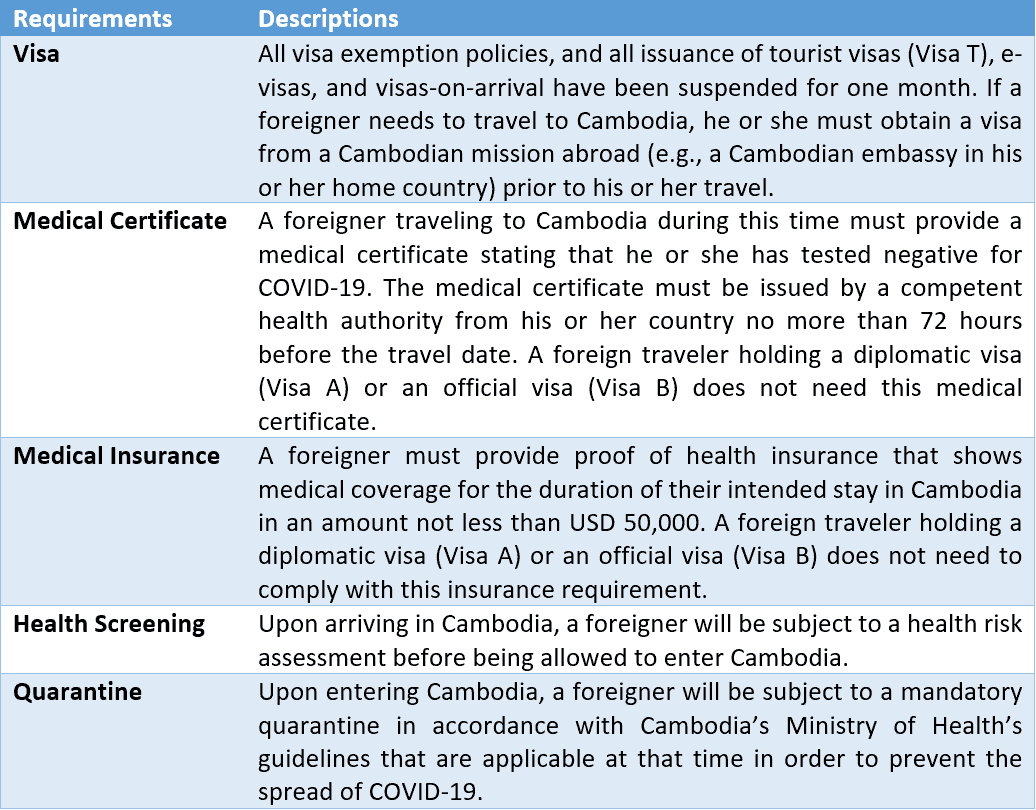
Cambodia’s Ministry of Foreign Affairs and International Cooperation notes that these requirements are temporary. The Cambodian government will review them regularly based on the current COVID-19 situation.

We would like to highlight that these travel requirements are in addition to the travel bans imposed earlier on travelers from the following six countries: France, Germany, Iran, Italy, Spain and the US as noted in our previous alert. These travel bans have been extended indefinitely until further notice, according to the Ministry of Foreign Affairs and International Cooperation’s letter on April 16, 2020.

RELATED INSIGHTS​ 

June 30, 2025
On April 29, 2025, the State Bank of Vietnam (SBV) issued Circular No. 03/2025/TT-NHNN (Circular 03), which provides detailed guidance on the opening and use of Vietnamese dong (VND) accounts by non-resident foreign investors engaging in indirect investment activities in Vietnam. Circular 03, which took effect on June 16, 2025, amends Circular No. 06/2019/TT-NHNN of the SBV on the management of foreign exchange for foreign direct investment activities in Vietnam (Circular 06) and replaces Circular No. 05/2014/TT-NHNN of the SBV guiding the opening and use of indirect investment capital accounts for implementation of foreign indirect investment activities in Vietnam (Circular 05). Below are some of the key points of Circular 03. Change of Account Name Circular 03 renames “indirect investment capital account” to “indirect investment account” (IIA). This change aligns with the terminology used in other legislation, ensuring consistency across Vietnam’s legal framework governing foreign exchange and investment activities. Additionally, by removing the word “capital,” the new term better encompasses the full range of transactions that may be conducted through these accounts, such as share transfer and other forms of indirect investment-related activities. This helps prevent misinterpretation and facilitates compliance for foreign investors operating in Vietnam. Account Types Circular 03 clearly delineates account types and investor residency status as follows: For non-resident foreign investors: The opening and use of investment accounts in VND is for carrying out transactions related to indirect investment activities. For resident foreign investors: Credit and debit transactions are made through payment accounts in VND in accordance with relevant laws. Additional Permitted Uses of IIAs In addition to the cash inflows and outflows authorized under Circular 05, Circular 03 introduces more cash transactions that can be conducted via IIAs. These include: Receiving interest and other legal income when conducting stock purchase transactions that do not require
June 25, 2025
In Thailand, in-court business rehabilitation is a legal proceeding that enhances a debtor’s chance to restructure business operations for corporate debtors who are unable to repay their debts. The purpose of this proceeding is to allow the debtor to continue operating the business and generate income to repay creditors. The amounts that creditors receive in the rehabilitation proceeding are greater than the amounts creditors would receive if the debtor went bankrupt. The law is not designed to allow debtors or creditors to use the business rehabilitation process in bad faith for their benefit or to defraud another party. Accordingly, the Business Rehabilitation Law, which is included in the Thai Bankruptcy Act B.E. 2483 (1940), provides criminal liability for actions taken before or during the process. This article addresses the key points regarding criminal liability for safeguarding debtors and creditors in business rehabilitation proceedings from any parties who act in bad faith. Criminal Liability in Business Rehabilitation The following provisions establish the framework for criminal liability in business rehabilitation cases, ensuring that all parties act with integrity throughout the process. The Bankruptcy Act of Thailand B.E. 2483 (1940) provides the relevant provisions regarding the business rehabilitation process. Additionally, if a company debtor or its authorized directors are found to have committed fraud or malfeasance under the Bankruptcy Act, they can also be held criminally liable under the Penal Code or related criminal statutes. The rehabilitation process aims to help a business recover financially under the supervision of the court. When the court approves the rehabilitation plan, the court appoints a business rehabilitation plan administrator to manage and implement the process. However, if it is discovered that the debtor, its executives, or even the plan administrator engaged in illegal activities prior to or during the rehabilitation process—such as tax evasion, embezzlement,
June 13, 2025
In today’s digital age, cyberattacks have become a real threat to organizations worldwide. These attacks can range from phishing and malware to ransomware and distributed denial of service (DDoS) attacks. As the frequency and sophistication of these attacks increase, so does the importance of cybersecurity compliance. In the corporate world, compliance refers to the process of ensuring that a company and its employees adhere to all relevant laws, regulations, standards, and ethical practices—but it should not stop there. Compliance should also encompass asset recovery and disciplinary measures, which can both help organizations address incidents effectively and promote good governance. Cyberattacks are malicious attempts to access or damage a computer system or network, often carried out for financial gain, for political activism, or simply to cause disruption. For instance, a successful attack might involve an attacker creating an email address that closely resembles a legitimate one, perhaps by changing only one or two characters. That email address is then inserted into an existing conversation thread, making it appear as if the user with this email address was already part of the discussion. This tactic can easily deceive a recipient into believing the email was sent from a trusted source, thereby leading them to click on malicious links, provide sensitive information, or even make payments in accordance with the attacker’s request or instructions. Phishing attacks like these are particularly dangerous and can have a serious impact on the ongoing business of a corporation because they exploit the trust and familiarity established in the original email chain. Effective Mitigation Approaches Mechanisms for addressing the aftermath of a crisis provide important recourse to affected organizations, but effective compliance mechanisms can minimize the risk of such crises ever occurring. Companies should therefore prioritize preventative measures and implementation of effective crisis management schemes. Various legal
June 11, 2025
Thailand’s tax dispute resolution framework has undergone a significant transformation with the enactment of the Act Establishing the Tax Court and the Procedure for Tax Cases (No. 3) B.E. 2568. Published in the Government Gazette on May 27, 2025, the amended act will come into force on November 24, 2025, which is 180 days after its publication. The amended act marks a pivotal shift in the jurisdiction and procedures of the Tax Court, most notably by empowering it to adjudicate certain criminal tax cases for the first time. Background and Rationale The Tax Court was originally established in 1985 as a specialized forum to handle complex tax disputes, including those related to revenue, customs, and excise taxes. The creation of the Tax Court recognized the need for judicial expertise in tax law, given its technical and specialized nature. The latest amendment is designed to address procedural inefficiencies, modernize court processes, and align Thailand’s tax litigation system with international standards. The reform demonstrates Thailand’s commitment to enhancing the efficiency, transparency, and fairness of its tax dispute resolution mechanisms. Key Amendments and Provisions Six of the key changes in the amendment are highlighted below. Expansion of jurisdiction to criminal tax cases. The most significant change is the extension of the Tax Court’s jurisdiction to include criminal offenses under the Revenue Code, customs law, excise tax law, and other tax-related laws that may be specified by royal decree. New sections in the act explicitly grant the Tax Court authority to hear and decide criminal tax cases, so individuals and entities accused of criminal tax evasion or other tax-related crimes will now have their cases heard by judges with specialized tax expertise. The law also clarifies the Tax Court’s jurisdiction when a single act constitutes multiple offenses (some tax-related, some not) or when