
You are using an outdated browser and your browsing experience will not be optimal. Please update to the latest version of Microsoft Edge, Google Chrome or Mozilla Firefox. Install Microsoft Edge

April 20, 2020

Current Requirements for Persons Traveling to Cambodia During the COVID-19 Pandemic

In order to prevent imported cases of COVID-19, on March 27, 2020, Cambodia’s Ministry of Foreign Affairs and International Cooperation imposed new requirements on foreigners entering Cambodia. These requirements are applicable to all foreigners, unless there is ban in effect for foreigners from specific countries. These legal requirements are effective from 23:59 of March 30, 2020.

Therefore, any foreigner considering a trip to Cambodia during this time should note the below requirements, plan appropriately and consider how they may impact their trip.
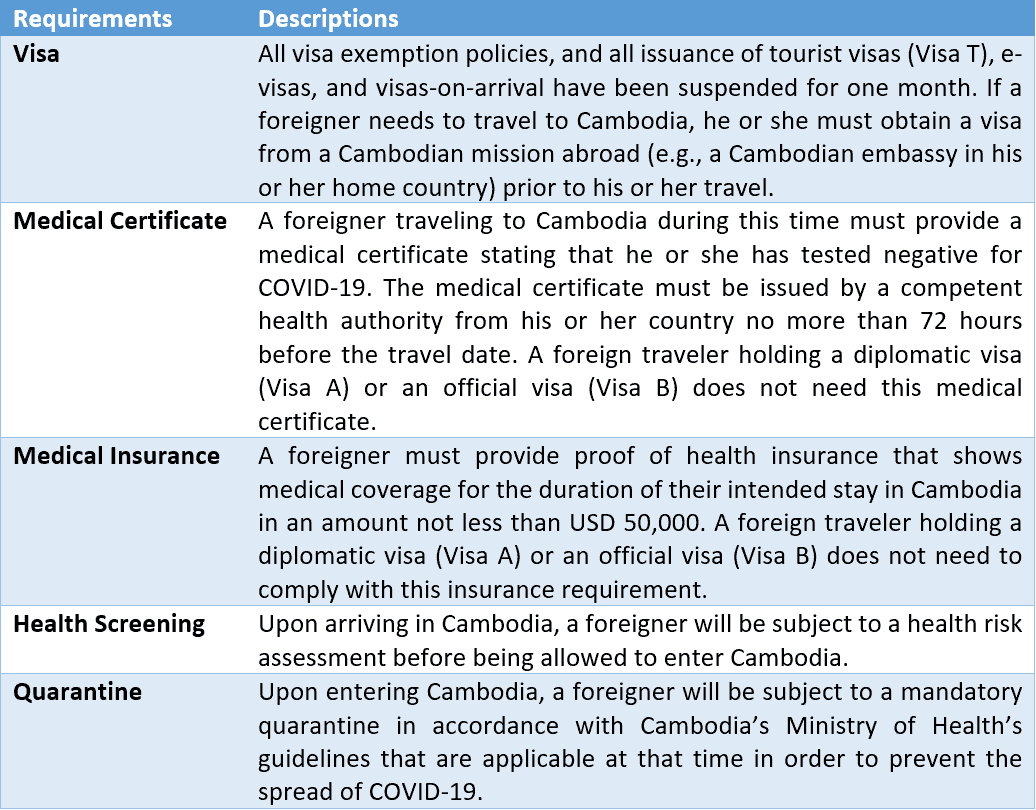
Cambodia’s Ministry of Foreign Affairs and International Cooperation notes that these requirements are temporary. The Cambodian government will review them regularly based on the current COVID-19 situation.

We would like to highlight that these travel requirements are in addition to the travel bans imposed earlier on travelers from the following six countries: France, Germany, Iran, Italy, Spain and the US as noted in our previous alert. These travel bans have been extended indefinitely until further notice, according to the Ministry of Foreign Affairs and International Cooperation’s letter on April 16, 2020.

RELATED INSIGHTS​ 

June 6, 2025
As from July 1, 2025, as part of its ongoing efforts to digitalize and streamline the delivery of public services, the Vietnamese government will officially conduct administrative procedures, both online and offline, only via electronic identity (“e-ID”) accounts on the VNeID platform. In particular: Online administrative procedures carried out via the National Public Service Portal or via information systems for administrative procedures at the ministerial or provincial level are required to be implemented by using e-ID accounts only. When receiving dossiers, authorities will be required to check and verify the e-IDs of companies or individuals responsible for conducting administrative procedures. Further, it is worth noting that to complete the registration of an e-ID account for a company, the legal representative of the company must hold a level-2 e-ID account. Compliance Considerations Vietnam’s first regulation of e-ID accounts for individuals and organizations was issued in Decree No. 59/2022/ND-CP dated September 5, 2022, on electronic authentication and identification. This decree was subsequently replaced by Decree No. 69/2024/ND-CP dated June 25, 2024, which governs the same matters. Registration and operation of e-ID accounts are centralized through VNeID, a digital ID app developed by the National Population Data Center under the Ministry of Public Security of Vietnam. Although the registration of e-ID accounts for companies is not explicitly mandated by law, the absence of an e-ID account may hinder companies from completing administrative procedures, including licensing and reporting obligations. Such non-compliance could consequently result in administrative penalties. To mitigate unexpected non-compliance and administrative fines due to the lack of an e-ID account, companies should be well prepared for and implement the registration of a company e-ID account as soon as possible.
June 4, 2025
On April 2, 2024, the Cambodian Competition Commission (CCC) issued Decision No. 087 on Requirements and Procedures of Exemptions under the Law on Competition, outlining the requirements and procedures for requesting exemptions for agreements or activities that could prevent, restrict, or distort competition in Cambodia. Franchise agreements often include clauses such as price fixing, exclusive supply arrangements, or territorial restrictions, which could potentially raise concerns under the Law on Competition. Therefore, it is necessary for both franchisors and franchisees to understand how the law applies to their agreements and whether an exemption request may be required. Some arrangements under franchise agreements may fall within the scope of prohibited practices under the Law on Competition. These include horizontal and vertical agreements, abuse of dominant position, and anti-competitive business combination. If a business owner contemplates that their franchise agreement could be interpreted as anti-competitive, they must assess whether to apply for an exemption. Key Criteria for Exemption Under Decision No. 087, the CCC may grant an exemption if the applicant can demonstrate that the proposed agreement or activity meets all four of the following conditions: Significant and identifiable benefits: The agreement must provide clear technological, social, or economic benefits such as cost efficiencies, qualitative efficiencies, initiations of new technologies, or environmental and sustainable benefits. Necessity of the agreement/activities: These benefits must not be achievable without the proposed agreement or activity. The applicant must show that prevention, restriction, or distortion of competition are essential to realizing the benefits. Benefits outweigh harm: The positive impacts must significantly outweigh any adverse effects caused by the prevention, restriction, or distortion of competition, and the benefits should be likely to materialize within one year. No elimination of competition: The agreement must not eliminate competition in any substantial aspect of goods or services. Application and Supporting Documents
June 4, 2025
The growth of Vietnam’s vibrant digital economy offers tremendous potential but is also a driver of the persistent problem of online intellectual property (IP) infringement. The spectrum of issues faced by IP rights holders runs from copyright piracy on digital services (such as streaming and torrent sites) to the sale of counterfeit goods via e-commerce sites and social platforms to the misuse of rights through misleading use of trademarks. These infringements do not only eat into profits; they damage brand reputation and mislead consumers. As a result, site blocking and keyword blocking have become increasingly important components of the enforcement toolkit available in Vietnam. Legal Framework for Blocking Actions Site and keyword blocking in Vietnam is supported by a growing legal framework, particularly following the 2022 amendment to the IP Law. Prior to this, the legal basis for blocking was scattered across various laws, and internet service providers (ISPs) were only obligated to block access to infringing content upon official requests from authorities. The introduction of Article 198b under the amended IP Law marked a significant shift, establishing a clearer mechanism for rights holders to request site blocking directly. This provision obliges them to act upon valid takedown or blocking requests. In addition to the IP Law, other key legislation includes the Law on Information Technology, the Law on Cybersecurity, the Law on Advertising, and various decrees. Together, these laws provide a more structured and enforceable basis for blocking actions in Vietnam, though practical enforcement still depends on ISP cooperation and the clarity of the infringement evidence. Competent Authorities Previously, rights holders could pursue administrative actions through specialized inspectorates under the Ministry of Science and Technology, the Ministry of Culture, Sports and Tourism, or the Vietnam E-Commerce and Digital Economy Agency (iDEA). However, due to a recent government restructuring,
June 4, 2025
On June 1, 2025, Thailand’s Office of Central Company and Partnership Registration of the Department of Business Development opened a public hearing period on its draft notification regarding criteria and supporting documents for establishment of partnerships and limited companies in which foreign nationals are involved as investors or have signing authority. The draft notification requires applicants for registration of establishment of partnerships and limited companies to submit financial evidence of the capital contributions made by each Thai partner or shareholder in the following cases: When a partnership or limited company has partners or shareholders who are foreign nationals holding shares or equity amounting to less than 50% of the total capital contribution or registered capital in the partnership or company; or When a limited company has no foreign shareholders but has a non-Thai director who is an authorized or co-authorized signatory. The amounts shown in this financial evidence must be in accordance with the capital contribution or shareholding amount of each Thai partner or shareholder. Evidence can be provided in one of the following forms: Financial evidence issued by a bank to verify or demonstrate financial status. Copy of bank statement for the past six months. Copy of personal income tax or corporate income tax document (Form PorNgorDor.90 or PorNgorDor.91 for individuals; Form PorNgorDor.50 or PorNgorDor.51 for corporate shareholders). Any other supporting document showing the source of funds used for the capital contribution. The consultation period will be open until June 20, 2025, and the draft may be subject to additional revisions before it is finalized and made legally binding.