
You are using an outdated browser and your browsing experience will not be optimal. Please update to the latest version of Microsoft Edge, Google Chrome or Mozilla Firefox. Install Microsoft Edge

March 19, 2020

COVID-19 Status Update for Southeast Asia – March 18, 2020

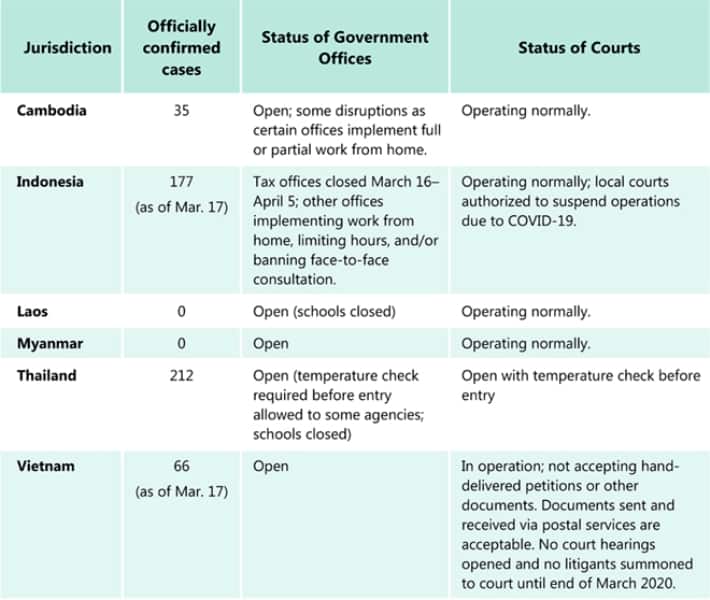
The effects of the global COVID-19 pandemic on Southeast Asia are a deep concern shared by all with connections to the region. To encourage clear understanding of the facts on the ground, Tilleke & Gibbins has prepared this high-level snapshot of the legal situation as it currently stands in each of our jurisdictions.

Administrative and Judicial Functions
Travel Restrictions

Cambodia
The government has imposed the following:

  • Ban on incoming foreign nationals traveling from France, Germany, Iran, Italy, Spain, and the USA for 30 days, effective from March 17, 2020 (or from March 18 for Iran only).
  • Mandatory 14-day self-quarantine for Cambodian citizens traveling from European countries, Iran, or the USA required.
  • Restriction on Cambodian public officials attending meetings in European countries, Iran, or the USA.
  • Ban on entry of cruise ships via Kaam Samnor International Border.

Indonesia
The government has imposed the following:

  • Cancellation of all direct flights to and from China.
  • Suspensions of all visa-on-arrival allowances for one month starting March 20, 2020.
  • Restrictions on incoming travelers who have been in any of the following countries within 14 days of arrival: China, France, Germany, Iran, Italy, South Korea, Spain, Switzerland, the UK, and Vatican City.

Laos
Various border checkpoints have been closed. Further recommendations for travelers from certain affected areas have been issued by the National Taskforce Committee for COVID-19 Prevention and Control on March 16. However, prohibitions, restrictions, and mandatory actions are not formally in place.

Myanmar
An announcement made on March 15, 2020, applies requirements to travelers coming from the following countries:

Thailand
Incoming travelers with a temperature of 37.5 degrees Celsius or higher, and with any symptom associated with COVID-19, will be taken to a hospital approved by the Ministry of Public Health for testing, diagnosis, isolation, and quarantine as necessary.

For all other incoming travelers, the following measures apply:

  • Mandatory 14-day self-quarantine for travelers arriving from China (including Hong Kong and Macau), Iran, Italy, and South Korea.
  • Mandatory self-monitoring and reporting of symptoms in the Ministry of Public Health system for travelers arriving from Denmark, France, Germany, Netherlands, Norway, Spain, Sweden, Switzerland, the UK, and the USA. In addition, travelers from these countries must notify a disease control officer of their location and itinerary so their movements and contacts can be monitored.
  • All of the above incoming travelers must inform a disease control officer immediately upon the onset of any symptom associated with COVID-19.

As for outbound travelers, no blanket restriction has been issued for government employees, but many individual agencies have issued such prohibitions.

Vietnam
As of March 18, 2020, the following measures are in effect:

  • Visas on arrival suspended for all foreign nationals.
  • Travelers entering with visa exemption certificates granted to overseas Vietnamese (Viet Kieu), their relatives, and some other special cases (such as experts, business managers, and skilled workers) must have a certificate proving they have tested negative for the COVID-19 virus. The certificate must be issued by the relevant authority of the host country and also approved by Vietnam, except for those on official or diplomatic trips.
  • All travelers from outside of Vietnam entering with a visa will be subject to health checks and a mandatory 14-day quarantine.

***********

Our primary professional concern, in all things, is for the wellbeing and commerciality of our clients. For that reason, we are implementing practical social distancing measures designed to ensure that we work together safely, effectively, and without change to the quality and efficiency of the services you receive. If you have any queries about these measures, or about any of the information given above, please contact [email protected].

RELATED INSIGHTS​ 

June 23, 2026
On May 26, 2026, Thailand’s Department of Land Transport (DLT) published for public consultation a draft amendment to the Ministerial Regulation on Electronic Ride-Hailing Vehicles that would, for the first time, allow juristic persons (legal entities) to register vehicles as electronic ride-hailing cars—a right that currently belongs exclusively to natural persons, limited to one person per one vehicle. If finalized in its current form, the regulation would significantly expand the supply side of Thailand’s ride-hailing market by enabling corporate fleet operators to enter the space. The public comment period is open through June 24, 2026. Key Principles Under the Draft Regulation Under the proposed amendment, juristic persons that maintain a fleet of at least 50 vehicles will be permitted to register vehicles as electronic ride-hailing cars. This represents a fundamental shift from the current framework, which restricts registration to individual natural persons on a one-person-one-car basis. Vehicle Specifications Corporate-owned ride-hailing vehicles must meet the following requirements: Be brand new from the factory, or no more than two years old from first registration with no more than 20,000 km of use. Not be a vehicle that has been reconstructed or repaired after involvement in a serious accident affecting safety—a standard consistent with public transport vehicles (RorYor. 6). Be classified as small, medium, or large in accordance with ministerial or director-general specifications. The vehicles may be equipped with safety devices such as interior or exterior cameras (video/photo recording) and can retain the original factory color of the vehicle body (no mandatory color change is required). License Plates Corporate ride-hailing vehicles will use license plates of the same size, characteristics, and color as those for private passenger vehicles not exceeding seven seats (RorYor. 1), rather than public transport plates. Potential Impact The government has stated that the regulation is intended to: Promote
June 23, 2026
On May 14, 2026, Thailand published a ministerial regulation in the Government Gazette to prescribe measures for prevention and suppression of technology crimes. The regulation creates a comprehensive procedural framework for returning money and digital assets to victims of technology crimes. It will take effect 90 days after publication (in mid-August 2026), giving affected entities a limited window to prepare. Mandatory Reporting Obligations for Financial Institutions When a deposit account, e-money account, or digital asset wallet is frozen in connection with a technology crime, the relevant financial institution or business operator must report transaction data to the Anti-Money Laundering Office (AMLO) via AMLO’s designated electronic system. Required data elements include account numbers (sender and receiver), names, identification or passport numbers, legal entity registration numbers, phone numbers, remaining balance, damage amount, transaction reference numbers, and the bank case ID. Institutions that already share data through the information-sharing system under the emergency decree are deemed to have satisfied this reporting obligation, creating an incentive for platform participation. When the Royal Thai Police or the Department of Special Investigation seize or freeze assets related to technology crimes, they must provide AMLO with investigation reports, complaint evidence, money-trail data, and account statements. Notification and Claims Process Once the AMLO secretary-general approves verified reports of a technology crime, the account information of persons connected to the crime will be published in the Government Gazette, triggering a 90-day window for victims to file claims and for related persons to file objections. Officers will also publish details on AMLO’s electronic media and send registered mail to identified victims, which will be deemed received after 7 days domestically or 15 days internationally. Victims have 90 days from the date the crime is published in the Government Gazette to file claims through AMLO’s electronic system. Claims must include
June 19, 2026
For the first time, Thailand’s Food and Drug Administration (FDA) has published a consolidated list identifying all substances that have successfully passed its novel food safety evaluation process. The list is a step forward in regulatory transparency, but it also highlights a feature of the Thai regime that food companies often overlook: each approval is tied exclusively to the company that applied for it. A substance’s appearance on the list does not give other companies the green light to use it. This article examines the structure of Thailand’s novel food approval framework, the implications of applicant exclusivity, and the strategic choices it requires of food companies looking to bring novel ingredients to the Thai market. Thai FDA Food Safety Evaluation Framework Notification No. 376 of the Ministry of Public Health requires novel food substances to undergo a food safety assessment, with an exemption only for novel foods manufactured exclusively for export. The framework also encompasses “foods that do not qualify as novel foods” but which present characteristics warranting a safety evaluation, such as differing quality standards, increased serving sizes, or applications in specific food categories, where such changes affect consumption levels, nutritional value, or consumer safety. The recently published list of foods that passed the safety evaluation by the Thai FDA is structured by substance category and identifies the approved company (domestic manufacturer or importer), country of origin, substance name and trade name, approved purpose of use, and date of the Thai FDA’s approval notification certificate. A notable feature of Thailand’s novel food regime is that the approval result is tied exclusively to the company that submitted the application. Publication of the consolidated list does not constitute a general authorization to use the approved substances. The Thai FDA’s approval certificate specifies the approved conditions of use and the requirements
June 17, 2026
Thailand’s new labeling requirements for medical devices, which include for the first time a unique device identification (UDI) requirement for software as a medical device (SaMD), take effect on June 20, 2026. The Notification of the Ministry of Public Health regarding Criteria, Methods, and Conditions on Labeling and Instructions for Use for Medical Devices 2025, which replaces a similar notification from 2020, was published in the Government Gazette on December 22, 2025. To ensure clarity, modernity, and patient safety, the regulation requires domestic manufacturers and importers to provide labels and instructions for use (IFU) that are clearly legible, complete, and free of false or misleading claims. It also permits IFU to be provided in electronic format, such as via QR codes, websites, or other digital channels—directly relevant to SaMD, where physical labels are impractical and electronic presentation is the natural medium. The notification distinguishes two categories for labeling language. Home-use medical devices (for lay users outside healthcare facilities) must have labels and IFU in Thai. Professional-use medical devices may display labels and documentation in either Thai or English. This distinction is significant for SaMD developers: software intended for clinical professionals may use English-language interfaces and IFU, while consumer-facing health applications must provide Thai-language content. Labeling and UDI Requirements Labels and IFU must include, at a minimum: Product name and intended purpose Quantity or volume Name and address of domestic manufacturer or importer Thai FDA approval number Lot, version, or serial number Manufacturing date and expiry date For SaMD, the version number requirement is particularly relevant. The regulation also mandates display of a UDI code for SaMD in risk category 2 (moderate-risk), category 3 (moderate- to high-risk), and category 4 (high-risk), according to Thailand’s medical device risk classification system (which complies with the ASEAN Medical Device Directive and the EU