
You are using an outdated browser and your browsing experience will not be optimal. Please update to the latest version of Microsoft Edge, Google Chrome or Mozilla Firefox. Install Microsoft Edge

March 19, 2020

COVID-19 Status Update for Southeast Asia – March 18, 2020

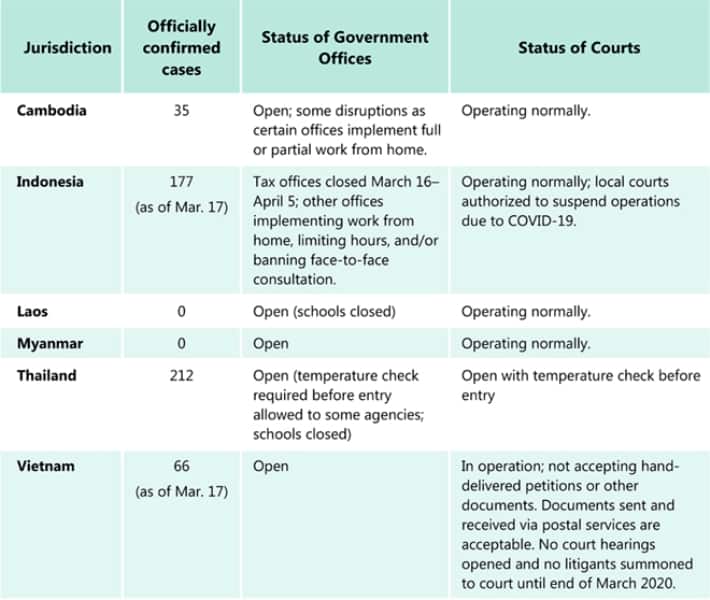
The effects of the global COVID-19 pandemic on Southeast Asia are a deep concern shared by all with connections to the region. To encourage clear understanding of the facts on the ground, Tilleke & Gibbins has prepared this high-level snapshot of the legal situation as it currently stands in each of our jurisdictions.

Administrative and Judicial Functions
Travel Restrictions

Cambodia
The government has imposed the following:

  • Ban on incoming foreign nationals traveling from France, Germany, Iran, Italy, Spain, and the USA for 30 days, effective from March 17, 2020 (or from March 18 for Iran only).
  • Mandatory 14-day self-quarantine for Cambodian citizens traveling from European countries, Iran, or the USA required.
  • Restriction on Cambodian public officials attending meetings in European countries, Iran, or the USA.
  • Ban on entry of cruise ships via Kaam Samnor International Border.

Indonesia
The government has imposed the following:

  • Cancellation of all direct flights to and from China.
  • Suspensions of all visa-on-arrival allowances for one month starting March 20, 2020.
  • Restrictions on incoming travelers who have been in any of the following countries within 14 days of arrival: China, France, Germany, Iran, Italy, South Korea, Spain, Switzerland, the UK, and Vatican City.

Laos
Various border checkpoints have been closed. Further recommendations for travelers from certain affected areas have been issued by the National Taskforce Committee for COVID-19 Prevention and Control on March 16. However, prohibitions, restrictions, and mandatory actions are not formally in place.

Myanmar
An announcement made on March 15, 2020, applies requirements to travelers coming from the following countries:

Thailand
Incoming travelers with a temperature of 37.5 degrees Celsius or higher, and with any symptom associated with COVID-19, will be taken to a hospital approved by the Ministry of Public Health for testing, diagnosis, isolation, and quarantine as necessary.

For all other incoming travelers, the following measures apply:

  • Mandatory 14-day self-quarantine for travelers arriving from China (including Hong Kong and Macau), Iran, Italy, and South Korea.
  • Mandatory self-monitoring and reporting of symptoms in the Ministry of Public Health system for travelers arriving from Denmark, France, Germany, Netherlands, Norway, Spain, Sweden, Switzerland, the UK, and the USA. In addition, travelers from these countries must notify a disease control officer of their location and itinerary so their movements and contacts can be monitored.
  • All of the above incoming travelers must inform a disease control officer immediately upon the onset of any symptom associated with COVID-19.

As for outbound travelers, no blanket restriction has been issued for government employees, but many individual agencies have issued such prohibitions.

Vietnam
As of March 18, 2020, the following measures are in effect:

  • Visas on arrival suspended for all foreign nationals.
  • Travelers entering with visa exemption certificates granted to overseas Vietnamese (Viet Kieu), their relatives, and some other special cases (such as experts, business managers, and skilled workers) must have a certificate proving they have tested negative for the COVID-19 virus. The certificate must be issued by the relevant authority of the host country and also approved by Vietnam, except for those on official or diplomatic trips.
  • All travelers from outside of Vietnam entering with a visa will be subject to health checks and a mandatory 14-day quarantine.

***********

Our primary professional concern, in all things, is for the wellbeing and commerciality of our clients. For that reason, we are implementing practical social distancing measures designed to ensure that we work together safely, effectively, and without change to the quality and efficiency of the services you receive. If you have any queries about these measures, or about any of the information given above, please contact [email protected].

RELATED INSIGHTS​ 

June 15, 2026
The surge in AI development has led to a desperate demand for large, high-quality training data. However, real-world data can be expensive to collect, difficult to access, and often subject to strict privacy and regulatory constraints. Synthetic data, which consists of artificially generated records that replicate the statistical properties of real-world data without reproducing specific individuals’ information, provides an appealing solution by generating artificial datasets at scale without relying on identifiable personal information. It combines speed, cost efficiency, and regulatory compliance, making it a sensible alternative for organizations seeking to reduce risks while maintaining data utility. When properly anonymized, synthetic datasets may fall outside the scope of laws such as the EU’s General Data Protection Regulation (GDPR) or Thailand’s Personal Data Protection Act (PDPA), reducing compliance burdens while still supporting high-quality model training. However, relying on synthetic data without rigorous legal due diligence could be a strategic mistake. It replaces one set of known risks (scraping, direct privacy liability) with a new set of complex liabilities. The narrative that synthetic data is a “silver bullet” for privacy and IP compliance is dangerous and could be misleading. While synthetic data addresses data scarcity, it also introduces new legal uncertainties. Legal counsel should anticipate downstream risks arising from compromised data sources. Models trained on unlawfully obtained data may need to be decommissioned, even if their outputs appear lawful. What is synthetic data? Synthetic data refers to artificially generated information created using AI techniques such as deep learning and generative models. Instead of copying real records, it reproduces the statistical patterns and relationships found in the original dataset. Synthetic data generally falls into three categories: Fully synthetic data – Entirely new data points generated from learned patterns. The model studies the structure of the original data and produces records that resemble real-world
June 11, 2026
Thailand’s Electronic Transactions Development Agency (ETDA) has released a revised draft Electronic Transactions Act (ETA) for public hearing from May 12, 2026, to June 15, 2026. This is not merely an amendment to certain provisions of the current ETA, but a comprehensive redrafting of the entire act. The revised draft ETA introduces several significant changes from the current framework, with practical implications for businesses operating in Thailand. Unified Coverage of Public and Private Sectors The current law segregates government transactions into a separate chapter with distinct rules. The draft ETA eliminates this division, defining “transaction” to encompass civil and commercial juristic acts as well as administrative procedures, administrative contracts, and other acts of government agencies. Enhanced E-Signature Definition The definition of “electronic signature” is broadened to expressly include biometric data and refocused on identifying the signatory and demonstrating intent regarding the content of the electronic data. Shift in Burden of Proof When a party challenges the reliability of electronic data created using a “trusted electronic method” or a method prescribed by the ETDA, the burden of proof and the cost of proving unreliability shifts to the challenger. Introduction of New Digital Method Concepts The draft ETA introduces several new digital method concepts that are not currently recognized under the existing ETA framework. These include: Electronic timestamping (e-timestamp) Electronic registered delivery Electronic company seals Electronic stamp duty compliance Electronic identity authentication and verification Electronic transferable records (electronic bills of lading, promissory notes, and similar negotiable instruments) Recognition of Automated Systems and Electronic Contracting The draft ETA expressly recognizes the legal validity and enforceability of contracts formed through automated systems, including contracts concluded entirely between automated systems or between an automated system and a person. A party may not deny the binding effect of such contracts solely because no human review
June 5, 2026
On May 25, 2026, Vietnam’s Ministry of Health issued Circular No. 16/2026/TT-BYT governing free-of-charge medicine support programs for medical establishments (Circular 16). Circular 16 will take effect on July 10, 2026, replacing Circular No. 31/2018/TT-BYT, which currently regulates the same subject matter. Circular 16 introduces several significant changes compared to the existing legal framework. Removal of Prior Approval Requirement Under the current regulations, free-of-charge medicine support programs are divided into two categories: (1) entirely free-of-charge provision of medicines for all types of drugs and (2) partially free-of-charge provision applicable only to brand-name drugs under patent protection or drugs whose generic products with identical active ingredients and dosage forms are available in Vietnam. Under the current regulations, partially free-of-charge programs are subject to mandatory registration with the competent authority, while entirely free-of-charge programs could be implemented without prior approval. A key reform under Circular 16 is that it stipulates only entirely free-of-charge medicine support programs applicable to all types of medicines, thereby eliminating the partially free-of-charge category. In addition, free-of-charge medicine support programs may be carried out solely based on a written agreement between the pharmaceutical company and the medical establishment, without any requirement for prior approval from competent authorities prior to implementation. Written Agreement Requirements Circular 16 requires the pharmaceutical company and medical establishment to enter into a written agreement in accordance with a prescribed template. This agreement must include the following compulsory information: Information on the supported medicines Form of support (entirely free-of-charge provision to patients) Quantity of medicines provided Target patient groups and applicable indications Duration of the program Rights and obligations of each party Transitional provisions on the protection of patients’ rights upon completion of the program The agreement may contain other contents as agreed by the parties, provided that these do not contradict applicable laws.
June 5, 2026
Thailand’s Office of Insurance Commission (OIC) has opened a public hearing on proposed amendments to the OIC Notification on Criteria for Information Technology Risk Governance and Management for Life Insurance and Non-Life Insurance Companies B.E. 2563 (2020) via the centralized Law platform. The public consultation period runs from May 8, 2026, to June 9, 2026. The proposed amendments aim to elevate the IT risk governance and cybersecurity risk management framework to be more modern and aligned with international standards, with a focus on strengthening cyber resilience, enhancing the role of IT audits, and establishing data governance and data quality controls. The parties affected by these amendments include life insurance companies, non-life insurance companies, and external IT auditors. Key Changes Elevated Role of Board of Directors The proposed notification requires the company’s board of directors to oversee data governance, cybersecurity, and the responsible use of AI. Additionally, the board should include at least one director with IT knowledge or experience. Companies are also required to designate a head of security responsible for information security. The board’s duties are expanded to include oversight of data governance and AI usage, including establishing relevant policies and committees. Enhanced IT Security and Cybersecurity The revised notification consolidates the existing chapters on IT project management, IT security and cybersecurity to reduce redundancy, and introduces significant new measures. These include mandatory multi-factor authentication for material systems, enhanced data security measures such as data masking and data leakage prevention, security hardening requirements, web filtering, and mandatory vulnerability assessment and penetration testing at least annually. New requirements are also introduced for mobile application security, API security, and security measures for emerging technologies such as cloud computing and post quantum cryptography. The cybersecurity framework now encompasses identification, protection, detection, response, and recovery. The draft also introduces source code review