
You are using an outdated browser and your browsing experience will not be optimal. Please update to the latest version of Microsoft Edge, Google Chrome or Mozilla Firefox. Install Microsoft Edge

March 19, 2020

COVID-19 Status Update for Southeast Asia – March 18, 2020

The effects of the global COVID-19 pandemic on Southeast Asia are a deep concern shared by all with connections to the region. To encourage clear understanding of the facts on the ground, Tilleke & Gibbins has prepared this high-level snapshot of the legal situation as it currently stands in each of our jurisdictions.

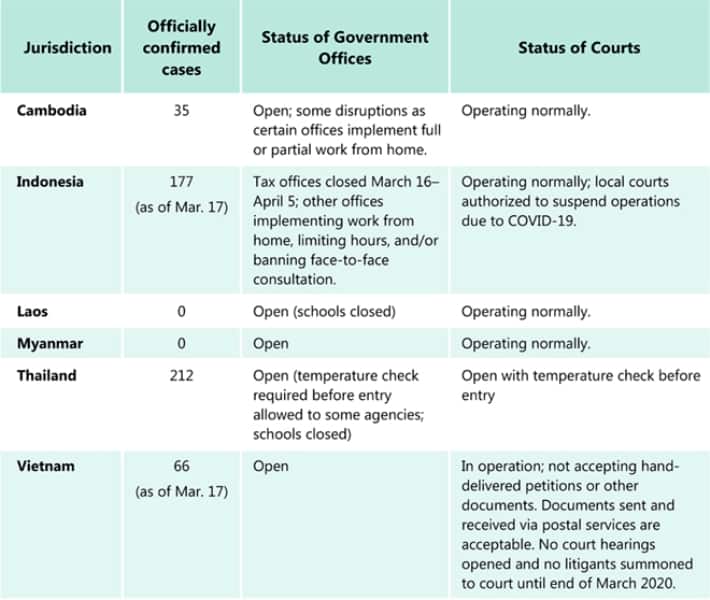
Administrative and Judicial Functions
Travel Restrictions

Cambodia
The government has imposed the following:

  • Ban on incoming foreign nationals traveling from France, Germany, Iran, Italy, Spain, and the USA for 30 days, effective from March 17, 2020 (or from March 18 for Iran only).
  • Mandatory 14-day self-quarantine for Cambodian citizens traveling from European countries, Iran, or the USA required.
  • Restriction on Cambodian public officials attending meetings in European countries, Iran, or the USA.
  • Ban on entry of cruise ships via Kaam Samnor International Border.

Indonesia
The government has imposed the following:

  • Cancellation of all direct flights to and from China.
  • Suspensions of all visa-on-arrival allowances for one month starting March 20, 2020.
  • Restrictions on incoming travelers who have been in any of the following countries within 14 days of arrival: China, France, Germany, Iran, Italy, South Korea, Spain, Switzerland, the UK, and Vatican City.

Laos
Various border checkpoints have been closed. Further recommendations for travelers from certain affected areas have been issued by the National Taskforce Committee for COVID-19 Prevention and Control on March 16. However, prohibitions, restrictions, and mandatory actions are not formally in place.

Myanmar
An announcement made on March 15, 2020, applies requirements to travelers coming from the following countries:

Thailand
Incoming travelers with a temperature of 37.5 degrees Celsius or higher, and with any symptom associated with COVID-19, will be taken to a hospital approved by the Ministry of Public Health for testing, diagnosis, isolation, and quarantine as necessary.

For all other incoming travelers, the following measures apply:

  • Mandatory 14-day self-quarantine for travelers arriving from China (including Hong Kong and Macau), Iran, Italy, and South Korea.
  • Mandatory self-monitoring and reporting of symptoms in the Ministry of Public Health system for travelers arriving from Denmark, France, Germany, Netherlands, Norway, Spain, Sweden, Switzerland, the UK, and the USA. In addition, travelers from these countries must notify a disease control officer of their location and itinerary so their movements and contacts can be monitored.
  • All of the above incoming travelers must inform a disease control officer immediately upon the onset of any symptom associated with COVID-19.

As for outbound travelers, no blanket restriction has been issued for government employees, but many individual agencies have issued such prohibitions.

Vietnam
As of March 18, 2020, the following measures are in effect:

  • Visas on arrival suspended for all foreign nationals.
  • Travelers entering with visa exemption certificates granted to overseas Vietnamese (Viet Kieu), their relatives, and some other special cases (such as experts, business managers, and skilled workers) must have a certificate proving they have tested negative for the COVID-19 virus. The certificate must be issued by the relevant authority of the host country and also approved by Vietnam, except for those on official or diplomatic trips.
  • All travelers from outside of Vietnam entering with a visa will be subject to health checks and a mandatory 14-day quarantine.

***********

Our primary professional concern, in all things, is for the wellbeing and commerciality of our clients. For that reason, we are implementing practical social distancing measures designed to ensure that we work together safely, effectively, and without change to the quality and efficiency of the services you receive. If you have any queries about these measures, or about any of the information given above, please contact [email protected].

RELATED INSIGHTS​ 

June 30, 2026
Tilleke & Gibbins’ insurance specialists in Bangkok provided Thomson Reuters’ latest country update on Thailand’s regulatory framework for the insurance industry. The country update, which is part of Thomson Reuters’ extensive Regulatory Intelligence offerings, contains information and guidance for insurers active in the Thai market. The guide covers the following topics in detail: Permission to operate; Legal and regulatory considerations for domestic and international insurers; Capital reserve requirements; Investment management and markets; The Office of Insurance Commission’s arbitration system for handling complaints; Creditor hierarchy; Rehabilitation of non-life insurance companies; and Personal data protection requirements for insurers. Thomson Reuters Regulatory Intelligence is a service that provides with curated news, analysis, and data across jurisdictions to help legal, risk, and compliance professionals manage compliance and mitigate global risk. The full Thailand insurance country update is available by subscription to Regulatory Intelligence on the Thomson Reuters website.
June 30, 2026
Insurance specialists from Tilleke & Gibbins have provided an update to the Vietnam chapter of Thomson Reuters’ Practical Law guide to insurance and reinsurance. The guide is a Q&A-style overview of insurance and reinsurance law in jurisdictions worldwide. The Vietnam chapter provides a detailed overview of the legal framework for the insurance and reinsurance market in the country, covering the following issues: Regulatory framework for insurance and reinsurance Authorization for insurers, reinsurers, and insurance intermediaries Ownership restrictions Ongoing requirements Penalties for noncompliance Sales and marketing of insurance and reinsurance Transfer of risk Reinsurance contracts and risks Contracts and policies Claims Dispute resolution Insolvency Tax Practical Law, a legal reference resource from Thomson Reuters, publishes a range of guides for hundreds of jurisdictions and practice areas. The insurance and reinsurance guide is a valuable resource for legal practitioners, covering numerous jurisdictions worldwide. To view the latest version of the guide, please visit the Practical Law website and enroll in the free Practical Law trial to gain full access.
June 25, 2026
On June 18, 2026, Thailand’s Office of the Personal Data Protection Committee (PDPC) published two notifications in the Government Gazette establishing Thailand’s first formal certification framework for personal data protection standards under the Personal Data Protection Act B.E. 2562 (2019) (PDPA). The notifications, which took immediate effect, introduce a voluntary certification framework aimed at promoting accountability, strengthening organizational data protection governance, and aligning Thailand more closely with international frameworks that recognize certification as a key compliance tool. Certification Criteria The first notification sets out the assessment criteria for organizations seeking certification. Applicants must undergo an evaluation against a framework comprising four assessment categories, 10 focus areas, and 128 assessment criteria covering key elements of a privacy management program. These include: Organizational oversight and internal policies and procedures. Human resource development, including staff training and awareness programs. Clearly defined operational processes and procedures covering data subject rights, transparency obligations, records of processing activities, and lawful basis management, as well as contractual safeguards such as data-processing and data-sharing agreements and risk assessments, including Data Protection Impact Assessments. Technical measures encompassing data security controls and breach response capabilities Based on the assessment results, organizations may be awarded either a PDPA Compliance Certificate or a higher-level PDPA Certificate accompanied by a certification mark. Application and Assessment Process The second notification establishes the application and assessment process for obtaining certification. Eligible applicants include government agencies and private-sector entities that demonstrate sufficient privacy governance maturity and meet the prescribed eligibility requirements. Applicants must submit their applications along with supporting documentation for review. Upon receiving an application, the Office of the PDPC will conduct a detailed evaluation, which may include both documentary review and on-site inspections. Incomplete applications may be rejected, though applicants are typically given a limited period to correct deficiencies before a final decision
June 24, 2026
Patent enablement requirements are provided under Article 102 of Vietnam’s Law on Intellectual Property (IP Law). In particular, a patent specification must “fully and clearly disclose the nature of the invention to such an extent that, based on the specification, a person having ordinary skill in the relevant art can implement the invention.” In pharmaceutical and biotechnology patents, this requirement is more complicated and subject to more rigorous assessment. The Patent Examination Guidelines (Guidelines) of the Intellectual Property Office of Vietnam (IP Office) were amended in March 2026 to introduce Annexes III and IV for the pharmaceutical and biotechnology sectors, in which Annex III provides detailed guidelines on the assessment of specification requirements. These amendments were made under a project for strengthening capacity in industrial property examination between the Japan International Cooperation Agency (JICA) and the IP Office. Annex III provides detailed instructions on how examiners assess enablement in a pharmaceutical or biotechnology application, and offers examples of acceptable and unacceptable descriptions with regard to the enablement aspect. Enablement Requirements in Pharma and Biotech Patents Article 12.7 of Circular 10/2026/TT-BKHCN (Circular 10) adds to the requirements of Article 102 of the IP Law that the description must demonstrate the novelty, inventive step, and industrial applicability of the technical solution. For pharmaceutical composition subject matters, Article 12.9 of Circular 10 sets out that the description must present the results of clinical trials and/or the pharmacological effects of the claimed pharmaceutical composition, and must include at least the following information: Substance/mixture used. Testing method (system) employed. Information on the test results. Correlation between the pharmacological effects obtained from the tests and the application of the pharmaceutical product in the prevention, diagnosis, and treatment of diseases. The Guidelines note that pharmacological study results should be presented in a quantified manner, and pharmacological