
You are using an outdated browser and your browsing experience will not be optimal. Please update to the latest version of Microsoft Edge, Google Chrome or Mozilla Firefox. Install Microsoft Edge

March 19, 2020

COVID-19 Status Update for Southeast Asia – March 18, 2020

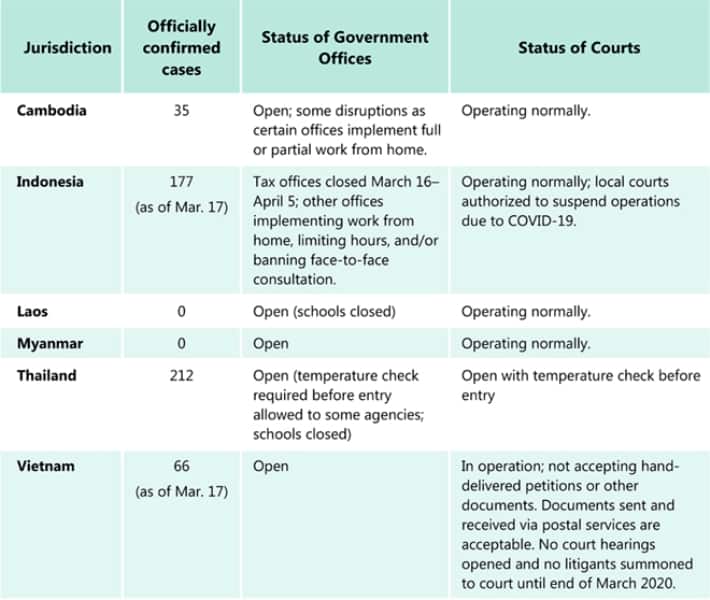
The effects of the global COVID-19 pandemic on Southeast Asia are a deep concern shared by all with connections to the region. To encourage clear understanding of the facts on the ground, Tilleke & Gibbins has prepared this high-level snapshot of the legal situation as it currently stands in each of our jurisdictions.

Administrative and Judicial Functions
Travel Restrictions

Cambodia
The government has imposed the following:

  • Ban on incoming foreign nationals traveling from France, Germany, Iran, Italy, Spain, and the USA for 30 days, effective from March 17, 2020 (or from March 18 for Iran only).
  • Mandatory 14-day self-quarantine for Cambodian citizens traveling from European countries, Iran, or the USA required.
  • Restriction on Cambodian public officials attending meetings in European countries, Iran, or the USA.
  • Ban on entry of cruise ships via Kaam Samnor International Border.

Indonesia
The government has imposed the following:

  • Cancellation of all direct flights to and from China.
  • Suspensions of all visa-on-arrival allowances for one month starting March 20, 2020.
  • Restrictions on incoming travelers who have been in any of the following countries within 14 days of arrival: China, France, Germany, Iran, Italy, South Korea, Spain, Switzerland, the UK, and Vatican City.

Laos
Various border checkpoints have been closed. Further recommendations for travelers from certain affected areas have been issued by the National Taskforce Committee for COVID-19 Prevention and Control on March 16. However, prohibitions, restrictions, and mandatory actions are not formally in place.

Myanmar
An announcement made on March 15, 2020, applies requirements to travelers coming from the following countries:

Thailand
Incoming travelers with a temperature of 37.5 degrees Celsius or higher, and with any symptom associated with COVID-19, will be taken to a hospital approved by the Ministry of Public Health for testing, diagnosis, isolation, and quarantine as necessary.

For all other incoming travelers, the following measures apply:

  • Mandatory 14-day self-quarantine for travelers arriving from China (including Hong Kong and Macau), Iran, Italy, and South Korea.
  • Mandatory self-monitoring and reporting of symptoms in the Ministry of Public Health system for travelers arriving from Denmark, France, Germany, Netherlands, Norway, Spain, Sweden, Switzerland, the UK, and the USA. In addition, travelers from these countries must notify a disease control officer of their location and itinerary so their movements and contacts can be monitored.
  • All of the above incoming travelers must inform a disease control officer immediately upon the onset of any symptom associated with COVID-19.

As for outbound travelers, no blanket restriction has been issued for government employees, but many individual agencies have issued such prohibitions.

Vietnam
As of March 18, 2020, the following measures are in effect:

  • Visas on arrival suspended for all foreign nationals.
  • Travelers entering with visa exemption certificates granted to overseas Vietnamese (Viet Kieu), their relatives, and some other special cases (such as experts, business managers, and skilled workers) must have a certificate proving they have tested negative for the COVID-19 virus. The certificate must be issued by the relevant authority of the host country and also approved by Vietnam, except for those on official or diplomatic trips.
  • All travelers from outside of Vietnam entering with a visa will be subject to health checks and a mandatory 14-day quarantine.

***********

Our primary professional concern, in all things, is for the wellbeing and commerciality of our clients. For that reason, we are implementing practical social distancing measures designed to ensure that we work together safely, effectively, and without change to the quality and efficiency of the services you receive. If you have any queries about these measures, or about any of the information given above, please contact [email protected].

RELATED INSIGHTS​ 

July 6, 2026
Indonesia’s regulation on reporting online intellectual property (IP) infringement provides comprehensive procedural guidance for IP rights holders and their licensees in reporting online infringement complaints. Issued in December 2025 by the Ministry of Law as Regulation No. 47 of 2025 regarding Handling of Intellectual Property Infringement Reports in Electronic Systems, this regulation covers all types of IP rights. It also specifies documentation when reporting infringement, and lays out the procedures for examination, verification, and enforcement actions. Submission of Complaints Complainants may submit reports through the online system of the Directorate General of Intellectual Property (DGIP) or in person at the DGIP office. Complaints may also be filed through an authorized proxy. Under the regulation, complainants are required to provide the following information and documents: Personal details of the complainant; Brief description of the protected work or subject matter (i.e., type of IP and name or address of the infringing website, portal, account, or application, or a link to the location of the infringing content); Complete description of the alleged infringement; Certificate of registration or recordal of the relevant IP; Recordal of IP license agreement, if any; and Other supporting evidence. Verification and Examination Process Upon receiving a complaint, the responsible formality officer may request clarification or additional supporting documents. In the latter case, the complainant must then submit the necessary administrative documents within 14 days of the notification date. Once the documentation is deemed complete and sufficient, the case will be formally registered. Subsequently, the DGIP will establish a verification team to handle online IP violations, which will include the Civil Servant Investigator (PPNS), the Ministry of Communication and Digital Affairs, experts with relevant expertise in IP, and representatives from related associations such as AVISI (Indonesian Video Streaming Association). After examining the report, the team will prepare the Minutes
July 6, 2026
Tilleke & Gibbins has contributed the Vietnam chapter to Data Protection & Privacy 2027, a global guide published by Lexology Panoramic that provides comparative insights into data protection and privacy regimes across multiple jurisdictions. The Vietnam chapter offers a comprehensive overview of the country’s data protection framework, addressing both regulatory structure and practical compliance considerations for businesses operating in or engaging with Vietnam. Topics covered include: Law and the regulatory authority: Legislative framework; data protection authority; cooperation with other data protection authorities; breaches of data protection law; judicial review of data protection authority orders Scope: Exempt sectors and institutions; interception of communications and surveillance laws; other laws; personal information formats; extraterritoriality; covered uses of personal information Legitimate processing of personal information: Lawful bases for processing; grounds for legitimate processing; types of personal information Data handling responsibilities of owners of personal information: Transparency; exemptions from transparency obligations; data accuracy; data minimization; data retention; purpose limitation; automated decision-making Security: Security obligations; notification of data breaches; internal controls Accountability: Data protection officer requirements; record-keeping; risk assessment; design of personal information processing systems Registration and notification: Registration requirements; other transparency duties Sharing and cross-border transfers of personal information: Sharing with processors and service providers; restrictions on third-party disclosures; cross-border transfers; further transfers; localization requirements Rights of individuals: Right of access; other statutory rights; compensation Enforcement: Enforcement mechanisms; exemptions, derogations, and restrictions; further exemptions and restrictions Specific data processing: Cookies and similar technologies; electronic communications marketing; targeted advertising; sensitive personal information; profiling; cloud services The chapter concludes with an update on key legal and regulatory developments over the past year and emerging trends in Vietnam’s data protection landscape. The full Vietnam chapter is available as a PDF through the button below. Readers can also gain 30 days of complementary access to the full Data
July 2, 2026
Thailand’s Electronic Transactions Development Agency (ETDA) released a new version of the draft Act on Artificial Intelligence on July 2, 2026, for a public hearing period expected to be approximately 30 days. The draft act adopts a risk-based regulatory approach modeled in part on international frameworks—particularly the EU’s AI Act—while incorporating provisions tailored to Thailand’s regulatory landscape and digital economy objectives. If enacted in its current form, the law would introduce extraterritorial obligations, a tiered risk classification system, strict liability for AI-related damages, and new transparency requirements for AI-generated content. Scope and Extraterritorial Application The draft act applies to AI development, deployment, or any other action affecting people in Thailand, even if the action occurs outside the country. Of note: This extraterritorial reach creates compliance obligations for global AI companies whose systems impact Thai residents or consumers, even if the provider has no physical presence in Thailand. Foreign AI providers serving Thai deployers or users must appoint a local coordinator or authorized representative. Depending on the type of AI system, the representative may need full authority to act on behalf of the provider without any limitation of liability. Certain activities are exempt from the draft act’s oversight, including AI used by natural persons solely for personal or household activities, AI for educational research conducted by higher education institutions with ethics committee approval, research and development activities conducted prior to distribution or service provision, and other AI systems prescribed by royal decree. Risk-Based Classification Framework The draft act establishes a tiered risk classification system with three main categories: Prohibited AI. The act outright prohibits AI systems employing cognitive-behavioral manipulation using subliminal techniques, AI systems causing unfair broad-scale discrimination from processing irrelevant data, and other categories of serious risk as determined by announcement of a forthcoming committee that will be responsible
July 1, 2026
Obtaining marketing authorization is a fundamental requirement for bringing pharmaceutical products to the Thai market. Companies must navigate the Thai Food and Drug Administration’s registration procedures while also complying with post-approval pharmacovigilance obligations, licensing requirements for manufacturing and importation, data protection rules, and other regulatory requirements. This guide provides an overview of Thailand’s regulatory framework for pharmaceutical marketing authorization, including available registration pathways, review timelines, application fees, postmarketing surveillance obligations, licensing requirements, exemptions, data exclusivity, freedom of information, and parallel import considerations. It is intended as a practical reference for pharmaceutical companies, regulatory affairs professionals, and others involved in bringing medicinal products to the Thai market. Download the guide below for a concise overview of the current requirements and procedures governing pharmaceutical marketing authorization in Thailand.