
You are using an outdated browser and your browsing experience will not be optimal. Please update to the latest version of Microsoft Edge, Google Chrome or Mozilla Firefox. Install Microsoft Edge

March 19, 2020

COVID-19 Status Update for Southeast Asia – March 18, 2020

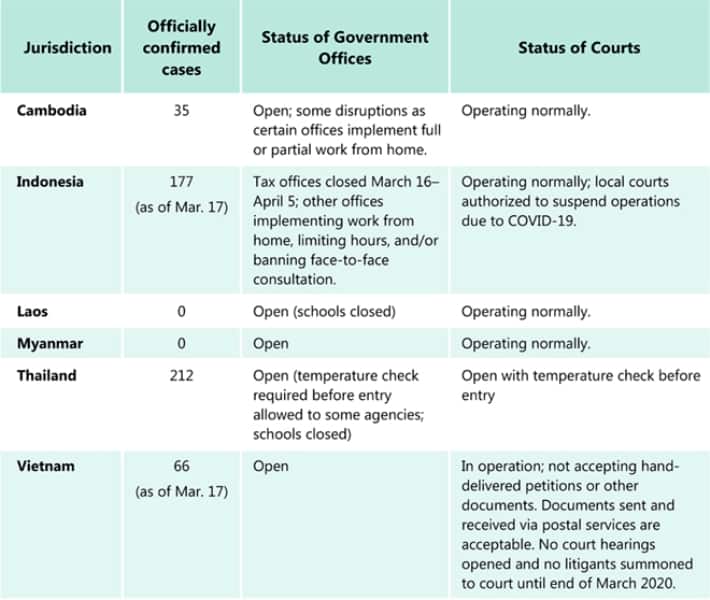
The effects of the global COVID-19 pandemic on Southeast Asia are a deep concern shared by all with connections to the region. To encourage clear understanding of the facts on the ground, Tilleke & Gibbins has prepared this high-level snapshot of the legal situation as it currently stands in each of our jurisdictions.

Administrative and Judicial Functions
Travel Restrictions

Cambodia
The government has imposed the following:

  • Ban on incoming foreign nationals traveling from France, Germany, Iran, Italy, Spain, and the USA for 30 days, effective from March 17, 2020 (or from March 18 for Iran only).
  • Mandatory 14-day self-quarantine for Cambodian citizens traveling from European countries, Iran, or the USA required.
  • Restriction on Cambodian public officials attending meetings in European countries, Iran, or the USA.
  • Ban on entry of cruise ships via Kaam Samnor International Border.

Indonesia
The government has imposed the following:

  • Cancellation of all direct flights to and from China.
  • Suspensions of all visa-on-arrival allowances for one month starting March 20, 2020.
  • Restrictions on incoming travelers who have been in any of the following countries within 14 days of arrival: China, France, Germany, Iran, Italy, South Korea, Spain, Switzerland, the UK, and Vatican City.

Laos
Various border checkpoints have been closed. Further recommendations for travelers from certain affected areas have been issued by the National Taskforce Committee for COVID-19 Prevention and Control on March 16. However, prohibitions, restrictions, and mandatory actions are not formally in place.

Myanmar
An announcement made on March 15, 2020, applies requirements to travelers coming from the following countries:

Thailand
Incoming travelers with a temperature of 37.5 degrees Celsius or higher, and with any symptom associated with COVID-19, will be taken to a hospital approved by the Ministry of Public Health for testing, diagnosis, isolation, and quarantine as necessary.

For all other incoming travelers, the following measures apply:

  • Mandatory 14-day self-quarantine for travelers arriving from China (including Hong Kong and Macau), Iran, Italy, and South Korea.
  • Mandatory self-monitoring and reporting of symptoms in the Ministry of Public Health system for travelers arriving from Denmark, France, Germany, Netherlands, Norway, Spain, Sweden, Switzerland, the UK, and the USA. In addition, travelers from these countries must notify a disease control officer of their location and itinerary so their movements and contacts can be monitored.
  • All of the above incoming travelers must inform a disease control officer immediately upon the onset of any symptom associated with COVID-19.

As for outbound travelers, no blanket restriction has been issued for government employees, but many individual agencies have issued such prohibitions.

Vietnam
As of March 18, 2020, the following measures are in effect:

  • Visas on arrival suspended for all foreign nationals.
  • Travelers entering with visa exemption certificates granted to overseas Vietnamese (Viet Kieu), their relatives, and some other special cases (such as experts, business managers, and skilled workers) must have a certificate proving they have tested negative for the COVID-19 virus. The certificate must be issued by the relevant authority of the host country and also approved by Vietnam, except for those on official or diplomatic trips.
  • All travelers from outside of Vietnam entering with a visa will be subject to health checks and a mandatory 14-day quarantine.

***********

Our primary professional concern, in all things, is for the wellbeing and commerciality of our clients. For that reason, we are implementing practical social distancing measures designed to ensure that we work together safely, effectively, and without change to the quality and efficiency of the services you receive. If you have any queries about these measures, or about any of the information given above, please contact [email protected].

RELATED INSIGHTS​ 

July 28, 2026
Data protection officers (DPOs) have become a fixture of Thailand’s privacy compliance landscape since the Personal Data Protection Act B.E. 2562 (2019) (PDPA) took full effect and the Office of the Personal Data Protection Committee (PDPC) began requiring certain organizations to appoint them. On July 7, 2026, the Office of the PDPC presented draft guidance on DPOs as part of a public consultation on a series of draft personal data protection manuals and recommendations. The draft offers the clearest indication yet of how the regulator expects the DPO role to work in practice, addressing recurring implementation issues under the PDPA—including when an organization must appoint a DPO, how the DPO should operate independently, how to manage conflicts of interest, and how data subjects and regulators should be able to contact the DPO. Because it remains in draft, organizations have an opportunity to weigh the practical implications now before the guidance is finalized. When a DPO Must Be Appointed The draft guidance clarifies the triggers for mandatory DPO appointment, including: Regular and systematic monitoring of personal data or systems on a large scale, such as tracking, analyzing, or predicting behavior, attitudes, or individual characteristics. Core activities involving large-scale processing of sensitive personal data, such as health data, biometric data, or criminal records. Certain foreign-organization representative arrangements. Public-sector coverage under relevant notifications identifying government entities that must appoint a DPO. Processing involving 100,000 or more data subjects may be considered large-scale. The guidance also contemplates voluntary DPO appointment for organizations that wish to raise their privacy governance standards, and such organizations should still comply with the standards applicable to DPOs under the law. Independence and Reporting Lines The draft guidance identifies lack of DPO independence as a core risk because an ineffective or constrained DPO may be unable to raise deficiencies
July 27, 2026
Vietnam’s new E-Commerce Law, which took effect on 1 July 2026 along with its implementing Decree No. 248/2026/ND-CP (Decree 248), marks a significant development in the country’s approach to online intellectual property (IP) enforcement, reflecting a clear shift from a reactive model of intermediary liability to one that expects platforms to play a more active role in preventing infringement. From notice-and-takedown to platform responsibility The most significant change introduced by the E-Commerce Law is the transformation of the legal role of e-commerce platforms. The existing safe harbor provisions under the IP Law and the copyright notice-and-takedown regime established by Decree 17/2023/ND-CP (Decree 17) largely required intermediaries to act only after receiving notice of infringement. Once infringing content had been removed, the platform’s legal obligation was generally considered fulfilled. The new legislation adopts a fundamentally different approach. Article 17 of the E-Commerce Law requires intermediary platforms to screen information relating to goods and services before publication in order to prevent listings involving counterfeit or IP-infringing goods, and goods of unknown origin. Rather than relying exclusively on complaints from rights holders, platforms are now expected to implement preventive measures before infringing listings become publicly available. Decree 248 further requires platforms to update keyword filters based on recommendations issued by competent authorities. These filtering mechanisms are intended to prevent prohibited listings from appearing on the platform and represent a further move away from a purely complaint-driven enforcement model. The legislation also introduces Vietnam’s first statutory stay-down obligation. Under the E-Commerce Law and Decree 248, major digital platforms must maintain automated systems capable of reviewing, warning against, and removing unlawful listings while also implementing measures to prevent repeat violations, defined under Decree 248 as conduct that has previously been identified and handled by the platform, but continues to recur. This obligation addresses one
July 27, 2026
A new decree on penalties for violations related to the crypto asset market creates compliance risks for offshore crypto asset exchanges in Vietnam that do not hold, and practically cannot obtain, a Vietnamese license, and for Vietnamese users who continue to transact on those platforms. Decree No. 284/2026/ND-CP (Decree 284), issued by the government of Vietnam on July 16, 2026, formally establishes an administrative penalty framework for violations related to crypto assets and the crypto asset market. The decree takes effect on September 1, 2026, and will remain in force for the duration of the five-year pilot program under Resolution No. 05/2025/NQ-CP, which is scheduled to end in September 2030. Direct Penalties on Vietnamese Users The most immediate commercial risk to offshore platforms is that their Vietnamese users now face direct personal liability for using their exchanges. Vietnamese users who trade crypto assets outside of a Ministry of Finance-licensed service provider face fines of up to VND 50 million (approximately USD 1,900). Vietnamese users trading in crypto assets that are offered or issued to foreign users face higher penalties of up to VND 100 million (approximately USD 3,800). It is expected that Vietnamese users will be more willing to migrate away from offshore platforms now that there is a risk of real enforcement against them. Penalties on Unlicensed Service Providers Violations of providing crypto asset services or advertising crypto-related services without a license face fines of up to VND 200 million (approximately USD 7,700). Operating a crypto asset trading market without proper authorization falls within the same highest penalty bands. Organizations that violate issuance, provision, or disclosure rules may face fines of up to VND 200 million. Although the maximum administrative fine per violation is capped at VND 200 million for organizations and VND 100 million for individuals, these
July 24, 2026
As food innovation continues to accelerate, manufacturers are increasingly introducing ingredients derived from new sources, produced using novel technologies, or lacking a significant history of human consumption. While these innovations create new opportunities for the food industry, they also raise important questions regarding consumer safety. For this reason, many jurisdictions, including Thailand, the European Union, Australia and New Zealand, Canada, and Singapore, require a premarket safety assessment for novel food ingredients before they can be placed on the market. The objective of this assessment is to ensure that each ingredient is safe for its intended use and level of consumption, does not present toxicological, allergenic, microbiological, or nutritional concerns, and will not mislead consumers. Scientific authorities typically evaluate the ingredient’s identity, manufacturing process, composition, specifications, anticipated dietary exposure, toxicological information, nutritional impact, and history of use before determining whether it can be marketed. Against this background, the Thai Food and Drug Administration (FDA) recently took an important step toward improving regulatory transparency by publishing, for the first time, a consolidated public list of substances that have successfully completed the Thai FDA’s safety assessment process, including substances determined to be novel foods and those determined not to fall within the novel food category. The list identifies the approved substances, the corresponding manufacturers or importers, approval dates, and the approved conditions of use. Although the publication does not change the existing legal framework governing novel food approvals, it provides businesses with greater visibility into the Thai FDA’s regulatory precedents and the types of substances that have previously been accepted through the safety assessment process. The full announcement is available on the Thai FDA’s website. As the list is now publicly available, it also provides useful insight into the types of substances that have successfully completed the Thai FDA’s safety assessment process.