
You are using an outdated browser and your browsing experience will not be optimal. Please update to the latest version of Microsoft Edge, Google Chrome or Mozilla Firefox. Install Microsoft Edge

March 19, 2020

COVID-19 Status Update for Southeast Asia – March 18, 2020

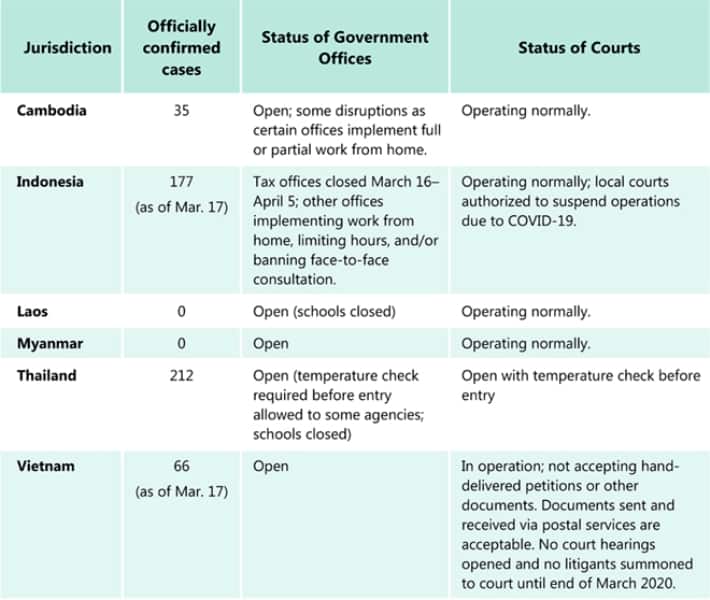
The effects of the global COVID-19 pandemic on Southeast Asia are a deep concern shared by all with connections to the region. To encourage clear understanding of the facts on the ground, Tilleke & Gibbins has prepared this high-level snapshot of the legal situation as it currently stands in each of our jurisdictions.

Administrative and Judicial Functions
Travel Restrictions

Cambodia
The government has imposed the following:

  • Ban on incoming foreign nationals traveling from France, Germany, Iran, Italy, Spain, and the USA for 30 days, effective from March 17, 2020 (or from March 18 for Iran only).
  • Mandatory 14-day self-quarantine for Cambodian citizens traveling from European countries, Iran, or the USA required.
  • Restriction on Cambodian public officials attending meetings in European countries, Iran, or the USA.
  • Ban on entry of cruise ships via Kaam Samnor International Border.

Indonesia
The government has imposed the following:

  • Cancellation of all direct flights to and from China.
  • Suspensions of all visa-on-arrival allowances for one month starting March 20, 2020.
  • Restrictions on incoming travelers who have been in any of the following countries within 14 days of arrival: China, France, Germany, Iran, Italy, South Korea, Spain, Switzerland, the UK, and Vatican City.

Laos
Various border checkpoints have been closed. Further recommendations for travelers from certain affected areas have been issued by the National Taskforce Committee for COVID-19 Prevention and Control on March 16. However, prohibitions, restrictions, and mandatory actions are not formally in place.

Myanmar
An announcement made on March 15, 2020, applies requirements to travelers coming from the following countries:

Thailand
Incoming travelers with a temperature of 37.5 degrees Celsius or higher, and with any symptom associated with COVID-19, will be taken to a hospital approved by the Ministry of Public Health for testing, diagnosis, isolation, and quarantine as necessary.

For all other incoming travelers, the following measures apply:

  • Mandatory 14-day self-quarantine for travelers arriving from China (including Hong Kong and Macau), Iran, Italy, and South Korea.
  • Mandatory self-monitoring and reporting of symptoms in the Ministry of Public Health system for travelers arriving from Denmark, France, Germany, Netherlands, Norway, Spain, Sweden, Switzerland, the UK, and the USA. In addition, travelers from these countries must notify a disease control officer of their location and itinerary so their movements and contacts can be monitored.
  • All of the above incoming travelers must inform a disease control officer immediately upon the onset of any symptom associated with COVID-19.

As for outbound travelers, no blanket restriction has been issued for government employees, but many individual agencies have issued such prohibitions.

Vietnam
As of March 18, 2020, the following measures are in effect:

  • Visas on arrival suspended for all foreign nationals.
  • Travelers entering with visa exemption certificates granted to overseas Vietnamese (Viet Kieu), their relatives, and some other special cases (such as experts, business managers, and skilled workers) must have a certificate proving they have tested negative for the COVID-19 virus. The certificate must be issued by the relevant authority of the host country and also approved by Vietnam, except for those on official or diplomatic trips.
  • All travelers from outside of Vietnam entering with a visa will be subject to health checks and a mandatory 14-day quarantine.

***********

Our primary professional concern, in all things, is for the wellbeing and commerciality of our clients. For that reason, we are implementing practical social distancing measures designed to ensure that we work together safely, effectively, and without change to the quality and efficiency of the services you receive. If you have any queries about these measures, or about any of the information given above, please contact [email protected].

RELATED INSIGHTS​ 

July 24, 2026
For businesses in Thailand’s regulated industries, the problem of “too many licenses” is one of the most familiar hurdles to getting a product to market. Take a simple example: importing the materials necessary to sell teriyaki chicken skewers. To legally do this, a business may need approvals from several different agencies—separate permits for the chicken (Department of Livestock Development), the dipping sauce (Thai FDA), the wooden skewers (Department of Forestry), and other ingredients, each under a different authority. This kind of overlap is often cited to argue for a “regulatory guillotine”—a systematic review to cut outdated or duplicative rules that slow investment and business activity. The Facilitation of Licensing and Public Service Consideration Act B.E. 2569 (2026) (Licensing Facilitation Act 2026) is Thailand’s most significant response yet to that concern. This article looks at the Facilitation Act 2026 through a life sciences and regulatory affairs lens—what it may mean for the manufacturers, importers, and distributors of food, drugs, medical devices, cosmetics, and similar products who routinely deal with several regulators to bring a single product to market. The Super License: One Approval Standing in for Many The reform with the clearest potential for regulated-product businesses is the law’s “super license” mechanism, referred to as a “main license” in the statute. Once a business obtains the main license for a regulated activity, it is automatically deemed to hold all related sublicenses issued by other agencies for that same activity, provided the activity has been designated as eligible in the Government Gazette. The Licensing Facilitation Act 2026 also creates a central application center, allowing applicants to submit a single application and pay all relevant fees at one point of contact, with the center routing the application to each agency through a shared information system. The potential benefits of this for businesses
July 23, 2026
Tilleke & Gibbins’ Bangkok-based aviation specialists have authored the Thailand chapter of Aviation Finance & Leasing 2026 from Chambers and Partners. This annual guide examines the key legal issues impacting aircraft lessors, lessees, and financiers in nearly 40 jurisdictions worldwide. In addition to the Thailand chapter, Tilleke & Gibbins also contributed the Vietnam chapter to this year’s edition. The Thailand chapter offers a comprehensive overview of the country’s legal framework governing all aspects of aircraft sale and purchase, aircraft and engine leasing, and aircraft debt finance. Some topics covered include: sale and lease agreement terms taxation lease registration and enforcement lease assignment/novation insurance and reinsurance debt structuring securities liens The guide also examines other matters with practical implications for the aviation industry’s day-to-day operations. Chambers and Partners’ Global Practice Guides provide in-house counsel with authoritative commentary on practical legal issues affecting business, enabling readers to compare legislation and procedures across multiple jurisdictions. The Thailand chapter of Aviation Finance & Leasing 2026 is available as a PDF through the button below. The full guide can be accessed for free on the Chambers and Partners website.
July 23, 2026
Aviation law experts from Tilleke & Gibbins’ Vietnam offices have prepared the Vietnam chapter of Aviation Finance & Leasing 2026 from Chambers and Partners. Covering nearly 40 jurisdictions worldwide, the guide addresses key legal considerations for aircraft lessors, lessees, and financiers. Alongside the Vietnam chapter, Tilleke & Gibbins also provided the Thailand chapter for this year’s edition. The Vietnam chapter delivers detailed insights into the legal environment affecting aircraft sale and purchase, aircraft and engine leasing, and aircraft debt finance. Some of the topics it examines include: sale and lease agreement terms taxation lease registration and enforcement lease assignment/novation insurance and reinsurance debt structuring securities liens The guide also covers other issues influencing the day-to-day activities of aviation industry participants in Vietnam. Chambers and Partners’ Global Practice Guides provide in-house counsel with authoritative analysis of practical legal matters impacting business, enabling readers to compare legislation and relevant procedures across leading jurisdictions. The Vietnam chapter of Aviation Finance & Leasing 2026 is available as a PDF through the button below. The full guide can be accessed for free on the Chambers and Partners website.
July 21, 2026
Thailand’s Ministry of Digital Economy and Society (MDES) published a notification establishing an expedited court-ordered takedown mechanism for online content in cases of “urgent necessity.” The notification, which was issued on July 17, 2026, under the Computer Crime Act B.E. 2550 (2007), as amended, took effect the following day. It significantly expands the categories of content subject to rapid government-initiated removal. Content Categories Subject to Takedown The notification defines “urgent necessity” (section 20, paragraph 5, of the Computer Crime Act) as circumstances where any delay in suppressing computer data may impact national security, religion, the monarchy, good morals, social culture, or public order. In this regard, it establishes four broad categories of content: Computer Crime Act offenses. National security offenses. IP and other criminal offenses, where it is contrary to public order or good morals and a competent officer has requested its suppression. Content contrary to public order or good morals, a broad residual category encompassing 14 subcategories approved by the Computer Data Screening Committee. The fourth category is the most expansive. Its 14 subcategories include: Content defaming, mocking, satirizing, or devaluing the monarchy. Online gambling advertising or facilitation. Offering illegal firearms for sale. Offering baraku (hookah) products or e-cigarettes for sale. Offering cannabis inflorescences or processed cannabis products for sale. Advertising or soliciting prostitution. Content inciting violence, hatred, or social division. Unauthorized overseas employment advertising. Offering boiled kratom juice for sale. Online sale or advertising of alcoholic beverages. Content satirizing or degrading Buddhism. Money lending at interest rates exceeding legally prescribed limits. Advertising or disseminating information about surrogacy services. Forgery of documents, cards, or official documents. Enforcement Procedure In cases of urgent necessity, a competent official assigned by the MDES permanent secretary must file a petition with supporting evidence to the court with jurisdiction, requesting an order to