
You are using an outdated browser and your browsing experience will not be optimal. Please update to the latest version of Microsoft Edge, Google Chrome or Mozilla Firefox. Install Microsoft Edge

March 19, 2020

COVID-19 Status Update for Southeast Asia – March 18, 2020

The effects of the global COVID-19 pandemic on Southeast Asia are a deep concern shared by all with connections to the region. To encourage clear understanding of the facts on the ground, Tilleke & Gibbins has prepared this high-level snapshot of the legal situation as it currently stands in each of our jurisdictions.

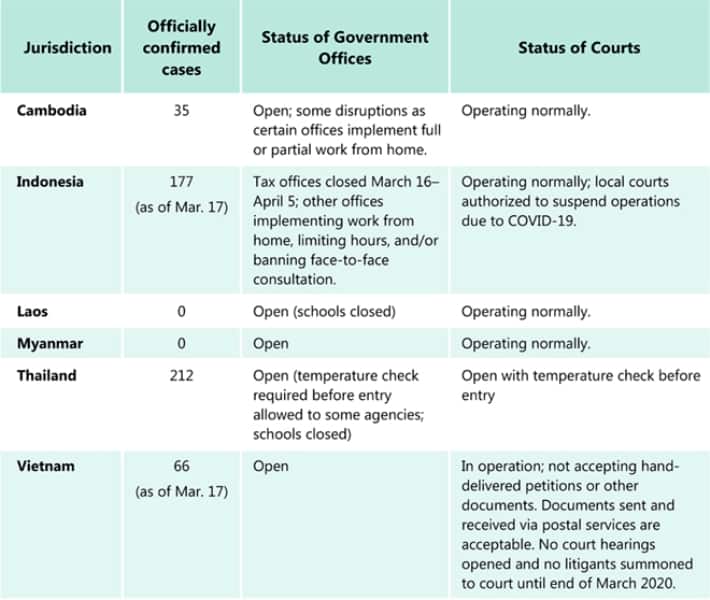
Administrative and Judicial Functions
Travel Restrictions

Cambodia
The government has imposed the following:

  • Ban on incoming foreign nationals traveling from France, Germany, Iran, Italy, Spain, and the USA for 30 days, effective from March 17, 2020 (or from March 18 for Iran only).
  • Mandatory 14-day self-quarantine for Cambodian citizens traveling from European countries, Iran, or the USA required.
  • Restriction on Cambodian public officials attending meetings in European countries, Iran, or the USA.
  • Ban on entry of cruise ships via Kaam Samnor International Border.

Indonesia
The government has imposed the following:

  • Cancellation of all direct flights to and from China.
  • Suspensions of all visa-on-arrival allowances for one month starting March 20, 2020.
  • Restrictions on incoming travelers who have been in any of the following countries within 14 days of arrival: China, France, Germany, Iran, Italy, South Korea, Spain, Switzerland, the UK, and Vatican City.

Laos
Various border checkpoints have been closed. Further recommendations for travelers from certain affected areas have been issued by the National Taskforce Committee for COVID-19 Prevention and Control on March 16. However, prohibitions, restrictions, and mandatory actions are not formally in place.

Myanmar
An announcement made on March 15, 2020, applies requirements to travelers coming from the following countries:

Thailand
Incoming travelers with a temperature of 37.5 degrees Celsius or higher, and with any symptom associated with COVID-19, will be taken to a hospital approved by the Ministry of Public Health for testing, diagnosis, isolation, and quarantine as necessary.

For all other incoming travelers, the following measures apply:

  • Mandatory 14-day self-quarantine for travelers arriving from China (including Hong Kong and Macau), Iran, Italy, and South Korea.
  • Mandatory self-monitoring and reporting of symptoms in the Ministry of Public Health system for travelers arriving from Denmark, France, Germany, Netherlands, Norway, Spain, Sweden, Switzerland, the UK, and the USA. In addition, travelers from these countries must notify a disease control officer of their location and itinerary so their movements and contacts can be monitored.
  • All of the above incoming travelers must inform a disease control officer immediately upon the onset of any symptom associated with COVID-19.

As for outbound travelers, no blanket restriction has been issued for government employees, but many individual agencies have issued such prohibitions.

Vietnam
As of March 18, 2020, the following measures are in effect:

  • Visas on arrival suspended for all foreign nationals.
  • Travelers entering with visa exemption certificates granted to overseas Vietnamese (Viet Kieu), their relatives, and some other special cases (such as experts, business managers, and skilled workers) must have a certificate proving they have tested negative for the COVID-19 virus. The certificate must be issued by the relevant authority of the host country and also approved by Vietnam, except for those on official or diplomatic trips.
  • All travelers from outside of Vietnam entering with a visa will be subject to health checks and a mandatory 14-day quarantine.

***********

Our primary professional concern, in all things, is for the wellbeing and commerciality of our clients. For that reason, we are implementing practical social distancing measures designed to ensure that we work together safely, effectively, and without change to the quality and efficiency of the services you receive. If you have any queries about these measures, or about any of the information given above, please contact [email protected].

RELATED INSIGHTS​ 

March 13, 2026
Vietnam’s Law on Intellectual Property (IP Law) has undergone continuous amendment in recent years, with the latest amendment issued at the end of 2025. Among the amended and supplemented provisions, the regulation that has perhaps attracted the most attention is a provision relating to the use of protected IP objects by artificial intelligence (AI) systems. Specifically, Article 7 of the 2025 IP Law introduces a completely new Clause 5, which reads in full as follows: “Organizations and individuals are permitted to use texts and data relating to intellectual property objects that have been lawfully published, and which the public is allowed to access, for the purposes of scientific research, experimentation, and training of artificial intelligence systems, provided that such use will not unreasonably affect the legitimate rights and interests of the authors and intellectual property rights holders in accordance with this Law. With respect to texts and data that are objects protected by copyright and related rights, the use of the texts and data as set forth herein must also be in accordance with the regulations of the Government.” Analyzing this newly added provision in the context of how it was conceived, as well as the challenges that still lie ahead, can provide some interesting insights. From Aspirations to Flight in Science and Technology From the end of 2024 and throughout 2025—the 50th anniversary of the country’s reunification—Vietnam witnessed numerous sweeping changes in many areas, including legislative development. It could be said that no sessions of the National Assembly have ever adopted as many laws, resolutions, and major policies as this one. The aspirations of the highest-level leadership have been concretized into major law and policy projects, which were drafted, developed, and passed at record speed. All of this was aimed at building a foundation for Vietnam to achieve
March 12, 2026
Thailand’s AI legislative framework took another step forward when the Office of the Consumer Protection Board (OCPB) issued a notification establishing guidelines for AI-generated advertising that may cause material misunderstanding about products or services. The notification, which is already in effect, was issued under the Consumer Protection Act B.E. 2522 (1979) and its amendments, which prohibit advertising that is unfair to consumers or may cause harm to society, including false or exaggerated statements and statements that may cause material misunderstanding about products or services. The notification addresses emerging advertising practices, including the use of images edited using software or AI to attract consumer interest or build credibility. The OCPB noted that such advertising may result in consumers misunderstanding the essential characteristics, condition, or usage of products, which violates consumer rights and causes damage. Key Requirements on AI-Generated or Digitally Manipulated Advertising Content For advertisements using still images or videos created or edited with software programs or AI tools that may cause the depicted product or service to differ from the actual product sold or service provided—which may cause misunderstanding regarding the condition, quality, quantity, or other essential aspects of the products or services—advertisers and business operators must comply with the following requirements: Prior authorization. Obtain approval from relevant regulatory authorities where required by law. Accurate representation. Ensure that the advertised size, quantity, volume, number, or composition matches the actual product or service being sold, whether in still images or videos. Mandatory AI disclosure labels. Display clear disclosures when AI or software is used to create or edit images, such as: “Real image or simulation edited using AI” “Photo from actual location or simulation edited using AI” “Photo from actual product or edited simulation” “Image created by AI” “Video created by AI” Clarity of disclosure. Ensure disclosures are clearly visible,
March 10, 2026
Thailand’s Ministry of Finance and Securities and Exchange Commission (SEC) have issued regulations broadening the criteria for determining who qualifies as a “major shareholder” of licensed securities and digital asset business operators. Under relevant SEC regulations, major shareholders of a regulated entity must obtain regulatory approval and undergo screening by the SEC. The revised framework introduces both shareholding-based and control-based tests to determine which shareholders require regulatory approval for a wider range of indirect ownership structures and de facto control. The Ministry of Finance notification took effect on February 21, 2026, while the SEC’s clarifying rules took effect on March 4, 2026. These changes aim to enhance transparency around beneficial ownership and strengthen regulatory oversight of entities operating in Thailand’s capital markets. Expanded Definition Under the revised framework, a “major shareholder” now includes persons who directly or indirectly hold more than 10% of the voting rights in a regulated company, as well as persons who exercise control over the regulated company or its shares. This system of two separate tests, based on both shareholding and control, differs from the prior regime, which focused primarily on shareholding thresholds and applied a more limited method for determining indirect shareholdings. The two tests (detailed below) operate independently of each other, and any person identified by either of the tests will be deemed a major shareholder. Shareholding-Based Test Broadens Indirect Ownership Attribution For the shareholding-based test, the SEC recognizes two existing methods for identifying indirect ownership, together with a new proportional attribution method. Any person captured under these methods, which are described below, will be regarded as a major shareholder of the regulated company and must obtain SEC approval as a major shareholder. First, the existing framework continues to apply to both first-tier and chain ownership structures. Approval is required for (1) first-tier
March 6, 2026
Thailand’s Legislation Consideration Committee of the Ministry of Interior has ruled that in-game loot boxes in online games do not constitute gambling under the Gambling Act B.E. 2478 (1935). This first-of-its-kind ruling provides useful guidance for online game operators and digital entertainment companies operating in Thailand. Background The ruling came in response to an inquiry concerning an online role-playing game operator that launched a campaign featuring a loot box mechanism. The mechanism allowed players to purchase a token in exchange for the opportunity to receive a virtual loot box containing randomized in-game items. The key features of this were as follows: The items received were digital, noncash items usable only within the game. The items could not be exchanged, redeemed, or converted into cash with the game operator. Items may differ in rarity but remain purely virtual. The central question was whether paying money to obtain randomized in-game items constituted a risk-based activity involving the chance to receive money or property of monetary value, which would constitute gambling under the Gambling Act. Committee Ruling The committee reached the following conclusions regarding the characteristics of the game’s loot-box mechanism: No cash or monetary equivalent: Players did not receive cash or property that could be exchanged for cash. The in-game items were merely usage rights within the online game ecosystem. No real-world monetary valuation: There was no determination of item value in real currency, and no mechanism for redeeming or converting items into money with the game operator. Any off-platform trading of in-game items between players is irrelevant to online game operators, as any value arising from such transactions is determined by the market rather than by the operators themselves. Service fee characterization: Payments made by players purchasing in-game loot boxes constituted fees for online game services. Accordingly, the committee concluded