
You are using an outdated browser and your browsing experience will not be optimal. Please update to the latest version of Microsoft Edge, Google Chrome or Mozilla Firefox. Install Microsoft Edge

March 19, 2020

COVID-19 Status Update for Southeast Asia – March 18, 2020

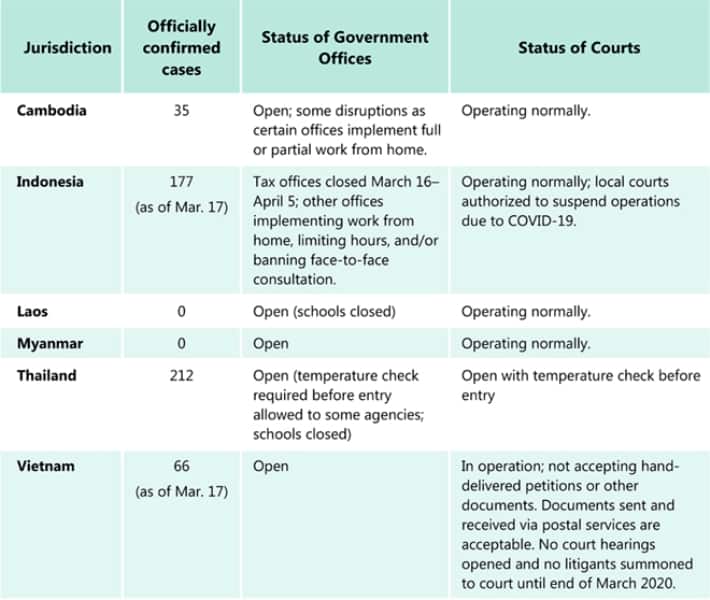
The effects of the global COVID-19 pandemic on Southeast Asia are a deep concern shared by all with connections to the region. To encourage clear understanding of the facts on the ground, Tilleke & Gibbins has prepared this high-level snapshot of the legal situation as it currently stands in each of our jurisdictions.

Administrative and Judicial Functions
Travel Restrictions

Cambodia
The government has imposed the following:

  • Ban on incoming foreign nationals traveling from France, Germany, Iran, Italy, Spain, and the USA for 30 days, effective from March 17, 2020 (or from March 18 for Iran only).
  • Mandatory 14-day self-quarantine for Cambodian citizens traveling from European countries, Iran, or the USA required.
  • Restriction on Cambodian public officials attending meetings in European countries, Iran, or the USA.
  • Ban on entry of cruise ships via Kaam Samnor International Border.

Indonesia
The government has imposed the following:

  • Cancellation of all direct flights to and from China.
  • Suspensions of all visa-on-arrival allowances for one month starting March 20, 2020.
  • Restrictions on incoming travelers who have been in any of the following countries within 14 days of arrival: China, France, Germany, Iran, Italy, South Korea, Spain, Switzerland, the UK, and Vatican City.

Laos
Various border checkpoints have been closed. Further recommendations for travelers from certain affected areas have been issued by the National Taskforce Committee for COVID-19 Prevention and Control on March 16. However, prohibitions, restrictions, and mandatory actions are not formally in place.

Myanmar
An announcement made on March 15, 2020, applies requirements to travelers coming from the following countries:

Thailand
Incoming travelers with a temperature of 37.5 degrees Celsius or higher, and with any symptom associated with COVID-19, will be taken to a hospital approved by the Ministry of Public Health for testing, diagnosis, isolation, and quarantine as necessary.

For all other incoming travelers, the following measures apply:

  • Mandatory 14-day self-quarantine for travelers arriving from China (including Hong Kong and Macau), Iran, Italy, and South Korea.
  • Mandatory self-monitoring and reporting of symptoms in the Ministry of Public Health system for travelers arriving from Denmark, France, Germany, Netherlands, Norway, Spain, Sweden, Switzerland, the UK, and the USA. In addition, travelers from these countries must notify a disease control officer of their location and itinerary so their movements and contacts can be monitored.
  • All of the above incoming travelers must inform a disease control officer immediately upon the onset of any symptom associated with COVID-19.

As for outbound travelers, no blanket restriction has been issued for government employees, but many individual agencies have issued such prohibitions.

Vietnam
As of March 18, 2020, the following measures are in effect:

  • Visas on arrival suspended for all foreign nationals.
  • Travelers entering with visa exemption certificates granted to overseas Vietnamese (Viet Kieu), their relatives, and some other special cases (such as experts, business managers, and skilled workers) must have a certificate proving they have tested negative for the COVID-19 virus. The certificate must be issued by the relevant authority of the host country and also approved by Vietnam, except for those on official or diplomatic trips.
  • All travelers from outside of Vietnam entering with a visa will be subject to health checks and a mandatory 14-day quarantine.

***********

Our primary professional concern, in all things, is for the wellbeing and commerciality of our clients. For that reason, we are implementing practical social distancing measures designed to ensure that we work together safely, effectively, and without change to the quality and efficiency of the services you receive. If you have any queries about these measures, or about any of the information given above, please contact [email protected].

RELATED INSIGHTS​ 

March 5, 2026
Thailand’s Securities and Exchange Commission (SEC) has filed a criminal complaint against a licensed digital asset broker, its overseas trading platform, and its executives for allegedly operating an unlicensed digital asset exchange targeting Thai customers. The case marks an escalation in the SEC’s enforcement efforts against unlicensed offshore platforms that attempt to serve Thai users through local licensed entities. Criminal Complaint On February 20, 2026, the SEC filed a criminal complaint with the Economic Crime Suppression Division against a local licensed digital asset broker, its overseas global trading platform, and its executives. The SEC alleges that the parties violated the Digital Asset Business Emergency Decree B.E. 2561 (2018) by cooperatively operating a digital asset exchange business on a cross-border basis since 2023 without the required SEC license. According to the SEC, the local broker promoted the overseas platform’s services to the public through Thai-language posts on social media channels, with services available exclusively to customers residing in Thailand. Access to the global platform was provided through the local broker’s website and mobile application. Customers who registered for the local broker’s services were automatically granted access to the global platform without having to undergo a separate identity verification process. The SEC also found that the local broker provided back-office system support services to the global platform. The SEC considers these activities to constitute joint operation of an unlicensed digital asset exchange. The former executives of the local broker are being held liable as the responsible persons during the relevant period. The SEC emphasized that the complaint initiates the criminal process, and the decision to prosecute or convict the accused parties will ultimately be made by law enforcement authorities and the criminal courts. Platform Blocking The SEC has also coordinated with the Ministry of Digital Economy and Society to block public
February 27, 2026
The Bank of Thailand (BOT) has officially implemented a new regulatory framework supervising systemically important retail payment systems (SIRPS), effective February 21, 2026, with PromptPay being the first payment system designated as a SIRPS. Under this new set of regulations, the BOT may designate payment systems under the Payment Systems Act B.E. 2560 (2017) as SIRPSs based on quantitative and qualitative assessments. Once a system is designated as a SIRPS, the operator becomes subject to expanded supervisory obligations beyond the general requirements of the Payment Systems Act. Enhanced Supervisory Requirements SIRPS operators must comply with a heightened supervisory regime across three key areas, outlined below. 1. Governance SIRPS operators must maintain robust and transparent governance structures, including: Balanced board composition, with at least one-third of the board comprising independent directors who represent stakeholders in the system (such as payment service providers, consumers, and experts). Independent directors may serve for no more than two consecutive terms. Subcommittees to assist the board in overseeing compliance, policy implementation, and operational strategy. Clear separation between executives responsible for risk and information security and those overseeing day-to-day business operations. Risk Management and System SecuritySIRPS operators must implement comprehensive risk management frameworks, including: Clear service agreements between the SIRPS operator and its direct participants (payment service providers who connect directly to the SIRPS), defining roles and responsibilities among stakeholders. These agreements must include obligations for direct SIRPS participants to supervise any indirect participants they onboard to ensure compliance with service agreements and business rules. A business continuity plan covering both IT and non-IT aspects, with annual review. The SIRPS must target service availability comparable to international payment infrastructures, including the ability to recover operations within two hours of a disruption and to maintain scalable operational capacity. Tools and controls to monitor and manage material or
February 26, 2026
Thailand is preparing to offer new tools for intellectual property enforcement as the Electronic Transactions Development Agency (ETDA) recently released for public consultation a draft notification requiring social media platforms to verify user identities and conduct know-your-customer (KYC) checks on advertisers. The draft Notification of the Electronic Transactions Commission on Measures to Prevent Technological Crimes for Social Media Service Providers, which is to be issued under the Emergency Decree on Measures for the Prevention and Suppression of Technological Crimes B.E. 2566 (2023), as amended in 2025, primarily aims to combat online fraud and technology-related crimes. However, its new obligations also provide IP owners with valuable tools to identify anonymous infringers. Key Regulatory Mandates The draft notification imposes several verification requirements on social media platforms operating in Thailand. These requirements also strengthen IP rights holders’ ability to identify anonymous infringers, as platforms must: Verify user identities through registered phone numbers and link all accounts to verifiable identities. Conduct KYC checks on advertisers, including individuals, companies, and any third-party payers. Perform heightened identity checks for high-risk or repeat offenders before publishing advertisements. Promptly remove content flagged by the Anti-Technology Crime Division and prescreen advertisements for prohibited or high-risk content. How IP Owners Can Use This Notification for Enforcement The phone number–based verification requirement enables IP owners to work more effectively with enforcement authorities in tracing individuals or entities responsible for infringing content. The comprehensive advertiser KYC obligations, including mandatory disclosure of third-party payment sources, create a clear audit trail even when bad actors attempt to obscure their identity through intermediaries or shell accounts. This traceability is essential for pursuing damages and dismantling organized counterfeit operations. The ETDA is now considering adjustments to the draft notification after receiving comments during the public consultation period, which ended on February 2, 2026. Following finalization
February 26, 2026
Laos’ Food and Drug Department (FDD) has been using a new online registration system for drugs since the beginning of the year. The system, which was implemented following the November 2025 issuance of Notice No. 5960/FDD, became the official pathway for submissions on January 1, 2026. Since that date, paper-based registrations have no longer been accepted. This marks a significant advancement in the digitalization of regulatory processes in Laos. As the online system is now the exclusive platform for registration, renewal, and amendments, companies that have not yet aligned their processes to the new system should act promptly to ensure a smooth transition. To assist with this, the FDD will conduct periodic training sessions on the use of the online registration system, which will be delivered either in person or remotely, depending on operator demand. To start using the system, drug and medical device manufacturers, as well as import-export companies, that have not yet registered must submit a formal request identifying the authorized personnel who will access the platform, after which they will be issued user accounts and access codes. Each request must be accompanied by the company’s enterprise registration certificate (incorporation certificate), a copy of the identity card or passport of each designated user, and a scanned copy of their signature. There is no restriction on the number of users per company, allowing flexibility to meet operational needs. Companies that already hold accounts and access codes from the trial phase may continue using them and may apply for additional accounts if needed. Additional Requirements The new system also introduces a standardized format for drug registration numbers. For example, an import drug registration number such as 06 I 4040/15 will be changed to 06-IM-04040-15, and a domestic drug registration number such as 06 L 4040/15 will be changed to