
You are using an outdated browser and your browsing experience will not be optimal. Please update to the latest version of Microsoft Edge, Google Chrome or Mozilla Firefox. Install Microsoft Edge

March 19, 2020

COVID-19 Status Update for Southeast Asia – March 18, 2020

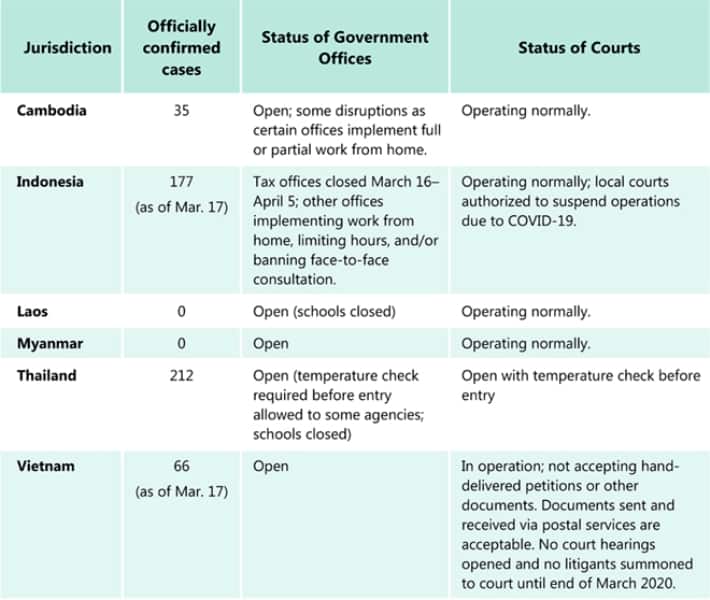
The effects of the global COVID-19 pandemic on Southeast Asia are a deep concern shared by all with connections to the region. To encourage clear understanding of the facts on the ground, Tilleke & Gibbins has prepared this high-level snapshot of the legal situation as it currently stands in each of our jurisdictions.

Administrative and Judicial Functions
Travel Restrictions

Cambodia
The government has imposed the following:

  • Ban on incoming foreign nationals traveling from France, Germany, Iran, Italy, Spain, and the USA for 30 days, effective from March 17, 2020 (or from March 18 for Iran only).
  • Mandatory 14-day self-quarantine for Cambodian citizens traveling from European countries, Iran, or the USA required.
  • Restriction on Cambodian public officials attending meetings in European countries, Iran, or the USA.
  • Ban on entry of cruise ships via Kaam Samnor International Border.

Indonesia
The government has imposed the following:

  • Cancellation of all direct flights to and from China.
  • Suspensions of all visa-on-arrival allowances for one month starting March 20, 2020.
  • Restrictions on incoming travelers who have been in any of the following countries within 14 days of arrival: China, France, Germany, Iran, Italy, South Korea, Spain, Switzerland, the UK, and Vatican City.

Laos
Various border checkpoints have been closed. Further recommendations for travelers from certain affected areas have been issued by the National Taskforce Committee for COVID-19 Prevention and Control on March 16. However, prohibitions, restrictions, and mandatory actions are not formally in place.

Myanmar
An announcement made on March 15, 2020, applies requirements to travelers coming from the following countries:

Thailand
Incoming travelers with a temperature of 37.5 degrees Celsius or higher, and with any symptom associated with COVID-19, will be taken to a hospital approved by the Ministry of Public Health for testing, diagnosis, isolation, and quarantine as necessary.

For all other incoming travelers, the following measures apply:

  • Mandatory 14-day self-quarantine for travelers arriving from China (including Hong Kong and Macau), Iran, Italy, and South Korea.
  • Mandatory self-monitoring and reporting of symptoms in the Ministry of Public Health system for travelers arriving from Denmark, France, Germany, Netherlands, Norway, Spain, Sweden, Switzerland, the UK, and the USA. In addition, travelers from these countries must notify a disease control officer of their location and itinerary so their movements and contacts can be monitored.
  • All of the above incoming travelers must inform a disease control officer immediately upon the onset of any symptom associated with COVID-19.

As for outbound travelers, no blanket restriction has been issued for government employees, but many individual agencies have issued such prohibitions.

Vietnam
As of March 18, 2020, the following measures are in effect:

  • Visas on arrival suspended for all foreign nationals.
  • Travelers entering with visa exemption certificates granted to overseas Vietnamese (Viet Kieu), their relatives, and some other special cases (such as experts, business managers, and skilled workers) must have a certificate proving they have tested negative for the COVID-19 virus. The certificate must be issued by the relevant authority of the host country and also approved by Vietnam, except for those on official or diplomatic trips.
  • All travelers from outside of Vietnam entering with a visa will be subject to health checks and a mandatory 14-day quarantine.

***********

Our primary professional concern, in all things, is for the wellbeing and commerciality of our clients. For that reason, we are implementing practical social distancing measures designed to ensure that we work together safely, effectively, and without change to the quality and efficiency of the services you receive. If you have any queries about these measures, or about any of the information given above, please contact [email protected].

RELATED INSIGHTS​ 

June 5, 2026
Vietnam’s AI regulatory framework has reached an important milestone. While the Law on Artificial Intelligence No. 134/2025/QH15 (AI Law) established the foundation for AI governance, many practical compliance requirements were left to implementing regulations. On April 30, 2026, the government issued Decree No. 142/2026/ND-CP (Decree 142), which took effect on May 1, 2026, and provides the first detailed guidance on the implementation of the AI Law. Although an official list of high-risk AI systems is still pending from the prime minister, Decree 142 provides valuable insight into how Vietnam’s risk-based AI regulatory framework will operate in practice. Risk Classification Framework The AI Law adopts a risk-based approach under which AI systems are classified as high-risk, medium-risk, or low-risk. Decree 142 builds on this framework by providing detailed guidance on how these classifications are determined. High-risk AI systems are determined based on factors such as (i) their potential impact on life, health, property, human rights, public interests, or national security; (ii) the sector in which they are deployed; and (iii) the scale of affected users or integration with critical infrastructure. The latest draft list of high-risk AI systems appears to follow these same principles. Medium-risk AI systems generally include systems that may mislead, influence, or manipulate users, particularly where users may not realize they are interacting with AI or AI-generated content. The focus is therefore on transparency and authenticity risks rather than broader societal or safety concerns. Low-risk AI systems are those that do not meet the criteria for either high-risk or medium-risk classification. Importantly, Decree 142 seeks to avoid over-classification. Certain systems may fall outside the high-risk or medium-risk regimes, including internal-use systems, office-support tools, technical editing applications, certain back-end processing systems, and AI systems used in artistic, gaming, cinematic, or other creative contexts. Providers must also review and
June 5, 2026
On May 11, 2026, Thailand’s Ministry of Social Development and Human Security released a draft Child Protection Act (“CPA”) for public review. The draft CPA would completely repeal and replace the current Child Protection Act B.E. 2546 (2003). This represents the most comprehensive overhaul of Thailand’s child protection framework in over two decades, reflecting the government’s stated objective of modernizing the law to address evolving social challenges—including those arising from digital technology—and to promote greater coordination among government agencies, local authorities, and civil society. The public review period closes on June 9, 2026. Key changes introduced by the draft CPA that could have significant implications for businesses, particularly online platform providers, media companies, and entities operating child-related services in Thailand, are set out below. Expanded Definition of “Child” Under the current CPA, a “child” is defined as a person under the age of 18, excluding those who have attained legal majority through marriage. The draft CPA removes the marriage exception entirely, broadening the scope of the law’s protections to include all individuals under 18 without exception. Replacement of “Abuse” with Broader Concept of “Violence” The current CPA uses the term “abuse/cruelty,” which covers acts causing harm to a child’s liberty, body, or mind; sexual offenses against children; and using children in harmful or immoral activities. The draft CPA replaces this with the broader concept of “violence,” which encompasses any act or omission causing harm to a child’s body, mind, or development; abandonment or neglect; improper exploitation; and sexual abuse. Notably, the new definition adds developmental harm as a recognized category of injury and captures all forms of misconduct regardless of the child’s consent. New Standalone Definition of Sexual Abuse, Including Online Conduct One of the most significant additions in the draft CPA is the introduction of a standalone definition
June 4, 2026
Indonesia’s Minister of Health has issued Decree No. HK.01.07/MENKES/301/2026 on the Affixation of Nutritional Labels and Health Information to Ready-to-Eat Processed Food Products. The decree came into force on April 14, 2026, and was issued to implement the Health Law and Minister of Health Regulation No. 3 of 2026 on Disease Control. The decree requires the inclusion of Nutri-Level labeling on the front-of-pack nutrition labeling (FOPNL) to indicate the product’s nutritional level based on the content of sugar, salt, and fat (“gula, garam dan lemak (GGL)”). Changes from 2024 Draft Regulation The Nutri-Level labeling was previously proposed in 2024 by the Indonesian FDA (BPOM) through a draft regulation concerning nutrition information. While the categories of Nutri-Level labeling remain the same in the issued decree, the content requirements of sugar, salt and fat in the decree are different from the earlier proposal introduced in the 2024 draft BPOM regulation. In addition, the decree has further specified that the content of fat in the Nutri-Level labeling is the content of saturated fat, not total fat as previously proposed in the 2024 draft. The decree requires Nutri-Level labeling to be implemented in beverage products, which is the same as previously proposed in the 2024 draft BPOM regulation. Other food products may gradually become subject to mandatory Nutri-Level labeling under future implementing regulations. Nutri-Level Labeling Food levels as shown by the Nutri-Level labeling are classified into four color-coded categories from A to D: Level A (lowest amount) in dark green Level B in light green Level C in yellow Level D (highest amount) in red The Nutri-Level labeling is represented by the following image. The requirements for each level for sugar, salt, and fat content, based on amounts per 100 milliliters of product in beverage form, are as follows. Nutri-Level information must be
May 29, 2026
Indonesia’s Food and Drug Authority (BPOM) has issued Regulation No. 7 of 2026 on Drug Promotion and Advertising, establishing an updated framework for promotional activities involving medicinal products in Indonesia. The regulation took effect on April 16, 2026, and supersedes BPOM Regulation No. 2 of 2021 on Drug Advertising Supervision. The new regulation maintains general principles for advertising content, including requirements that advertisements be objective, complete, and not misleading, as further detailed in its annex. It also confirms that advertisements for nonprescription drugs directed to the public must obtain prior approval from BPOM before publication and must be in Bahasa Indonesia. The regulation provides a more comprehensive framework governing how drug promotion is conducted, introducing several notable additions and changes, as described below. Procedure and Requirements for Drug Advertisement Approval To apply for a drug advertisement approval, applicants must create an online account through the dedicated portal SIAPIK. Advertisement approval is available only for registered drugs; unregistered drugs are not eligible for advertisement approval with BPOM. The application must include the advertisement design, along with a translation if the design contains any wording in a foreign language. The submission format varies by media type, requiring, for example, copies in the form of print advertisements for visual media, scripts for audio media, and storyboards for audiovisual media. For online media—including social media—submissions should include any captions, descriptions, and hashtags that form an integral part of the advertising material. The approval timeline takes approximately 3–4 months, as BPOM will generally request additional information or revisions during the verification and evaluation process. Applicants have 20 days to submit any such requested documents. BPOM may also conduct a reevaluation of advertisements that have already received approval, based on monitoring results or new information regarding the safety and quality of the advertised drug. This