
You are using an outdated browser and your browsing experience will not be optimal. Please update to the latest version of Microsoft Edge, Google Chrome or Mozilla Firefox. Install Microsoft Edge

March 19, 2020

COVID-19 Status Update for Southeast Asia – March 18, 2020

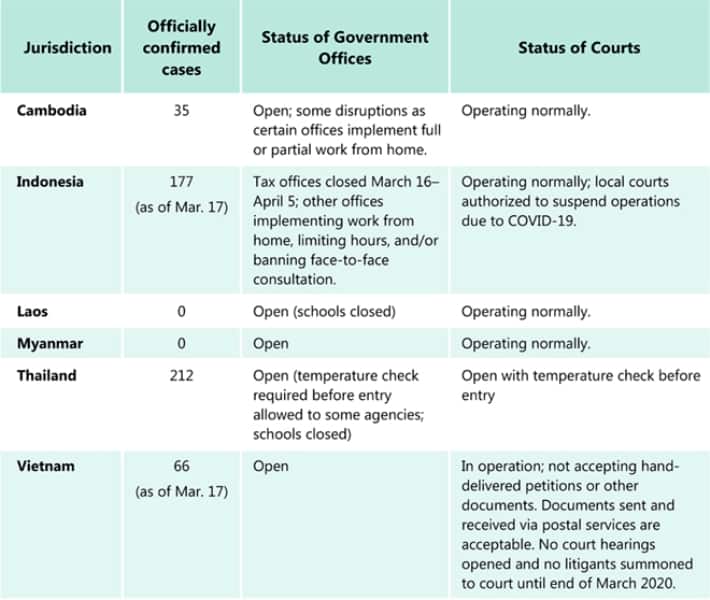
The effects of the global COVID-19 pandemic on Southeast Asia are a deep concern shared by all with connections to the region. To encourage clear understanding of the facts on the ground, Tilleke & Gibbins has prepared this high-level snapshot of the legal situation as it currently stands in each of our jurisdictions.

Administrative and Judicial Functions
Travel Restrictions

Cambodia
The government has imposed the following:

  • Ban on incoming foreign nationals traveling from France, Germany, Iran, Italy, Spain, and the USA for 30 days, effective from March 17, 2020 (or from March 18 for Iran only).
  • Mandatory 14-day self-quarantine for Cambodian citizens traveling from European countries, Iran, or the USA required.
  • Restriction on Cambodian public officials attending meetings in European countries, Iran, or the USA.
  • Ban on entry of cruise ships via Kaam Samnor International Border.

Indonesia
The government has imposed the following:

  • Cancellation of all direct flights to and from China.
  • Suspensions of all visa-on-arrival allowances for one month starting March 20, 2020.
  • Restrictions on incoming travelers who have been in any of the following countries within 14 days of arrival: China, France, Germany, Iran, Italy, South Korea, Spain, Switzerland, the UK, and Vatican City.

Laos
Various border checkpoints have been closed. Further recommendations for travelers from certain affected areas have been issued by the National Taskforce Committee for COVID-19 Prevention and Control on March 16. However, prohibitions, restrictions, and mandatory actions are not formally in place.

Myanmar
An announcement made on March 15, 2020, applies requirements to travelers coming from the following countries:

Thailand
Incoming travelers with a temperature of 37.5 degrees Celsius or higher, and with any symptom associated with COVID-19, will be taken to a hospital approved by the Ministry of Public Health for testing, diagnosis, isolation, and quarantine as necessary.

For all other incoming travelers, the following measures apply:

  • Mandatory 14-day self-quarantine for travelers arriving from China (including Hong Kong and Macau), Iran, Italy, and South Korea.
  • Mandatory self-monitoring and reporting of symptoms in the Ministry of Public Health system for travelers arriving from Denmark, France, Germany, Netherlands, Norway, Spain, Sweden, Switzerland, the UK, and the USA. In addition, travelers from these countries must notify a disease control officer of their location and itinerary so their movements and contacts can be monitored.
  • All of the above incoming travelers must inform a disease control officer immediately upon the onset of any symptom associated with COVID-19.

As for outbound travelers, no blanket restriction has been issued for government employees, but many individual agencies have issued such prohibitions.

Vietnam
As of March 18, 2020, the following measures are in effect:

  • Visas on arrival suspended for all foreign nationals.
  • Travelers entering with visa exemption certificates granted to overseas Vietnamese (Viet Kieu), their relatives, and some other special cases (such as experts, business managers, and skilled workers) must have a certificate proving they have tested negative for the COVID-19 virus. The certificate must be issued by the relevant authority of the host country and also approved by Vietnam, except for those on official or diplomatic trips.
  • All travelers from outside of Vietnam entering with a visa will be subject to health checks and a mandatory 14-day quarantine.

***********

Our primary professional concern, in all things, is for the wellbeing and commerciality of our clients. For that reason, we are implementing practical social distancing measures designed to ensure that we work together safely, effectively, and without change to the quality and efficiency of the services you receive. If you have any queries about these measures, or about any of the information given above, please contact [email protected].

RELATED INSIGHTS​ 

September 24, 2026
Vietnam is implementing and developing a broad package of regulatory reforms that could reshape how IP, data, digital platforms, and product authenticity are regulated and enforced. Several of the key measures have been led by the Ministry of Public Security in its legislative and administrative capacity, as part of a broader government effort. The core reform package consists of four key legal instruments: proposed amendments to the Criminal Code, a proposed new Data Security Law, a draft Decree on Product Identification, Authentication and Traceability, and the newly enacted Decree No. 330/2026/ND-CP. These instruments include rules on criminal enforcement, data security, electronic identification, product identification and traceability, administrative violations, and cybersecurity sanctions. Combined, these measures will affect copyright enforcement, industrial property rights, trade secrets, AI training data, product provenance, online takedowns, valuation of counterfeit goods and electronic evidence. It is worth noting that, in addition to strengthening criminal penalties for IP crimes, Vietnam’s emerging regulatory framework increasingly treats infringement, data misuse, product authentication, and platform-enabled violations as interconnected regulatory and enforcement challenges. For rights holders and foreign investors, this could mean stronger tools against counterfeiting and online infringement, but also more compliance obligations around data, traceability, AI, platform controls and government-facing reporting. Expansion of Criminal IP Enforcement Proposed amendments to Article 225 of the Criminal Code would expand criminal copyright exposure beyond reproduction and distribution to cover large-scale commercial public performance and online communication of works, phonograms and video recordings. This is important because piracy is increasingly about streaming, unauthorized communication, and platform access models rather than physical copying. Aggravated copyright infringement could be subject to up to 10 years in prison for individuals and fines of up to VND 6 billion (about USD 228,300) for commercial legal entities. The amended Article 226 would expand criminal industrial property liability beyond
September 24, 2026
On September 15, 2026, Thailand’s Office of Insurance Commission (OIC) issued two notifications—one for life insurance and one for non-life insurance—amending the 2020 regulatory framework governing policy issuance and offering, agent and broker conduct, premium collection, and advertising. The amendments take effect on January 1, 2027. Electronic Policy Delivery and OIC Reporting Insurers must now deliver policies electronically by default, with printed copies required only where the policyholder opts out of electronic delivery. For life insurance, this requirement extends to coverage summaries and exclusion documents. Insurers must also electronically submit issued policies to the OIC immediately upon issuance. This is a significant new data-reporting obligation that requires system integration with the OIC’s platform. Risk Management, Sales Conduct, and License Misuse The notifications introduce several amendments and additional requirements in the areas of risk management, sales conduct, and license misuse: Internal risk management must now expressly cover advertising, policy offering, and sales agent information, including market conduct risk and reputational risk. Sales conducted through employees, agents, or brokers are subject to enhanced requirements, including verification of the seller’s identity and authority, disclosure of the purpose of contacting the customer, provision of complete and accurate policy information, customer assistance with application forms, and notification of the expected timing for policy delivery or insurer follow-up. For life insurance, customers must also be informed of their right to cancel the policy. For life insurance specifically, employees, agents, and brokers must submit insurance applications to the insurer at the earliest opportunity, and no later than the next business day. Using another person’s name or license, or allowing another person to use one’s own name or license, for the purpose of offering insurance for sale, listing in sales-related documents, or recording in the insurance policy is now expressly prohibited for both life and non-life insurance.
September 17, 2026
Thailand’s Office of the Consumer Protection Board (OCPB) has released for public comment a draft bill to amend the Consumer Protection Act B.E. 2522 (1979), the country’s foundational consumer protection legislation. The draft amendment aims to modernize the nearly five-decade-old framework to address the rapid growth of digital commerce, online advertising, influencer marketing, and new business models. The public consultation period is open until October 10, 2026. Expanded Definitions Covering Digital Commerce The draft significantly broadens several core definitions to capture modern commercial activities: “Consumer” is expanded to include natural persons and nonprofit juristic persons who purchase or receive services, including those solicited by businesses and end users who do not directly pay for the goods or services. “Business operator” now explicitly covers advertising business operators and hired advertising persons, such as influencers and content creators. “Advertising media” is expanded to include digital platforms, social media, and social media user accounts. “Label” now encompasses electronic labels—symbols, codes, or other electronic formats displaying product information. Influencer and Advertising Disclosure Requirements In addition to these expanded definitions, “hired advertising person for selling goods or services” is a new definition covering influencers, content creators, live streamers, affiliate marketers, and virtual online media operators who receive monetary compensation or other benefits for advertising goods or services. Hired advertising persons—including influencers and content creators—must disclose to consumers that content is advertising and reveal their relationship with the business owner. Disclosure is required when the business owner employs the advertiser, pays or provides other benefits for the advertisement, or provides free or discounted products or services. These requirements apply where consumers would not otherwise know that the business has a connection to the person presenting the content. Labeling Requirements for Importers The draft introduces a clearer labeling obligation for importers of label-controlled goods, who must
September 15, 2026
Insurance specialists from Tilleke & Gibbins in Bangkok have contributed the updated Thailand chapter to the newly released 2026 edition of Thomson Reuters’ Practical Law guide to insurance and reinsurance. The Thailand chapter offers a comprehensive Q&A-style overview of the legal and regulatory framework governing insurance and reinsurance in the country. It provides key insights for businesses, insurers, reinsurers, and intermediaries operating in or entering the Thai market. Key topics covered include: Market structure and common types of insurance Regulatory framework and oversight by the Office of Insurance Commission (OIC) Authorisation requirements for insurers, reinsurers, and intermediaries Ownership restrictions and foreign investment rules Corporate governance, capital requirements, and solvency obligations Reinsurance arrangements, including fronting, risk transfer, and common contractual clauses Policy content requirements, standard clauses, and consumer protections Claims procedures, statutory time limits, and subrogation rights Dispute resolution mechanisms, including OIC arbitration and court proceedings Insolvency protections for policyholders Tax treatment of insurance and reinsurance businesses in Thailand Recent legal developments, including updated OIC regulations and insurance licensing guidelines The 2026 edition reflects Thailand’s evolving regulatory environment, including ongoing legislative reforms to strengthen corporate governance, risk-based capital requirements, and digital media compliance in the insurance sector. It also highlights practical considerations for foreign insurers, reinsurers, and intermediaries seeking to participate in Thailand’s insurance market. Tilleke & Gibbins contributes regularly to the Practical Law series of guides for various jurisdictions in Southeast Asia, providing trusted legal insight for multinational companies. Access the full Thailand chapter below. Reproduced from Practical Law with the permission of the publishers. For further information, visit practicallaw.com.