
You are using an outdated browser and your browsing experience will not be optimal. Please update to the latest version of Microsoft Edge, Google Chrome or Mozilla Firefox. Install Microsoft Edge

March 19, 2020

COVID-19 Status Update for Southeast Asia – March 18, 2020

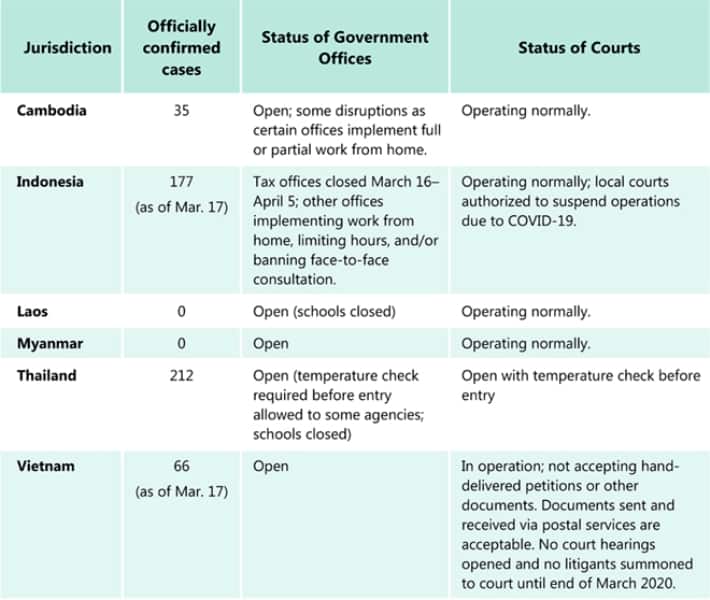
The effects of the global COVID-19 pandemic on Southeast Asia are a deep concern shared by all with connections to the region. To encourage clear understanding of the facts on the ground, Tilleke & Gibbins has prepared this high-level snapshot of the legal situation as it currently stands in each of our jurisdictions.

Administrative and Judicial Functions
Travel Restrictions

Cambodia
The government has imposed the following:

  • Ban on incoming foreign nationals traveling from France, Germany, Iran, Italy, Spain, and the USA for 30 days, effective from March 17, 2020 (or from March 18 for Iran only).
  • Mandatory 14-day self-quarantine for Cambodian citizens traveling from European countries, Iran, or the USA required.
  • Restriction on Cambodian public officials attending meetings in European countries, Iran, or the USA.
  • Ban on entry of cruise ships via Kaam Samnor International Border.

Indonesia
The government has imposed the following:

  • Cancellation of all direct flights to and from China.
  • Suspensions of all visa-on-arrival allowances for one month starting March 20, 2020.
  • Restrictions on incoming travelers who have been in any of the following countries within 14 days of arrival: China, France, Germany, Iran, Italy, South Korea, Spain, Switzerland, the UK, and Vatican City.

Laos
Various border checkpoints have been closed. Further recommendations for travelers from certain affected areas have been issued by the National Taskforce Committee for COVID-19 Prevention and Control on March 16. However, prohibitions, restrictions, and mandatory actions are not formally in place.

Myanmar
An announcement made on March 15, 2020, applies requirements to travelers coming from the following countries:

Thailand
Incoming travelers with a temperature of 37.5 degrees Celsius or higher, and with any symptom associated with COVID-19, will be taken to a hospital approved by the Ministry of Public Health for testing, diagnosis, isolation, and quarantine as necessary.

For all other incoming travelers, the following measures apply:

  • Mandatory 14-day self-quarantine for travelers arriving from China (including Hong Kong and Macau), Iran, Italy, and South Korea.
  • Mandatory self-monitoring and reporting of symptoms in the Ministry of Public Health system for travelers arriving from Denmark, France, Germany, Netherlands, Norway, Spain, Sweden, Switzerland, the UK, and the USA. In addition, travelers from these countries must notify a disease control officer of their location and itinerary so their movements and contacts can be monitored.
  • All of the above incoming travelers must inform a disease control officer immediately upon the onset of any symptom associated with COVID-19.

As for outbound travelers, no blanket restriction has been issued for government employees, but many individual agencies have issued such prohibitions.

Vietnam
As of March 18, 2020, the following measures are in effect:

  • Visas on arrival suspended for all foreign nationals.
  • Travelers entering with visa exemption certificates granted to overseas Vietnamese (Viet Kieu), their relatives, and some other special cases (such as experts, business managers, and skilled workers) must have a certificate proving they have tested negative for the COVID-19 virus. The certificate must be issued by the relevant authority of the host country and also approved by Vietnam, except for those on official or diplomatic trips.
  • All travelers from outside of Vietnam entering with a visa will be subject to health checks and a mandatory 14-day quarantine.

***********

Our primary professional concern, in all things, is for the wellbeing and commerciality of our clients. For that reason, we are implementing practical social distancing measures designed to ensure that we work together safely, effectively, and without change to the quality and efficiency of the services you receive. If you have any queries about these measures, or about any of the information given above, please contact [email protected].

RELATED INSIGHTS​ 

August 10, 2026
On June 17, 2026, Indonesia’s National Agency of Drug and Food Control (BPOM) issued BPOM Regulation No. 10 of 2026 on Nutritional Information on Processed Food Labels. The new regulation, which revokes three previous nutrition labeling regulations, introduces several notable changes affecting food and beverage manufacturers, importers, and distributors. These changes range from updated nutrient reference values and serving-size requirements to the introduction of the Nutri-Level front-of-pack labeling system for certain beverage products. Businesses operating in Indonesia should carefully review these developments and assess their products’ compliance with the new requirements during the transition period. Implementation of the Nutri-Level Labeling System To implement the recently issued decree on Nutri-Level labeling, BPOM Regulation No. 10 of 2026 stipulates the requirements to implement the Nutri-Level labeling system on the front-of-pack. Under the new framework, ready-to-drink beverages, powdered beverages, and liquid or solid concentrates are required to display Nutri-Level labeling on the front label of their packaging. The Nutri-Level labeling system classifies products into color-coded levels A through D based on their sugar, sodium, and total fat content. The applicable Nutri-Level is determined based on the lowest level measured in the assessment of sugar, sodium, and total fat content. For products classified as level C or D, the Nutri-Level label must be accompanied by information on the relevant sugar, sodium, and total fat content per 100 ml of the ready-to-consume product. Products classified as level A or B may either display only the Nutri-Level designation or display the Nutri-Level together with the relevant nutritional information per 100 ml. Minimum Vitamin and Mineral Content Required for Declaration BPOM Regulation No. 10 of 2026 introduces a stricter threshold for the declaration of vitamins and minerals in the nutritional value information section (ING). Vitamins or minerals may only be declared if they are present at a
August 10, 2026
The drug registration process in Vietnam will be simplified, particularly for foreign applicants, following the recent issuance by Vietnam’s Ministry of Health (MOH) of a new circular that is expected to reduce administrative hurdles. Circular No. 32/2026/TT-BYT on the registration of drugs and medicinal ingredients (Circular 32) was issued on July 29, 2026, and will take effect on October 1, 2026, replacing Circular No. 12/2025/TT-BYT. Key provisions of the new circular are discussed below. Five-Year Data Exclusivity and Five-Month Public Disclosure Framework Circular 32 updates data protection guidelines by explicitly referencing Article 128 of the amended Intellectual Property Law, which sets out that new drugs supported by clinical trial data submitted for the first time will be granted a five-year data exclusivity period from the date of the initial marketing authorization (MA) approval. Subsequent applications that rely on the originator’s protected data will not be eligible for approval from the date of submission of the originator’s registration dossier until five years after the first MA is granted. Furthermore, in accordance with the new regulations, the regulatory authority must publicly disclose information on subsequent applications five months before the granting of MA, providing originator companies with an opportunity to exercise and enforce their intellectual property rights. Simplified Requirements for Foreign Legal Documents Circular 32 expands the circumstances under which legal documents issued by foreign authorities are exempt from consular legalization and authenticity verification requirements. Specifically, such documents may be exempt if the Drug Administration of Vietnam (DAV) is able to verify their authenticity directly through official electronic means, including written confirmation or email correspondence sent directly to the MOH by the competent foreign authority, or publicly accessible English-language databases maintained by recognized foreign regulatory authorities. In addition, the new circular permits the submission of electronic notarized copies of legal documents
August 4, 2026
Thailand’s Personal Data Protection Act B.E. 2562 (2019) (PDPA) could soon see some important changes, as a draft bill to amend the PDPA has been introduced in the House of Representatives. The draft amendment is currently in the public consultation phase, with comments accepted from July 16 to August 15, 2026. If enacted in its current form, the amendment would make three key changes: expanding the government exemption to cover anticorruption operations, introducing a statutory definition of “government agency,” and restructuring the lawful bases for personal data processing to align with international standards. Background The PDPA has encountered several enforcement challenges since its implementation, including three core problems identified by the bill’s sponsors: (1) the current exemptions for government agencies do not cover anticorruption and misconduct-prevention operations; (2) the PDPA lacks a clear statutory definition of “government agency,” causing legal uncertainty as to which entities are covered; and (3) the existing framework for lawful bases of data processing does not align with international standards—particularly the multiple-lawful-bases system in the EU’s General Data Protection Regulation (GDPR)—making compliance inflexible for both government and private sector entities. Expanded Government Exemption The current PDPA exempts government agencies performing duties related to national security (including fiscal security), public safety, anti-money laundering, forensic science, and cybersecurity. The proposed amendment adds “prevention and suppression of corruption and misconduct” to this list of exempted functions. This would allow anticorruption bodies—most notably the National Anti-Corruption Commission (NACC), which is identified as a directly affected party—to collect, use, and disclose personal data without being subject to PDPA requirements when carrying out their duties. New Statutory Definition of “Government Agency” Notably, while the current PDPA use the term “government agency” in several provisions, the term is not comprehensively defined, creating potential uncertainty as to its scope. The draft bill therefore
August 3, 2026
On July 23, 2026, the Bank of Thailand (BOT) released for public comment its draft Notification on Digital Channel Security, which would significantly expand the scope and stringency of Thailand’s existing mobile banking security framework. If finalized in its current form, the draft notification would extend mandatory security requirements to credit card providers and credit providers, cover internet banking in addition to mobile applications, phase out SMS one-time passwords (OTPs) for transaction authentication, and introduce biometric verification requirements for high-value transactions. The public comment period is open through August 24, 2026. Background The BOT’s existing Mobile Banking Security Notification, issued in 2024, sets minimum security standards for financial institutions, specialized financial institutions (SFIs), and e-money providers, significantly reducing “money-draining app” fraud. However, fraudsters have since shifted to nonbank providers and internet banking channels, prompting the BOT to propose broader security requirements. Expanded Scope of Regulated Entities and Channels The existing Mobile Banking Security Notification covers only financial institutions, SFIs, and e-money providers offering mobile banking services. The draft expands coverage in two key areas: entities and channels. On the entity side, it adds credit card providers and credit providers that offer fund transfers to third parties at other financial service providers or that provide cash withdrawal services to individual retail customers. On the channel side, it broadens coverage to include internet banking in addition to mobile banking. Strengthened Customer Authentication The draft introduces enhanced authentication requirements in three areas: Service enrollment and device changes. Providers must implement rigorous identity verification, notify customers of enrollment results through out-of-band communication channels, and adopt risk-mitigation measures such as cooling-off periods and temporary transaction limits. Transaction-level authentication. Providers must use two-factor authentication for fund transfers, cardless ATM withdrawals, and transaction limit increases. Secure authentication factors. Key requirements include the following: “What-you-know” factors must