
You are using an outdated browser and your browsing experience will not be optimal. Please update to the latest version of Microsoft Edge, Google Chrome or Mozilla Firefox. Install Microsoft Edge

August 10, 2026

Changes in Nutrition Labeling Requirements in Indonesia

On June 17, 2026, Indonesia’s National Agency of Drug and Food Control (BPOM) issued BPOM Regulation No. 10 of 2026 on Nutritional Information on Processed Food Labels.

The new regulation, which revokes three previous nutrition labeling regulations, introduces several notable changes affecting food and beverage manufacturers, importers, and distributors. These changes range from updated nutrient reference values and serving-size requirements to the introduction of the Nutri-Level front-of-pack labeling system for certain beverage products. Businesses operating in Indonesia should carefully review these developments and assess their products’ compliance with the new requirements during the transition period.

Implementation of the Nutri-Level Labeling System

To implement the recently issued decree on Nutri-Level labeling, BPOM Regulation No. 10 of 2026 stipulates the requirements to implement the Nutri-Level labeling system on the front-of-pack. Under the new framework, ready-to-drink beverages, powdered beverages, and liquid or solid concentrates are required to display Nutri-Level labeling on the front label of their packaging.

The Nutri-Level labeling system classifies products into color-coded levels A through D based on their sugar, sodium, and total fat content. The applicable Nutri-Level is determined based on the lowest level measured in the assessment of sugar, sodium, and total fat content.

For products classified as level C or D, the Nutri-Level label must be accompanied by information on the relevant sugar, sodium, and total fat content per 100 ml of the ready-to-consume product. Products classified as level A or B may either display only the Nutri-Level designation or display the Nutri-Level together with the relevant nutritional information per 100 ml.

Minimum Vitamin and Mineral Content Required for Declaration

BPOM Regulation No. 10 of 2026 introduces a stricter threshold for the declaration of vitamins and minerals in the nutritional value information section (ING).

Vitamins or minerals may only be declared if they are present at a level of at least 5% of the recommended dietary allowance (RDA) per serving, per 100 g, per 100 ml, or per package, in accordance with the inclusion of the ING table, except for processed foods that declare vitamins or minerals claims in accordance with certain laws and regulations. This represents a significant change from the previous regime under the now-revoked BPOM Regulation No. 26 of 2021, under which vitamins and minerals could be declared when present at a level of at least 2% of the RDA per serving.

Revised Serving Size Requirements

While serving size declarations were already required under BPOM Regulation No. 26 of 2021, BPOM Regulation No. 10 of 2026 introduces additional technical guidance on serving-size determination and presentation. The new regulation expressly requires serving sizes to be rounded to the nearest half-unit, providing a standardized approach to serving-size calculations across product categories. An exception applies to products classified under food category 11.6 (sweeteners, including table-top sweeteners and high-intensity sweeteners), which may require businesses to review and, where necessary, update their existing nutrition labeling.

In addition, an appendix to Regulation No. 10 of 2026 sets out updated serving-size references for a wide range of food categories. As a result, food business operators should review the revised category-specific serving-size references to determine whether their existing nutrition information tables, nutrient calculations, and serving-size declarations remain compliant under the new framework. Although serving-size requirements were already regulated under BPOM Regulation No. 26 of 2021, the 2026 regulation provides greater technical detail and updated references that may necessitate label revisions for certain products.

Updated Nutrient Reference Values

BPOM Regulation No. 10 of 2026 updates the nutrient reference values previously set forth in BPOM Regulation No. 9 of 2016 to correspond with the current development of scientific knowledge in health. Several reference values have been revised from those in BPOM Regulation No. 9 of 2016 (e.g., for total fat, vitamin B1, vitamin B2, vitamin B12, magnesium, potassium, and various other vitamins and minerals). As these values are used to calculate the percentage of RDA displayed in nutrition information tables, the revisions may affect the nutrient percentage calculations currently appearing on product labels.

The regulation also introduces updated nutrient reference methodologies and conversion factors. In particular, vitamin B3 may now be expressed in niacin equivalents (NE), folate may be expressed in dietary folate equivalents (DFE), and revised conversion factors have been adopted for vitamins A, D, and E. These changes are intended to align nutrition labeling requirements with current nutritional science and may require food business operators to reassess existing nutrient declarations and label calculations.

Updated Nutritional Value Information Table Formats

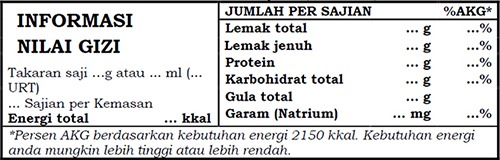
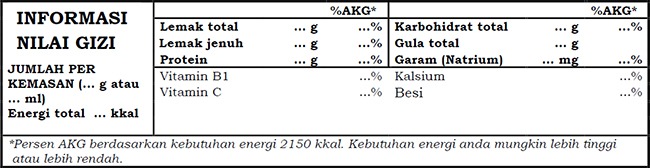
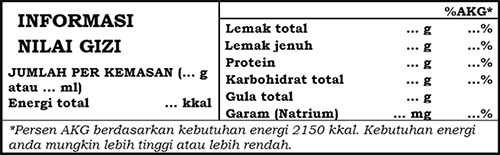
BPOM Regulation No. 10 of 2026 updates the standardized formats for the nutritional value information (ING) table. The regulation continues to allow both vertical and horizontal formats and now provides clearer templates for use on product labels.

For horizontal presentation, businesses may use either a three-column tabular format, which provides more space for displaying nutrient information and additional vitamins or minerals, or a two-column tabular format, which offers a simplified layout suitable for products with limited label space.


Three-column per-serving tabular format
 

Two-column per-serving tabular format
 

Three-column per-package tabular format
 

Two-column per-package tabular format


BPOM Regulation No. 10 of 2026 also introduces specific flexibility for micro-enterprises regarding the ING table. If analytical results are unavailable and the value of a processed food nutrient has not yet been established by the head of BPOM, the values in the ING table should be declared based on calculation results. The procedure for calculating the nutrient content for processed foods produced by micro-enterprises was established by the head of BPOM in 2026 and involves mostly traditional Indonesian food products.

Transition Period

BPOM Regulation No. 10 of 2026 provides a 24-month transition period to facilitate compliance with the new requirements, so processed foods that had already obtained distribution permits before the regulation entered into force, as well as products that were undergoing registration at that time, must be brought into compliance with the new regulation by June 17, 2028. Similar transitional provisions apply to the implementation of Nutri-Level labeling requirements for affected beverage products. As a result, food business operators are afforded additional time to review product portfolios, update nutritional information, and revise product labels where necessary.

Business Impact

The new regulation will require many food and beverage businesses to review their existing nutrition labeling practices in order to comply with the new requirements. In particular, companies should assess the impact of the revised nutrient reference values, updated serving-size requirements, and Nutri-Level labeling requirements on their products.

The Nutri-Level requirements will be especially relevant for beverage manufacturers. Businesses should therefore begin evaluating their product portfolios and preparing any necessary label updates to ensure compliance before the expiry of the 24-month transition period.


RELATED INSIGHTS​ 

July 6, 2022
Patent is an essential piece of the amended Law on Intellectual Property (“Amended IP Law”), which was passed by the National Assembly of Vietnam on June 16, 2022, and will take effect on January 1, 2023 (except for the regulation on protection of experimental data for agrochemical products, which will take delayed effect on January 14, 2024). Among the amended and supplemented contents of the Amended IP Law, there are notable patent-related amendments to Article 60 on assessing the novelty of inventions and Article 96 on grounds for invalidating patent protection titles. We discuss these changes below. Secret Prior Art Under Article 60.1 A significant amendment to Clause 1, Article 60 of the Amended IP Law on the novelty of inventions is to broaden the scope under which an invention can be considered to have lost its novelty. For the first time in Vietnam, “secret prior art” –a patent application with an earlier filing date or priority date but published on or after the filing date or priority date of an examined patent application – is introduced as a prior art document. In the diagram above, at the time of filing of the A2 application, secret prior art A1 has been filed but not yet published, making it inaccessible to the public. At this point, only the A1 applicant and the IP Office are aware of the A1 application. Under the current provisions of the 2005 IP Law, as amended in 2009 and 2019, the A1 patent application is not eligible to be a prior art document when assessing the novelty of A2. However, based on the “first-to-file principle” and the principle of priority, the IP Office has still had other approaches to bar the patentability of an A2 patent application if there is such an A1 application. By
June 13, 2022
Thailand’s cannabis cultivation licensing scheme for the country’s transition toward legalization of the plant has now come to an end. The Ministry of Public Health (MOPH) announced in the Government Gazette that from June 9, 2022, “only cannabis extract with tetrahydrocannabinol (THC) of more than 0.2% by weight will be considered a narcotic.” This means that now anyone can grow, sell, or purchase cannabis seeds, plants, and inflorescence freely in Thailand, and licenses for the cultivation, possession, and distribution of cannabis are no longer required. Neither the number of cannabis plants nor the place of cultivation is restricted. It is thus the beginning of a new chapter for cannabis cultivation in Thailand, with many opining that now is a good time to enter this exciting and growing industry. The journey to this point began in 2019, when Thailand amended its laws on cannabis to allow for treatment for medical purposes, with one of the prerequisite conditions being that the cannabis must be grown in Thailand. The law was further amended to promote commercialization of the cannabis industry, allowing for cannabis to be added to food and beverages, cosmetics, and herbal products. In addition, three traditional cannabis-based formulas were listed in the universal healthcare coverage scheme, which means that almost all Thais have access to traditional cannabis recipes without cost. The successful launch of medical cannabis and its applications, and its viability as an economic industry, have become a national agenda and priority policy of the MOPH. In order to achieve the above outcomes, several legal frameworks and guidelines throughout the product’s lifecycle have been developed. For example, the Thai Food and Drug Administration (FDA) has so far granted licenses to cultivate cannabis (also known as a license to manufacture a narcotic) on more than 1,977 acres (around 800 hectares).
April 19, 2022
New technologies and production processes in the food industry have led to novel foods becoming increasingly important to both food manufacturers and the consuming public worldwide. This is very much the case across a number of jurisdictions in Southeast Asia. “Novel foods” refer to new food production processes, foods, and ingredients that have not yet been commonly used for human consumption, so these innovative foods require safety assessments before companies can produce and market them. While rules for these safety assessments are already part of novel food regulations in several other jurisdictions—such as the novel food regulations in the United Kingdom and European Union adopted in 2003, and the major reform of food safety laws in the United States passed in 2011 under the Food Modernization Act—similar rules governing the assessment of novel foods are relatively new or yet to be introduced in many parts of Asia. Nevertheless, it is important to understand the laws and practices that apply to safety assessments and the process of bringing novel foods to market in jurisdictions in the region. This article provides some clarity in this regard by summarizing important practical information on novel foods and the relevant required safety assessments in Indonesia, Thailand, and Vietnam.   Indonesia Regulator National Agency for Drug and Food Control (NADFC); frequently referred to as BPOM (Badan Pengawas Obat dan Makanan). Relevant Measures BPOM Regulation No. 27 Year 2018 concerning Public Service Standards in BPOM; Decision of the Director of Processed Food Standardization No. HK.02.02.51.511.06.21.21 Year 2021 concerning Public Service Standard Directorate Processed Food Standardization Definitions General “food ingredients” are basic fresh or processed ingredients that can be used to produce food; novel food is any food ingredient not listed in BPOM’s positive list of ingredients. Official Fees None   Process and Timeline Before submitting an
March 31, 2022
Since the onset of the COVID-19 pandemic and the ensuing safety measures, many Thai retailers have shifted their sales toward online platforms. Unsurprisingly, counterfeiters have followed suit. The online sale of counterfeit healthcare and other life sciences products (e.g., food, cosmetics, and medical devices) is an area of significant concern, as it is particularly prevalent, damaging, and complex in relation to Thailand’s laws. This article outlines this type of counterfeiting activity in Thailand and explains some important tools brand owners have for fighting it. Counterfeiting Operations Although illicit operations seek to avoid being identified by authorities and brand owners, investigations by law enforcement and Tilleke & Gibbins on behalf of clients have yielded some insights into how these illegitimate sellers typically operate. Often, consumers are first exposed to these counterfeit life sciences products by paid social media advertisements that link to social media accounts set up by sellers impersonating brand owners. This brand impersonation may include unauthorized use of a trademark or trade name as part of the account name, and unauthorized reproduction of official advertisement artwork or product descriptions, taken directly from the official social media account. From the fake social media account, consumers are usually directed to a merchant website that contains consumer reviews, which are entirely fabricated. While not every counterfeiting operation follows this exact blueprint, employing some variation of these methods lends counterfeiting platforms the ability to proliferate through multiple iterations, as well as believability in the eyes of consumers. How Brand Owners Can Take Action Life sciences brand owners often discover that their products have been targeted by counterfeiters when a counterfeit item injures or negatively impacts a consumer. Thinking that the product is genuine, the consumer may then complain to the brand owner, or worse, file a complaint with the authorities. Many times