
You are using an outdated browser and your browsing experience will not be optimal. Please update to the latest version of Microsoft Edge, Google Chrome or Mozilla Firefox. Install Microsoft Edge

August 10, 2026

Changes in Nutrition Labeling Requirements in Indonesia

On June 17, 2026, Indonesia’s National Agency of Drug and Food Control (BPOM) issued BPOM Regulation No. 10 of 2026 on Nutritional Information on Processed Food Labels.

The new regulation, which revokes three previous nutrition labeling regulations, introduces several notable changes affecting food and beverage manufacturers, importers, and distributors. These changes range from updated nutrient reference values and serving-size requirements to the introduction of the Nutri-Level front-of-pack labeling system for certain beverage products. Businesses operating in Indonesia should carefully review these developments and assess their products’ compliance with the new requirements during the transition period.

Implementation of the Nutri-Level Labeling System

To implement the recently issued decree on Nutri-Level labeling, BPOM Regulation No. 10 of 2026 stipulates the requirements to implement the Nutri-Level labeling system on the front-of-pack. Under the new framework, ready-to-drink beverages, powdered beverages, and liquid or solid concentrates are required to display Nutri-Level labeling on the front label of their packaging.

The Nutri-Level labeling system classifies products into color-coded levels A through D based on their sugar, sodium, and total fat content. The applicable Nutri-Level is determined based on the lowest level measured in the assessment of sugar, sodium, and total fat content.

For products classified as level C or D, the Nutri-Level label must be accompanied by information on the relevant sugar, sodium, and total fat content per 100 ml of the ready-to-consume product. Products classified as level A or B may either display only the Nutri-Level designation or display the Nutri-Level together with the relevant nutritional information per 100 ml.

Minimum Vitamin and Mineral Content Required for Declaration

BPOM Regulation No. 10 of 2026 introduces a stricter threshold for the declaration of vitamins and minerals in the nutritional value information section (ING).

Vitamins or minerals may only be declared if they are present at a level of at least 5% of the recommended dietary allowance (RDA) per serving, per 100 g, per 100 ml, or per package, in accordance with the inclusion of the ING table, except for processed foods that declare vitamins or minerals claims in accordance with certain laws and regulations. This represents a significant change from the previous regime under the now-revoked BPOM Regulation No. 26 of 2021, under which vitamins and minerals could be declared when present at a level of at least 2% of the RDA per serving.

Revised Serving Size Requirements

While serving size declarations were already required under BPOM Regulation No. 26 of 2021, BPOM Regulation No. 10 of 2026 introduces additional technical guidance on serving-size determination and presentation. The new regulation expressly requires serving sizes to be rounded to the nearest half-unit, providing a standardized approach to serving-size calculations across product categories. An exception applies to products classified under food category 11.6 (sweeteners, including table-top sweeteners and high-intensity sweeteners), which may require businesses to review and, where necessary, update their existing nutrition labeling.

In addition, an appendix to Regulation No. 10 of 2026 sets out updated serving-size references for a wide range of food categories. As a result, food business operators should review the revised category-specific serving-size references to determine whether their existing nutrition information tables, nutrient calculations, and serving-size declarations remain compliant under the new framework. Although serving-size requirements were already regulated under BPOM Regulation No. 26 of 2021, the 2026 regulation provides greater technical detail and updated references that may necessitate label revisions for certain products.

Updated Nutrient Reference Values

BPOM Regulation No. 10 of 2026 updates the nutrient reference values previously set forth in BPOM Regulation No. 9 of 2016 to correspond with the current development of scientific knowledge in health. Several reference values have been revised from those in BPOM Regulation No. 9 of 2016 (e.g., for total fat, vitamin B1, vitamin B2, vitamin B12, magnesium, potassium, and various other vitamins and minerals). As these values are used to calculate the percentage of RDA displayed in nutrition information tables, the revisions may affect the nutrient percentage calculations currently appearing on product labels.

The regulation also introduces updated nutrient reference methodologies and conversion factors. In particular, vitamin B3 may now be expressed in niacin equivalents (NE), folate may be expressed in dietary folate equivalents (DFE), and revised conversion factors have been adopted for vitamins A, D, and E. These changes are intended to align nutrition labeling requirements with current nutritional science and may require food business operators to reassess existing nutrient declarations and label calculations.

Updated Nutritional Value Information Table Formats

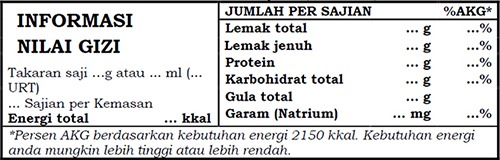
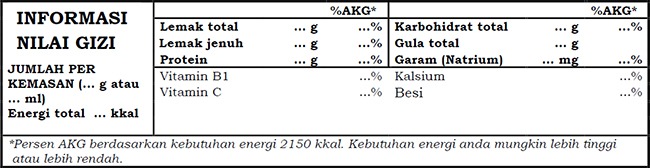
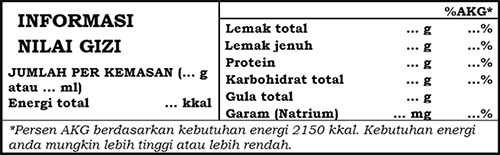
BPOM Regulation No. 10 of 2026 updates the standardized formats for the nutritional value information (ING) table. The regulation continues to allow both vertical and horizontal formats and now provides clearer templates for use on product labels.

For horizontal presentation, businesses may use either a three-column tabular format, which provides more space for displaying nutrient information and additional vitamins or minerals, or a two-column tabular format, which offers a simplified layout suitable for products with limited label space.


Three-column per-serving tabular format
 

Two-column per-serving tabular format
 

Three-column per-package tabular format
 

Two-column per-package tabular format


BPOM Regulation No. 10 of 2026 also introduces specific flexibility for micro-enterprises regarding the ING table. If analytical results are unavailable and the value of a processed food nutrient has not yet been established by the head of BPOM, the values in the ING table should be declared based on calculation results. The procedure for calculating the nutrient content for processed foods produced by micro-enterprises was established by the head of BPOM in 2026 and involves mostly traditional Indonesian food products.

Transition Period

BPOM Regulation No. 10 of 2026 provides a 24-month transition period to facilitate compliance with the new requirements, so processed foods that had already obtained distribution permits before the regulation entered into force, as well as products that were undergoing registration at that time, must be brought into compliance with the new regulation by June 17, 2028. Similar transitional provisions apply to the implementation of Nutri-Level labeling requirements for affected beverage products. As a result, food business operators are afforded additional time to review product portfolios, update nutritional information, and revise product labels where necessary.

Business Impact

The new regulation will require many food and beverage businesses to review their existing nutrition labeling practices in order to comply with the new requirements. In particular, companies should assess the impact of the revised nutrient reference values, updated serving-size requirements, and Nutri-Level labeling requirements on their products.

The Nutri-Level requirements will be especially relevant for beverage manufacturers. Businesses should therefore begin evaluating their product portfolios and preparing any necessary label updates to ensure compliance before the expiry of the 24-month transition period.


RELATED INSIGHTS​ 

March 15, 2022
Indonesia’s National Agency of Drug and Food Control (BPOM) has recently issued several new regulations governing advertisements for cosmetic products in the country. The main regulation—BPOM Regulation No. 32 of 2021 concerning Cosmetics Advertising—took effect on December 13, 2021, and revokes previous regulations regarding cosmetics advertising from 2016. The key aspects of the new regulation are outlined below. Cosmetic Claims The list of prohibited claims for cosmetic products is no longer included with the regulation. Instead, BPOM issued a stand-alone regulation on cosmetic claims as Regulation No. 3 of 2022, which was enacted on January 7, 2022. This regulation on cosmetic claims contains nonexhaustive lists of prohibited and allowed claims for cosmetic products. The new regulation states that published cosmetics advertisements must correspond to the information on the cosmetic product notification. This differs from the previous regulation, which only stated that published cosmetics advertisements were acceptable as long as they were in accordance with the Technical Guidelines for Cosmetics Advertising. Nonetheless, advertisements for cosmetics still do not have to be approved by BPOM prior to their publication. Publication Media Unlike the previous regulation, which only listed electronic, printed, or outdoor media for publishing advertisements for cosmetic products, the new regulation details six main types of advertising media: Printed media: Gazettes, magazines, tabloids, newspapers, bulletins, posters or flyers, leaflets, stickers, booklets, pamphlets, yellow pages, catalogs, and any other printed media  targeting a limited audience in a certain sector, industry, entity, or profession (i.e., non-mass media). Broadcast media: Television (including running-text classifieds, superimposed ads, and “built-in” ads displayed during a television program), radio, and cinema. Online media: Activities (such as searches of websites and webpages), e-commerce, games, social media (e.g., Instagram, Facebook, Twitter), applications, publications, transportation on demand, display ads, video ads, and entertainment, in various possible formats (such as video,
March 8, 2022
Attorneys from Tilleke & Gibbins’ offices in Vietnam have contributed the Vietnam chapter to Pharmaceutical Advertising 2022 from Chambers & Partners. Pharmaceutical Advertising 2022—the fifth annual edition of this practice guide—provides information on pharmaceutical advertising regulations in 18 jurisdictions around the world. The guidance is especially useful for pharmaceutical manufacturers looking to share their products and innovations with the public in a responsible, transparent way that is compliant with local laws. The Vietnam chapter specifically the following topics: Regulatory Framework for pharmaceutical advertising Scope of advertising and general principles Advertising of unauthorized medicines or unauthorized indications Advertising pharmaceuticals to the general public Advertising to healthcare professionals Vetting requirements and internal verification compliance Advertising of medicinal products on the internet Inducement and antibribery Gifts, hospitality, congresses and related payments Transparency considerations for pharmaceutical companies Enforcement of pharmaceutical advertising rules Tilleke & Gibbins also provided the Thailand chapter to this guide. Chambers & Partners’ Global Practice Guides provide in-house counsel with expert legal commentary focusing on practical legal issues affecting business, and enable readers to compare legislation and relevant procedures across a range of key jurisdictions. The full Pharmaceutical Advertising 2022 guide—including the Vietnam chapter—is available for free on the Chambers and Partners website. The Vietnam chapter is also available as a PDF through the button below.
March 8, 2022
Attorneys from Tilleke & Gibbins’ Bangkok office have authored the Thailand chapter in Pharmaceutical Advertising 2022 from Chambers & Partners. Pharmaceutical Advertising 2022—the fifth annual edition of this practice guide—provides information on pharmaceutical advertising regulations in 18 jurisdictions around the world. The guidance is especially useful for pharmaceutical manufacturers looking to share their products and innovations with the public in a responsible, transparent way that is compliant with local laws. The Thailand chapter covers the following topics: Regulatory Framework for pharmaceutical advertising Scope of advertising and general principles Advertising of unauthorized medicines or unauthorized indications Advertising pharmaceuticals to the general public Advertising to healthcare professionals Vetting requirements and internal verification compliance Advertising of medicinal products on the internet Inducement and antibribery Gifts, hospitality, congresses and related payments Transparency considerations for pharmaceutical companies Enforcement of pharmaceutical advertising rules Chambers & Partners’ Global Practice Guides provide in-house counsel with expert legal commentary focusing on practical legal issues affecting business, and enable readers to compare legislation and relevant procedures across a range of key jurisdictions. Tilleke & Gibbins also contributed the Vietnam chapter to the guide. The full Pharmaceutical Advertising 2022 guide—including the Thailand chapter—is available for free on the Chambers and Partners website. The Thailand chapter is also available as a PDF through the button below.
February 24, 2022
The enactment of Thailand’s Narcotics Code, effective December 10, 2021, marked a key milestone in promoting the commercial applications of cannabis (both marijuana and hemp) and kratom as economic plants—with subsequent regulatory developments continuing this push. For many decades, cannabis and kratom were classified as category 5 narcotics under the Narcotics Act. However, a movement for the legalization of cannabis and kratom developed over time. First, the legalization of marijuana (Cannabis indica) for medical purposes became effective on February 19, 2019, as prescribed in Amendment No. 7 of the Narcotics Act. Kratom has also been effectively decriminalized (covering consumption, production, disposal, and possession for any purpose) since August 24, 2021, as prescribed in Amendment No. 8 of the Narcotics Act. The laws governing narcotic and psychotropic substances in Thailand have now taken a significant step forward with the passage of the Narcotics Code, which is intended to be a comprehensive law covering all narcotics and psychotropic substances in Thailand. Most recently, the Ministry of Public Health announced in the Government Gazette on February 2, 2022, that only cannabis extract (both marijuana and hemp) with THC of more than 0.2% by weight will be classified as a category 5 narcotic. This means that seeds, cannabis plants, and inflorescences, if harvested in Thailand, have been removed from the list of category 5 narcotics. Although the changes to Thailand’s narcotics regulations for cannabis and kratom are intricate, both cannabis and kratom have become a topical issue for farmers and related industries. The plants are new cash crops and have attracted widespread public interest. Currently, we can see fresh kratom leaves and fresh cannabis leaves sold in the market. Unlike products with cannabis derivatives, kratom-based products are not yet available in the Thai market. Although there is an opportunity for developing kratom-based products