
You are using an outdated browser and your browsing experience will not be optimal. Please update to the latest version of Microsoft Edge, Google Chrome or Mozilla Firefox. Install Microsoft Edge

August 10, 2026

Changes in Nutrition Labeling Requirements in Indonesia

On June 17, 2026, Indonesia’s National Agency of Drug and Food Control (BPOM) issued BPOM Regulation No. 10 of 2026 on Nutritional Information on Processed Food Labels.

The new regulation, which revokes three previous nutrition labeling regulations, introduces several notable changes affecting food and beverage manufacturers, importers, and distributors. These changes range from updated nutrient reference values and serving-size requirements to the introduction of the Nutri-Level front-of-pack labeling system for certain beverage products. Businesses operating in Indonesia should carefully review these developments and assess their products’ compliance with the new requirements during the transition period.

Implementation of the Nutri-Level Labeling System

To implement the recently issued decree on Nutri-Level labeling, BPOM Regulation No. 10 of 2026 stipulates the requirements to implement the Nutri-Level labeling system on the front-of-pack. Under the new framework, ready-to-drink beverages, powdered beverages, and liquid or solid concentrates are required to display Nutri-Level labeling on the front label of their packaging.

The Nutri-Level labeling system classifies products into color-coded levels A through D based on their sugar, sodium, and total fat content. The applicable Nutri-Level is determined based on the lowest level measured in the assessment of sugar, sodium, and total fat content.

For products classified as level C or D, the Nutri-Level label must be accompanied by information on the relevant sugar, sodium, and total fat content per 100 ml of the ready-to-consume product. Products classified as level A or B may either display only the Nutri-Level designation or display the Nutri-Level together with the relevant nutritional information per 100 ml.

Minimum Vitamin and Mineral Content Required for Declaration

BPOM Regulation No. 10 of 2026 introduces a stricter threshold for the declaration of vitamins and minerals in the nutritional value information section (ING).

Vitamins or minerals may only be declared if they are present at a level of at least 5% of the recommended dietary allowance (RDA) per serving, per 100 g, per 100 ml, or per package, in accordance with the inclusion of the ING table, except for processed foods that declare vitamins or minerals claims in accordance with certain laws and regulations. This represents a significant change from the previous regime under the now-revoked BPOM Regulation No. 26 of 2021, under which vitamins and minerals could be declared when present at a level of at least 2% of the RDA per serving.

Revised Serving Size Requirements

While serving size declarations were already required under BPOM Regulation No. 26 of 2021, BPOM Regulation No. 10 of 2026 introduces additional technical guidance on serving-size determination and presentation. The new regulation expressly requires serving sizes to be rounded to the nearest half-unit, providing a standardized approach to serving-size calculations across product categories. An exception applies to products classified under food category 11.6 (sweeteners, including table-top sweeteners and high-intensity sweeteners), which may require businesses to review and, where necessary, update their existing nutrition labeling.

In addition, an appendix to Regulation No. 10 of 2026 sets out updated serving-size references for a wide range of food categories. As a result, food business operators should review the revised category-specific serving-size references to determine whether their existing nutrition information tables, nutrient calculations, and serving-size declarations remain compliant under the new framework. Although serving-size requirements were already regulated under BPOM Regulation No. 26 of 2021, the 2026 regulation provides greater technical detail and updated references that may necessitate label revisions for certain products.

Updated Nutrient Reference Values

BPOM Regulation No. 10 of 2026 updates the nutrient reference values previously set forth in BPOM Regulation No. 9 of 2016 to correspond with the current development of scientific knowledge in health. Several reference values have been revised from those in BPOM Regulation No. 9 of 2016 (e.g., for total fat, vitamin B1, vitamin B2, vitamin B12, magnesium, potassium, and various other vitamins and minerals). As these values are used to calculate the percentage of RDA displayed in nutrition information tables, the revisions may affect the nutrient percentage calculations currently appearing on product labels.

The regulation also introduces updated nutrient reference methodologies and conversion factors. In particular, vitamin B3 may now be expressed in niacin equivalents (NE), folate may be expressed in dietary folate equivalents (DFE), and revised conversion factors have been adopted for vitamins A, D, and E. These changes are intended to align nutrition labeling requirements with current nutritional science and may require food business operators to reassess existing nutrient declarations and label calculations.

Updated Nutritional Value Information Table Formats

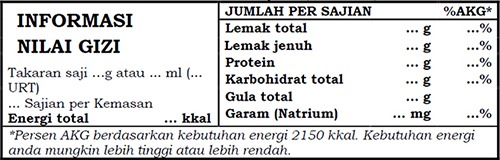
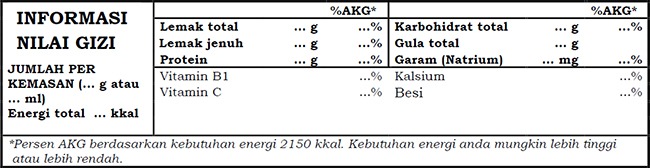
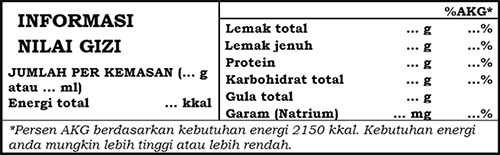
BPOM Regulation No. 10 of 2026 updates the standardized formats for the nutritional value information (ING) table. The regulation continues to allow both vertical and horizontal formats and now provides clearer templates for use on product labels.

For horizontal presentation, businesses may use either a three-column tabular format, which provides more space for displaying nutrient information and additional vitamins or minerals, or a two-column tabular format, which offers a simplified layout suitable for products with limited label space.


Three-column per-serving tabular format
 

Two-column per-serving tabular format
 

Three-column per-package tabular format
 

Two-column per-package tabular format


BPOM Regulation No. 10 of 2026 also introduces specific flexibility for micro-enterprises regarding the ING table. If analytical results are unavailable and the value of a processed food nutrient has not yet been established by the head of BPOM, the values in the ING table should be declared based on calculation results. The procedure for calculating the nutrient content for processed foods produced by micro-enterprises was established by the head of BPOM in 2026 and involves mostly traditional Indonesian food products.

Transition Period

BPOM Regulation No. 10 of 2026 provides a 24-month transition period to facilitate compliance with the new requirements, so processed foods that had already obtained distribution permits before the regulation entered into force, as well as products that were undergoing registration at that time, must be brought into compliance with the new regulation by June 17, 2028. Similar transitional provisions apply to the implementation of Nutri-Level labeling requirements for affected beverage products. As a result, food business operators are afforded additional time to review product portfolios, update nutritional information, and revise product labels where necessary.

Business Impact

The new regulation will require many food and beverage businesses to review their existing nutrition labeling practices in order to comply with the new requirements. In particular, companies should assess the impact of the revised nutrient reference values, updated serving-size requirements, and Nutri-Level labeling requirements on their products.

The Nutri-Level requirements will be especially relevant for beverage manufacturers. Businesses should therefore begin evaluating their product portfolios and preparing any necessary label updates to ensure compliance before the expiry of the 24-month transition period.


RELATED INSIGHTS​ 

July 23, 2025
On June 26, 2025, the National Assembly of Vietnam adopted Resolution No. 216/2025/QH15 to extend the duration of agricultural land use tax exemption through December 31, 2030. This policy extension reaffirms the government’s ongoing efforts to support the agricultural sector, ensure national food security, and promote rural development. Key Takeaways Tax Exemption Period Extended: The new resolution continues the full exemption from agricultural land use tax as stipulated under Resolution No. 55/2010/QH12, as amended in 2016 and 2020. The tax exemption, which was originally set to expire at the end of 2025, will now remain in effect until December 31, 2030. Scope of Exemption: The exemption applies to all types of land currently eligible under the existing legal framework for agricultural land use tax relief. This typically includes land used by households, cooperatives, and non-commercial organizations for agricultural production, aquaculture, salt-making, and reforestation. Effective Date: Resolution 216 will take effect on January 1, 2026. During the interim period, tax exemption remains valid under existing laws and resolutions until the end of 2025. Implementation Guidance to Follow: The government is tasked with issuing detailed guidance to ensure effective implementation of this extended exemption. Businesses, cooperatives, and individuals engaged in agricultural activities should monitor upcoming regulations and instructions from relevant ministries. Outlook Vietnam’s extension of agricultural land use tax exemption demonstrates a strong policy commitment to rural economic stability and environmental sustainability. For land users, the exemption represents meaningful financial relief that can be reinvested into modernizing farming techniques, improving land efficiency, or transitioning to sustainable practices. While the extension itself is automatic, it is recommended that agricultural land users and stakeholders review their land use documentation and tax profiles to ensure alignment with eligibility requirements. Future implementation regulations may also introduce new compliance obligations that should be tracked closely.
July 15, 2025
On July 1, 2025, Vietnam’s Ministry of Health issued Circular No. 30/2025/TT-BYT providing updated guidance on the application of drug quality standards, testing of drugs and pharmaceutical ingredients, and procedures for the recall and handling of noncompliant drugs (Circular 30). Circular 30 officially came into effect on the same day and replaces Circular No. 11/2018/TT-BYT and its amendments. Key highlights of Circular 30 are presented below. Drug and Pharmaceutical Ingredient Quality Standards Circular 30 maintains consistency with previous regulations regarding the selection of an applicable quality specification. Pharmaceutical businesses and drug preparation establishments may still choose to apply standards from the Vietnamese Pharmacopoeia, reference pharmacopoeias (including the United States Pharmacopoeia, the European Pharmacopoeia, the British Pharmacopoeia, the Japanese Pharmacopoeia, and the International Pharmacopoeia), or an in-house specification. Priority is given to the Vietnamese Pharmacopoeia and reference pharmacopoeias, encompassing quality indicators, quality levels, and testing methods. If alternative pharmacopoeias or in-house specifications are used, they must meet the requirements outlined in the corresponding monographs of the Vietnamese or reference pharmacopoeias. At the time of registration, the quality standards of drugs and pharmaceutical ingredients must comply with either the current version of the pharmacopoeia or a previous version of the pharmacopoeia that is no more than two years older than the current version. The requirement for updating quality specifications in line with the quality under the corresponding pharmacopoeia also applies to products that have already been granted marketing authorization. Testing Drugs and Pharmaceutical Ingredients in Quality Management Similar to the regulations under the previous circular, if pharmaceutical businesses disagree with the sample testing results, they may, within five working days of receiving the test report, request that the state quality inspection authority designate an alternative testing facility. The testing period for establishments listed as foreign drug manufacturers with quality violations remains
July 14, 2025
Life sciences specialists from Tilleke & Gibbins have updated the firm’s guide to pharmaceutical data exclusivity regulations and practices in Southeast Asia. This guide contains quick-reference information on the availability of data exclusivity protections and limitations in Cambodia, Indonesia, Laos, Malaysia, Myanmar, Thailand, and Vietnam. Developing and launching a new drug on a commercial scale requires an enormous amount of time and investment in research and development (R&D), including pre-clinical testing and clinical trials. When considering the aggregate amount of drug development costs, it is important to recognize that this includes not only the investment in developing new drugs that get approved by a government food and drug regulator and are successfully brought to market, but also the R&D expenditures on a large number of potential pharmaceutical compounds and products that never actually make it to market. In particular, considerable investment is required in order to conduct and produce clinical trial data—to prove safety, efficacy and effectiveness of a new drug—that would warrant marketing approval by the regulatory authority. Such data is proprietary in nature and highly valuable for a research-based pharmaceutical company that develops an original drug. On the other hand, patent law typically confers generic drug manufacturers with the ability to engage in various preparatory activities with a view to obtaining marketing approval for a generic product before the patent for the original drug expires (commonly known as a “Bolar provision”). Since a generic drug maker may submit an application for marketing approval of a generic product before the relevant patent expires, the extent to which the drug originator’s data submitted to the regulatory authority is protected—or in other words, the extent to which the generic company may rely on the drug originator’s previously filed data, which underpins the safety and efficacy of the drug, to support
July 8, 2025
On July 3, 2025, Vietnam’s Ministry of Health (MOH) issued Circular No. 34/2025/TT-BYT amending some articles of Circular No. 06/2011/TT-BYT on the management of cosmetics products (Circular 34), which provides the current regulations on the product notification process for cosmetics (cosmetic notification). Circular 34 will come into effect on August 18, 2025. Changes to Cosmetic Notification Some of the key stipulations of Circular 34 are outlined below. Addition of submission route for notification Circular 34 officially adds online submission via the National Public Service Portal as an accepted type of cosmetic notification, in addition to direct submission and submission via post. Clearer regulations on preparing cosmetic notification form Circular 34 provides clarification on the signing requirements for cosmetic notification forms. For online submissions, both e-signatures and digital signatures are accepted. For offline submissions, the circular explicitly states that stamped/generated signatures are not acceptable. There are no substantive changes to existing requirements regarding grouping of products in a single declaration, ingredient listing, or language used in the notification form. Circular 34 only introduces formatting adjustments to these provisions. Updated administrative procedures Circular 34 updates requirements on digital procedures and authentication for online submission with references to new government decrees. In addition, processing timelines for cosmetic notification are further clarified, in particular, five working days for feedback on incomplete dossiers and five working days for approval after receiving complete supplemental dossiers. Revised requirements for import of samples for testing and research An updated Appendix 14-MP form is introduced with Circular 34, in which the receiving authority is updated from the Drug Administration of Vietnam to the specialized health agency under the provincial People’s Committee. Both online and direct submission of the request are allowed. The approval timeline is three working days from the date of reviewing the request. Transition clause Notifications