
You are using an outdated browser and your browsing experience will not be optimal. Please update to the latest version of Microsoft Edge, Google Chrome or Mozilla Firefox. Install Microsoft Edge

August 10, 2026

Changes in Nutrition Labeling Requirements in Indonesia

On June 17, 2026, Indonesia’s National Agency of Drug and Food Control (BPOM) issued BPOM Regulation No. 10 of 2026 on Nutritional Information on Processed Food Labels.

The new regulation, which revokes three previous nutrition labeling regulations, introduces several notable changes affecting food and beverage manufacturers, importers, and distributors. These changes range from updated nutrient reference values and serving-size requirements to the introduction of the Nutri-Level front-of-pack labeling system for certain beverage products. Businesses operating in Indonesia should carefully review these developments and assess their products’ compliance with the new requirements during the transition period.

Implementation of the Nutri-Level Labeling System

To implement the recently issued decree on Nutri-Level labeling, BPOM Regulation No. 10 of 2026 stipulates the requirements to implement the Nutri-Level labeling system on the front-of-pack. Under the new framework, ready-to-drink beverages, powdered beverages, and liquid or solid concentrates are required to display Nutri-Level labeling on the front label of their packaging.

The Nutri-Level labeling system classifies products into color-coded levels A through D based on their sugar, sodium, and total fat content. The applicable Nutri-Level is determined based on the lowest level measured in the assessment of sugar, sodium, and total fat content.

For products classified as level C or D, the Nutri-Level label must be accompanied by information on the relevant sugar, sodium, and total fat content per 100 ml of the ready-to-consume product. Products classified as level A or B may either display only the Nutri-Level designation or display the Nutri-Level together with the relevant nutritional information per 100 ml.

Minimum Vitamin and Mineral Content Required for Declaration

BPOM Regulation No. 10 of 2026 introduces a stricter threshold for the declaration of vitamins and minerals in the nutritional value information section (ING).

Vitamins or minerals may only be declared if they are present at a level of at least 5% of the recommended dietary allowance (RDA) per serving, per 100 g, per 100 ml, or per package, in accordance with the inclusion of the ING table, except for processed foods that declare vitamins or minerals claims in accordance with certain laws and regulations. This represents a significant change from the previous regime under the now-revoked BPOM Regulation No. 26 of 2021, under which vitamins and minerals could be declared when present at a level of at least 2% of the RDA per serving.

Revised Serving Size Requirements

While serving size declarations were already required under BPOM Regulation No. 26 of 2021, BPOM Regulation No. 10 of 2026 introduces additional technical guidance on serving-size determination and presentation. The new regulation expressly requires serving sizes to be rounded to the nearest half-unit, providing a standardized approach to serving-size calculations across product categories. An exception applies to products classified under food category 11.6 (sweeteners, including table-top sweeteners and high-intensity sweeteners), which may require businesses to review and, where necessary, update their existing nutrition labeling.

In addition, an appendix to Regulation No. 10 of 2026 sets out updated serving-size references for a wide range of food categories. As a result, food business operators should review the revised category-specific serving-size references to determine whether their existing nutrition information tables, nutrient calculations, and serving-size declarations remain compliant under the new framework. Although serving-size requirements were already regulated under BPOM Regulation No. 26 of 2021, the 2026 regulation provides greater technical detail and updated references that may necessitate label revisions for certain products.

Updated Nutrient Reference Values

BPOM Regulation No. 10 of 2026 updates the nutrient reference values previously set forth in BPOM Regulation No. 9 of 2016 to correspond with the current development of scientific knowledge in health. Several reference values have been revised from those in BPOM Regulation No. 9 of 2016 (e.g., for total fat, vitamin B1, vitamin B2, vitamin B12, magnesium, potassium, and various other vitamins and minerals). As these values are used to calculate the percentage of RDA displayed in nutrition information tables, the revisions may affect the nutrient percentage calculations currently appearing on product labels.

The regulation also introduces updated nutrient reference methodologies and conversion factors. In particular, vitamin B3 may now be expressed in niacin equivalents (NE), folate may be expressed in dietary folate equivalents (DFE), and revised conversion factors have been adopted for vitamins A, D, and E. These changes are intended to align nutrition labeling requirements with current nutritional science and may require food business operators to reassess existing nutrient declarations and label calculations.

Updated Nutritional Value Information Table Formats

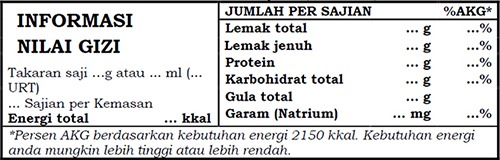
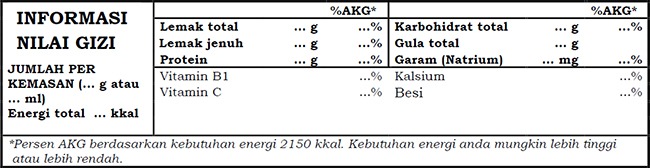
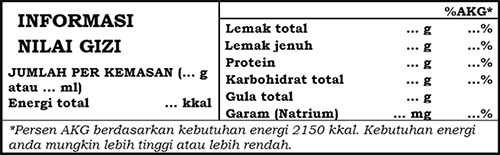
BPOM Regulation No. 10 of 2026 updates the standardized formats for the nutritional value information (ING) table. The regulation continues to allow both vertical and horizontal formats and now provides clearer templates for use on product labels.

For horizontal presentation, businesses may use either a three-column tabular format, which provides more space for displaying nutrient information and additional vitamins or minerals, or a two-column tabular format, which offers a simplified layout suitable for products with limited label space.


Three-column per-serving tabular format
 

Two-column per-serving tabular format
 

Three-column per-package tabular format
 

Two-column per-package tabular format


BPOM Regulation No. 10 of 2026 also introduces specific flexibility for micro-enterprises regarding the ING table. If analytical results are unavailable and the value of a processed food nutrient has not yet been established by the head of BPOM, the values in the ING table should be declared based on calculation results. The procedure for calculating the nutrient content for processed foods produced by micro-enterprises was established by the head of BPOM in 2026 and involves mostly traditional Indonesian food products.

Transition Period

BPOM Regulation No. 10 of 2026 provides a 24-month transition period to facilitate compliance with the new requirements, so processed foods that had already obtained distribution permits before the regulation entered into force, as well as products that were undergoing registration at that time, must be brought into compliance with the new regulation by June 17, 2028. Similar transitional provisions apply to the implementation of Nutri-Level labeling requirements for affected beverage products. As a result, food business operators are afforded additional time to review product portfolios, update nutritional information, and revise product labels where necessary.

Business Impact

The new regulation will require many food and beverage businesses to review their existing nutrition labeling practices in order to comply with the new requirements. In particular, companies should assess the impact of the revised nutrient reference values, updated serving-size requirements, and Nutri-Level labeling requirements on their products.

The Nutri-Level requirements will be especially relevant for beverage manufacturers. Businesses should therefore begin evaluating their product portfolios and preparing any necessary label updates to ensure compliance before the expiry of the 24-month transition period.


RELATED INSIGHTS​ 

July 8, 2025
On June 29, 2025, the government of Vietnam issued Decree No. 163/2025/ND-CP providing detailed guidance on the implementation of the amended Law on Pharmacy (Decree 163). Decree 163, like the amended Law on Pharmacy, took effect on July 1, 2025, officially replacing Decree No. 54/2017/ND-CP (Decree 54). The new decree introduces comprehensive regulations across key areas of pharmaceutical management such as pharmacy practice certificates, certificates of eligibility for pharmaceutical business, import and export of drugs and drug materials, GMP inspection of foreign manufacturers, drug and drug material recall, certificates of drug advertising content, and drug price management. Key Changes in Decree 163 Some outstanding changes and additions in Decree 163 are presented below. Destruction of Specially Controlled Drugs It is no longer required to obtain approval from the competent authority before the destruction of narcotic, psychotropic, and precursor drugs, and pharmaceutical ingredients that are narcotic or psychotropic substances, or precursors used in drugs. Instead, notification must be provided at least seven working days in advance, including the proposed destruction date and a detailed list of items to be destroyed. E-commerce in Pharmaceuticals Pharmaceutical businesses operating via e-commerce platforms must publicly disclose the following information to ensure transparency and consumer safety: (i) certificate of eligibility for pharmaceutical business, (ii) pharmacy practice certificate of the person responsible for pharmaceutical expertise, and (iii) drug information. Shelf-Life Requirements for Imported Products For drugs and ingredients with a total shelf life of nine months or less, at least one-third of the shelf life must remain at the time of customs clearance. Drugs with a shelf life of 30 days or less must still be within their shelf life at the time of clearance. Control of Imported Products Drugs subject to import control include all drugs with marketing authorization (MA), except for (i) drugs that
May 28, 2025
Tilleke & Gibbins attorneys in Vietnam have contributed the 2025 edition of Doing Business in Vietnam, a comprehensive Q&A-style resource from Thomson Reuters Practical Law that provides essential insights for companies navigating business operations in Vietnam. The guide presents a detailed overview of the country’s legal framework and regulatory environment, reflecting recent updates in Vietnamese legislation and practice. This annually updated guide offers key information on the following areas: Legal system: Structure of the Vietnamese judiciary and the role of codified law. Foreign investment: Conditions for market access, licensing requirements, foreign ownership restrictions, and investment incentives. Business vehicles: Formation and operation of legal entities, including limited liability companies, joint-stock companies, and representative offices. Employment: Employment contracts, social insurance, labor rights, and procedures for hiring foreign nationals. Tax: Overview of corporate income tax, personal income tax, value-added tax, and other tax obligations. Intellectual property: Procedures for protecting and enforcing patents, trademarks, copyrights, and other IP rights. Data protection: Compliance requirements under Vietnam’s data privacy laws, including the Personal Data Protection Decree. Competition law: Antitrust rules and regulatory oversight under the Law on Competition. Anti-bribery and corruption: Legal framework and enforcement practices aimed at curbing corrupt activities. E-commerce and digital business: Regulations governing online platforms, digital content, and cross-border services. Marketing and advertising: Laws and guidelines on advertising standards and consumer protection. Product regulation and liability: Safety requirements, product liability issues, and roles of relevant authorities. Doing Business in Vietnam is part of Practical Law’s global series of legal guides designed to support international practitioners and businesses. To access the most recent edition of the Vietnam guide, visit the Practical Law website and sign up for a free trial.
May 28, 2025
Thailand’s Food and Drug Administration (FDA) has launched a strategic collaboration with leading e-commerce platforms Lazada and Shopee to strengthen regulatory oversight of health-related products sold online. This partnership is part of a broader initiative to enhance consumer protection, enforce compliance with Thai health regulations, and foster a safer digital marketplace for health products. As part of this initiative, the Thai FDA is urging all sellers—particularly cross-border vendors—to secure proper FDA registration for their products before market entry. The objective is to ensure that only legally authorized, safe, and quality-assured healthcare products are available to Thai consumers. In pursuit of this goal, the FDA has been working closely with Lazada and Shopee to implement proactive surveillance mechanisms aimed at identifying and removing noncompliant, substandard, or unregistered products. This collaboration has already yielded measurable results. Between September 2023 and 2024, Lazada supported regulatory enforcement by removing 9,454 noncompliant listings and delisting 30 vendors. In addition, 134 sellers were subjected to legal proceedings for regulatory violations. Shopee has taken a similarly rigorous stance, committing to the immediate removal of products found to be in breach of FDA regulations. The platform has also provided educational materials for merchants and implemented consumer complaint mechanisms to enhance accountability. Looking ahead, the Thai FDA plans to roll out a data integration system utilizing API technology, enabling seamless and secure exchange of regulatory data between the agency and e-commerce platforms. This system will be supported by comprehensive training for both Thai FDA officials and e-commerce staff, with a particular focus on the use of the Thai government’s Law Enforcement Request Portal, a secure communication channel for coordinating enforcement actions between government agencies and platform operators. Additionally, a joint product inspection framework is currently under development in partnership with Lazada and Shopee. This framework will incorporate strict
May 27, 2025
On May 16, 2025, Vietnam’s Ministry of Health (MOH) issued Circular No. 12/2025/TT-BYT on registration of drugs and drug materials (Circular 12). Circular 12 will come into effect on July 1, 2025, replacing Circular No. 08/2022/TT-BYT (as amended), which provides the current regulations on drug registration, along with Circular No. 16/2023/TT-BYT on registration of drugs under toll manufacturing and technology transfer, and Circular No. 07/2017/TT promulgating the list of non-prescription drugs. Some of the key stipulations of Circular 12 are outlined below. Regulation of non-prescription drugs Circular 12 abolishes the detailed list of over-the-counter (OTC) drugs previously stipulated in Circular No. 07/2017/TT-BYT. Instead of relying on a fixed list for classification, Circular 12 introduces a new framework based on principles, criteria, and specific methods for determining the status of non-prescription/OTC drugs. This approach aims to enhance safety, ensure timely access, reflect actual usage and supply conditions, and align with international standards. Drugs that have already been approved will retain their classification (i.e., as prescription or non-prescription) throughout the validity of their marketing authorization (MA), and reclassification will be considered when the MA is renewed. If a change in classification is requested, the MA holder must submit a variation registration dossier to the Drug Administration of Vietnam (DAV). For drug registration dossiers currently under evaluation by the DAV, the classification will be assessed in accordance with the new provisions set out in Circular 12. Drug registration The new regulations under Circular 12 loosen the requirements on providing a Certificate of Pharmaceutical Product (CPP). For all drug registration cases, a single CPP will suffice, provided it is issued by the competent authority of the manufacturing country or by an authority from a country that is a member of the European Medicines Agency (EMA) or a Stringent Regulatory Authority (SRA), and confirms