
You are using an outdated browser and your browsing experience will not be optimal. Please update to the latest version of Microsoft Edge, Google Chrome or Mozilla Firefox. Install Microsoft Edge

August 10, 2026

Changes in Nutrition Labeling Requirements in Indonesia

On June 17, 2026, Indonesia’s National Agency of Drug and Food Control (BPOM) issued BPOM Regulation No. 10 of 2026 on Nutritional Information on Processed Food Labels.

The new regulation, which revokes three previous nutrition labeling regulations, introduces several notable changes affecting food and beverage manufacturers, importers, and distributors. These changes range from updated nutrient reference values and serving-size requirements to the introduction of the Nutri-Level front-of-pack labeling system for certain beverage products. Businesses operating in Indonesia should carefully review these developments and assess their products’ compliance with the new requirements during the transition period.

Implementation of the Nutri-Level Labeling System

To implement the recently issued decree on Nutri-Level labeling, BPOM Regulation No. 10 of 2026 stipulates the requirements to implement the Nutri-Level labeling system on the front-of-pack. Under the new framework, ready-to-drink beverages, powdered beverages, and liquid or solid concentrates are required to display Nutri-Level labeling on the front label of their packaging.

The Nutri-Level labeling system classifies products into color-coded levels A through D based on their sugar, sodium, and total fat content. The applicable Nutri-Level is determined based on the lowest level measured in the assessment of sugar, sodium, and total fat content.

For products classified as level C or D, the Nutri-Level label must be accompanied by information on the relevant sugar, sodium, and total fat content per 100 ml of the ready-to-consume product. Products classified as level A or B may either display only the Nutri-Level designation or display the Nutri-Level together with the relevant nutritional information per 100 ml.

Minimum Vitamin and Mineral Content Required for Declaration

BPOM Regulation No. 10 of 2026 introduces a stricter threshold for the declaration of vitamins and minerals in the nutritional value information section (ING).

Vitamins or minerals may only be declared if they are present at a level of at least 5% of the recommended dietary allowance (RDA) per serving, per 100 g, per 100 ml, or per package, in accordance with the inclusion of the ING table, except for processed foods that declare vitamins or minerals claims in accordance with certain laws and regulations. This represents a significant change from the previous regime under the now-revoked BPOM Regulation No. 26 of 2021, under which vitamins and minerals could be declared when present at a level of at least 2% of the RDA per serving.

Revised Serving Size Requirements

While serving size declarations were already required under BPOM Regulation No. 26 of 2021, BPOM Regulation No. 10 of 2026 introduces additional technical guidance on serving-size determination and presentation. The new regulation expressly requires serving sizes to be rounded to the nearest half-unit, providing a standardized approach to serving-size calculations across product categories. An exception applies to products classified under food category 11.6 (sweeteners, including table-top sweeteners and high-intensity sweeteners), which may require businesses to review and, where necessary, update their existing nutrition labeling.

In addition, an appendix to Regulation No. 10 of 2026 sets out updated serving-size references for a wide range of food categories. As a result, food business operators should review the revised category-specific serving-size references to determine whether their existing nutrition information tables, nutrient calculations, and serving-size declarations remain compliant under the new framework. Although serving-size requirements were already regulated under BPOM Regulation No. 26 of 2021, the 2026 regulation provides greater technical detail and updated references that may necessitate label revisions for certain products.

Updated Nutrient Reference Values

BPOM Regulation No. 10 of 2026 updates the nutrient reference values previously set forth in BPOM Regulation No. 9 of 2016 to correspond with the current development of scientific knowledge in health. Several reference values have been revised from those in BPOM Regulation No. 9 of 2016 (e.g., for total fat, vitamin B1, vitamin B2, vitamin B12, magnesium, potassium, and various other vitamins and minerals). As these values are used to calculate the percentage of RDA displayed in nutrition information tables, the revisions may affect the nutrient percentage calculations currently appearing on product labels.

The regulation also introduces updated nutrient reference methodologies and conversion factors. In particular, vitamin B3 may now be expressed in niacin equivalents (NE), folate may be expressed in dietary folate equivalents (DFE), and revised conversion factors have been adopted for vitamins A, D, and E. These changes are intended to align nutrition labeling requirements with current nutritional science and may require food business operators to reassess existing nutrient declarations and label calculations.

Updated Nutritional Value Information Table Formats

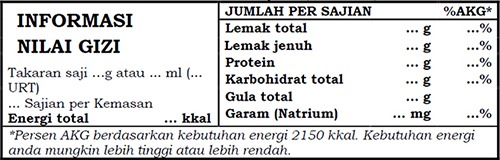
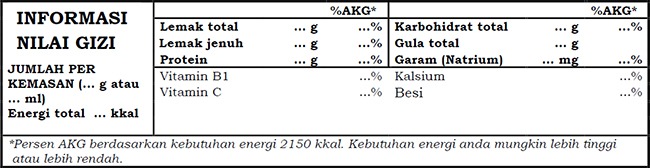
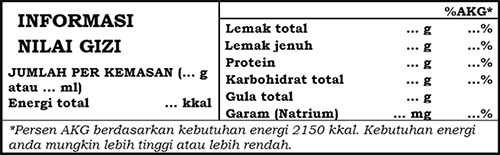
BPOM Regulation No. 10 of 2026 updates the standardized formats for the nutritional value information (ING) table. The regulation continues to allow both vertical and horizontal formats and now provides clearer templates for use on product labels.

For horizontal presentation, businesses may use either a three-column tabular format, which provides more space for displaying nutrient information and additional vitamins or minerals, or a two-column tabular format, which offers a simplified layout suitable for products with limited label space.


Three-column per-serving tabular format
 

Two-column per-serving tabular format
 

Three-column per-package tabular format
 

Two-column per-package tabular format


BPOM Regulation No. 10 of 2026 also introduces specific flexibility for micro-enterprises regarding the ING table. If analytical results are unavailable and the value of a processed food nutrient has not yet been established by the head of BPOM, the values in the ING table should be declared based on calculation results. The procedure for calculating the nutrient content for processed foods produced by micro-enterprises was established by the head of BPOM in 2026 and involves mostly traditional Indonesian food products.

Transition Period

BPOM Regulation No. 10 of 2026 provides a 24-month transition period to facilitate compliance with the new requirements, so processed foods that had already obtained distribution permits before the regulation entered into force, as well as products that were undergoing registration at that time, must be brought into compliance with the new regulation by June 17, 2028. Similar transitional provisions apply to the implementation of Nutri-Level labeling requirements for affected beverage products. As a result, food business operators are afforded additional time to review product portfolios, update nutritional information, and revise product labels where necessary.

Business Impact

The new regulation will require many food and beverage businesses to review their existing nutrition labeling practices in order to comply with the new requirements. In particular, companies should assess the impact of the revised nutrient reference values, updated serving-size requirements, and Nutri-Level labeling requirements on their products.

The Nutri-Level requirements will be especially relevant for beverage manufacturers. Businesses should therefore begin evaluating their product portfolios and preparing any necessary label updates to ensure compliance before the expiry of the 24-month transition period.


RELATED INSIGHTS​ 

June 5, 2026
On May 25, 2026, Vietnam’s Ministry of Health issued Circular No. 16/2026/TT-BYT governing free-of-charge medicine support programs for medical establishments (Circular 16). Circular 16 will take effect on July 10, 2026, replacing Circular No. 31/2018/TT-BYT, which currently regulates the same subject matter. Circular 16 introduces several significant changes compared to the existing legal framework. Removal of Prior Approval Requirement Under the current regulations, free-of-charge medicine support programs are divided into two categories: (1) entirely free-of-charge provision of medicines for all types of drugs and (2) partially free-of-charge provision applicable only to brand-name drugs under patent protection or drugs whose generic products with identical active ingredients and dosage forms are available in Vietnam. Under the current regulations, partially free-of-charge programs are subject to mandatory registration with the competent authority, while entirely free-of-charge programs could be implemented without prior approval. A key reform under Circular 16 is that it stipulates only entirely free-of-charge medicine support programs applicable to all types of medicines, thereby eliminating the partially free-of-charge category. In addition, free-of-charge medicine support programs may be carried out solely based on a written agreement between the pharmaceutical company and the medical establishment, without any requirement for prior approval from competent authorities prior to implementation. Written Agreement Requirements Circular 16 requires the pharmaceutical company and medical establishment to enter into a written agreement in accordance with a prescribed template. This agreement must include the following compulsory information: Information on the supported medicines Form of support (entirely free-of-charge provision to patients) Quantity of medicines provided Target patient groups and applicable indications Duration of the program Rights and obligations of each party Transitional provisions on the protection of patients’ rights upon completion of the program The agreement may contain other contents as agreed by the parties, provided that these do not contradict applicable laws.
June 4, 2026
Indonesia’s Minister of Health has issued Decree No. HK.01.07/MENKES/301/2026 on the Affixation of Nutritional Labels and Health Information to Ready-to-Eat Processed Food Products. The decree came into force on April 14, 2026, and was issued to implement the Health Law and Minister of Health Regulation No. 3 of 2026 on Disease Control. The decree requires the inclusion of Nutri-Level labeling on the front-of-pack nutrition labeling (FOPNL) to indicate the product’s nutritional level based on the content of sugar, salt, and fat (“gula, garam dan lemak (GGL)”). Changes from 2024 Draft Regulation The Nutri-Level labeling was previously proposed in 2024 by the Indonesian FDA (BPOM) through a draft regulation concerning nutrition information. While the categories of Nutri-Level labeling remain the same in the issued decree, the content requirements of sugar, salt and fat in the decree are different from the earlier proposal introduced in the 2024 draft BPOM regulation. In addition, the decree has further specified that the content of fat in the Nutri-Level labeling is the content of saturated fat, not total fat as previously proposed in the 2024 draft. The decree requires Nutri-Level labeling to be implemented in beverage products, which is the same as previously proposed in the 2024 draft BPOM regulation. Other food products may gradually become subject to mandatory Nutri-Level labeling under future implementing regulations. Nutri-Level Labeling Food levels as shown by the Nutri-Level labeling are classified into four color-coded categories from A to D: Level A (lowest amount) in dark green Level B in light green Level C in yellow Level D (highest amount) in red The Nutri-Level labeling is represented by the following image. The requirements for each level for sugar, salt, and fat content, based on amounts per 100 milliliters of product in beverage form, are as follows. Nutri-Level information must be
May 29, 2026
Indonesia’s Food and Drug Authority (BPOM) has issued Regulation No. 7 of 2026 on Drug Promotion and Advertising, establishing an updated framework for promotional activities involving medicinal products in Indonesia. The regulation took effect on April 16, 2026, and supersedes BPOM Regulation No. 2 of 2021 on Drug Advertising Supervision. The new regulation maintains general principles for advertising content, including requirements that advertisements be objective, complete, and not misleading, as further detailed in its annex. It also confirms that advertisements for nonprescription drugs directed to the public must obtain prior approval from BPOM before publication and must be in Bahasa Indonesia. The regulation provides a more comprehensive framework governing how drug promotion is conducted, introducing several notable additions and changes, as described below. Procedure and Requirements for Drug Advertisement Approval To apply for a drug advertisement approval, applicants must create an online account through the dedicated portal SIAPIK. Advertisement approval is available only for registered drugs; unregistered drugs are not eligible for advertisement approval with BPOM. The application must include the advertisement design, along with a translation if the design contains any wording in a foreign language. The submission format varies by media type, requiring, for example, copies in the form of print advertisements for visual media, scripts for audio media, and storyboards for audiovisual media. For online media—including social media—submissions should include any captions, descriptions, and hashtags that form an integral part of the advertising material. The approval timeline takes approximately 3–4 months, as BPOM will generally request additional information or revisions during the verification and evaluation process. Applicants have 20 days to submit any such requested documents. BPOM may also conduct a reevaluation of advertisements that have already received approval, based on monitoring results or new information regarding the safety and quality of the advertised drug. This
May 11, 2026
Vietnam’s legal framework governing chemicals has undergone significant reform, with the Law on Chemicals No. 69/2025/QH15 (Law on Chemicals 2025) taking effect on January 1, 2026. Together with a comprehensive set of implementing instruments issued in January 2026, including three decrees (No. 24/2026/ND‑CP, No. 25/2026/ND‑CP, and No. 26/2026/ND‑CP) and two circulars (No. 01/2026/TT‑BCT and No. 02/2026/TT‑BCT), the Law on Chemicals 2025 has significantly reshaped chemical registration and management requirements. Determining What Constitutes a “New Chemical” Among the most notable changes introduced under the Law on Chemicals 2025 are the rules governing the registration and management of new chemicals, which must be registered with the authority before being placed on the Vietnam market. Although the concept of new chemical registration was first introduced under the Law on Chemicals 2007, the corresponding registration mechanism has remained largely dormant in practice. Under the Law on Chemicals 2025, a “new chemical” is defined as a substance that is not yet included in Vietnam’s National Chemical Inventory and the list of foreign chemical inventories recognized by the competent Vietnamese authority (List of Foreign Chemicals). On a literal reading, the definition in the new law may suggest that a substance qualifies as a new chemical only if it is absent from both lists. Accordingly, a chemical present in either list should be treated as an existing chemical without the registration burden. However, a different interpretation emerges from Decree 26, which specifically requires registration of “new chemicals” even where such substances already appear in the List of Foreign Chemicals. This implies that inclusion in a recognized foreign inventory does not automatically exempt a substance from new chemical registration in Vietnam. This inconsistency between the statutory definition in the Law on Chemicals 2025 and the implementing provisions of Decree 26 creates significant interpretative and compliance challenges. At