
You are using an outdated browser and your browsing experience will not be optimal. Please update to the latest version of Microsoft Edge, Google Chrome or Mozilla Firefox. Install Microsoft Edge

August 10, 2026

Changes in Nutrition Labeling Requirements in Indonesia

On June 17, 2026, Indonesia’s National Agency of Drug and Food Control (BPOM) issued BPOM Regulation No. 10 of 2026 on Nutritional Information on Processed Food Labels.

The new regulation, which revokes three previous nutrition labeling regulations, introduces several notable changes affecting food and beverage manufacturers, importers, and distributors. These changes range from updated nutrient reference values and serving-size requirements to the introduction of the Nutri-Level front-of-pack labeling system for certain beverage products. Businesses operating in Indonesia should carefully review these developments and assess their products’ compliance with the new requirements during the transition period.

Implementation of the Nutri-Level Labeling System

To implement the recently issued decree on Nutri-Level labeling, BPOM Regulation No. 10 of 2026 stipulates the requirements to implement the Nutri-Level labeling system on the front-of-pack. Under the new framework, ready-to-drink beverages, powdered beverages, and liquid or solid concentrates are required to display Nutri-Level labeling on the front label of their packaging.

The Nutri-Level labeling system classifies products into color-coded levels A through D based on their sugar, sodium, and total fat content. The applicable Nutri-Level is determined based on the lowest level measured in the assessment of sugar, sodium, and total fat content.

For products classified as level C or D, the Nutri-Level label must be accompanied by information on the relevant sugar, sodium, and total fat content per 100 ml of the ready-to-consume product. Products classified as level A or B may either display only the Nutri-Level designation or display the Nutri-Level together with the relevant nutritional information per 100 ml.

Minimum Vitamin and Mineral Content Required for Declaration

BPOM Regulation No. 10 of 2026 introduces a stricter threshold for the declaration of vitamins and minerals in the nutritional value information section (ING).

Vitamins or minerals may only be declared if they are present at a level of at least 5% of the recommended dietary allowance (RDA) per serving, per 100 g, per 100 ml, or per package, in accordance with the inclusion of the ING table, except for processed foods that declare vitamins or minerals claims in accordance with certain laws and regulations. This represents a significant change from the previous regime under the now-revoked BPOM Regulation No. 26 of 2021, under which vitamins and minerals could be declared when present at a level of at least 2% of the RDA per serving.

Revised Serving Size Requirements

While serving size declarations were already required under BPOM Regulation No. 26 of 2021, BPOM Regulation No. 10 of 2026 introduces additional technical guidance on serving-size determination and presentation. The new regulation expressly requires serving sizes to be rounded to the nearest half-unit, providing a standardized approach to serving-size calculations across product categories. An exception applies to products classified under food category 11.6 (sweeteners, including table-top sweeteners and high-intensity sweeteners), which may require businesses to review and, where necessary, update their existing nutrition labeling.

In addition, an appendix to Regulation No. 10 of 2026 sets out updated serving-size references for a wide range of food categories. As a result, food business operators should review the revised category-specific serving-size references to determine whether their existing nutrition information tables, nutrient calculations, and serving-size declarations remain compliant under the new framework. Although serving-size requirements were already regulated under BPOM Regulation No. 26 of 2021, the 2026 regulation provides greater technical detail and updated references that may necessitate label revisions for certain products.

Updated Nutrient Reference Values

BPOM Regulation No. 10 of 2026 updates the nutrient reference values previously set forth in BPOM Regulation No. 9 of 2016 to correspond with the current development of scientific knowledge in health. Several reference values have been revised from those in BPOM Regulation No. 9 of 2016 (e.g., for total fat, vitamin B1, vitamin B2, vitamin B12, magnesium, potassium, and various other vitamins and minerals). As these values are used to calculate the percentage of RDA displayed in nutrition information tables, the revisions may affect the nutrient percentage calculations currently appearing on product labels.

The regulation also introduces updated nutrient reference methodologies and conversion factors. In particular, vitamin B3 may now be expressed in niacin equivalents (NE), folate may be expressed in dietary folate equivalents (DFE), and revised conversion factors have been adopted for vitamins A, D, and E. These changes are intended to align nutrition labeling requirements with current nutritional science and may require food business operators to reassess existing nutrient declarations and label calculations.

Updated Nutritional Value Information Table Formats

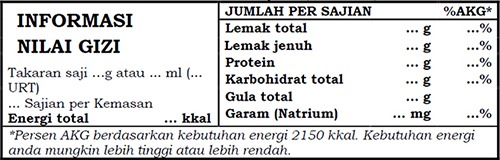
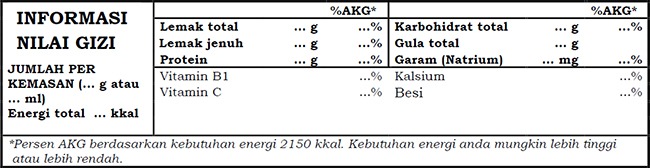
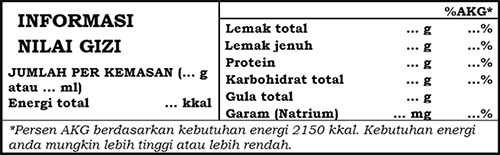
BPOM Regulation No. 10 of 2026 updates the standardized formats for the nutritional value information (ING) table. The regulation continues to allow both vertical and horizontal formats and now provides clearer templates for use on product labels.

For horizontal presentation, businesses may use either a three-column tabular format, which provides more space for displaying nutrient information and additional vitamins or minerals, or a two-column tabular format, which offers a simplified layout suitable for products with limited label space.


Three-column per-serving tabular format
 

Two-column per-serving tabular format
 

Three-column per-package tabular format
 

Two-column per-package tabular format


BPOM Regulation No. 10 of 2026 also introduces specific flexibility for micro-enterprises regarding the ING table. If analytical results are unavailable and the value of a processed food nutrient has not yet been established by the head of BPOM, the values in the ING table should be declared based on calculation results. The procedure for calculating the nutrient content for processed foods produced by micro-enterprises was established by the head of BPOM in 2026 and involves mostly traditional Indonesian food products.

Transition Period

BPOM Regulation No. 10 of 2026 provides a 24-month transition period to facilitate compliance with the new requirements, so processed foods that had already obtained distribution permits before the regulation entered into force, as well as products that were undergoing registration at that time, must be brought into compliance with the new regulation by June 17, 2028. Similar transitional provisions apply to the implementation of Nutri-Level labeling requirements for affected beverage products. As a result, food business operators are afforded additional time to review product portfolios, update nutritional information, and revise product labels where necessary.

Business Impact

The new regulation will require many food and beverage businesses to review their existing nutrition labeling practices in order to comply with the new requirements. In particular, companies should assess the impact of the revised nutrient reference values, updated serving-size requirements, and Nutri-Level labeling requirements on their products.

The Nutri-Level requirements will be especially relevant for beverage manufacturers. Businesses should therefore begin evaluating their product portfolios and preparing any necessary label updates to ensure compliance before the expiry of the 24-month transition period.


RELATED INSIGHTS​ 

May 15, 2025
Vietnam’s Ministry of Health (MOH) has published for public consultation a draft amendment of the Law on Donation, Recovery, and Transplantation of Human Tissues and Organs and Donation and Retrieval of Cadavers, a law which has been in effect since 2007. Among its changes, the draft amendment notably includes new provisions on stem cells, a hot-button topic with social, legal, and ethical ramifications extending beyond the medical field. There are currently no specific regulations on stem cells under Vietnamese law—only the MOH’s technical guidance—leaving many controversial issues unsettled. Key points related to stem cells that may impact the activities of researchers and institutions in Vietnam and abroad are highlighted below. Requirements for Stem Cells Under the draft amendment, stem cells are defined as cells naturally occurring in the body, having the ability to divide and differentiate into various types of cells. The draft amendment outlines conditions for stem cell donation, establishes requirements for medical facilities authorized to receive stem cell donations, and specifies the rights of stem cell donors. Under the draft amendment, it is prohibited to receive, screen, or produce stem cells at facilities that do not satisfy conditions. Establishment of Private Stem Cell Banks In addition to state-owned stem cell banks, the draft amendment also addresses independent stem cell banks established by private investors. In general, the stem cell banks (whether public or private) must obtain an operation license by meeting various conditions on personnel, equipment, facilities, and management systems to be further guided by the government. Notably, stem cell banks will have the right to cooperate with foreign entities in exchanging stem cells for treatment, education, and research purposes. Prohibition on Creating Embryos for Stem Cell Research or Therapy Considering the ethical concerns over the use and destruction of embryos, the draft amendment expressly prohibits the
May 2, 2025
Attorneys from Tilleke & Gibbins have updated the latest edition of Doing Business in Thailand, a Q&A-style guide from Thomson Reuters Practical Law that offers an overview of key legal considerations for companies operating in jurisdictions worldwide. The contribution outlines the country’s legal and regulatory framework for foreign investment and business operations and reflects the latest legislative developments. The chapter addresses the following core topics: Legal system: Structure of the courts and the codified nature of Thai law. Foreign investment: Business restrictions under the Foreign Business Act, sector-specific regulations, exchange control rules, and investment incentives. Business vehicles: Overview of partnerships, private and public limited companies, and other legal entities. Employment: Labor protections, employment contracts, foreign worker requirements, and termination procedures. Tax: Corporate and personal income tax, indirect taxes, and tax obligations for residents and non-residents. Intellectual property: Registration and enforcement of patents, trademarks, designs, and copyrights. Data protection: Key provisions of the Personal Data Protection Act and related compliance obligations. Competition law: Regulatory framework under the Trade Competition Act. Anti-bribery and corruption: Relevant legislation and enforcement mechanisms. E-commerce and digital business: Legal regime for online transactions and digital platforms. Marketing and advertising: Consumer protection laws and regulations affecting advertising and marketing practices. Product regulation and liability: Safety standards, liability regimes, and roles of enforcement authorities. Practical Law, a legal reference resource from Thomson Reuters, publishes a range of guides for hundreds of jurisdictions and practice areas. The insurance and reinsurance guide is a valuable resource for legal practitioners, covering numerous jurisdictions worldwide. To view the latest version of the guide, please visit the Practical Law website and enroll in the free Practical Law trial to gain full access.
March 7, 2025
On November 22, 2024, the Ministry of Health (MOH) in Laos issued Decision No. 3730/MOH, which regulates the management, processing, production, and use of biopharmaceutical products, genes, and stem cells. This decision came into force on January 18, 2025, 45 days after its publication in the Lao Official Gazette on December 4, 2024. This decision signifies Laos’ recognition and acceptance of biopharmaceutical products, genes, and stem cells for use in medical treatments and the beauty industry, and it aligns with the ongoing development of biomedical sciences in the country. Definitions The MOH’s decision defines biopharmaceuticals, gene therapy, and stem cells as follows: “Biopharmaceutical products” refers to a type of biological or drug product that is produced or synthesized from natural substances, objects, or chemicals. This group of products includes blood, blood components, allergens, cells or cellular components, gene therapies, tissues, protein-based medicines, drugs derived from living cells, and biologics, which can be produced from sugars, proteins, amino acids, or substances with complex characteristics derived from organic sources such as human, animal, and plant parts; yeast; and microorganisms. These products exclude vaccines and biosimilar products, which will be specified under separate regulations. “Gene therapy” refers to a treatment approach that applies the principle of arranging amino acids (which could involve DNA or RNA sent to the patient’s cells in the form of a drug with the purpose of treating a certain disease). “Stem cells” are defined in the decision as cells or immature cells that can be sourced from various organs in the They are characterized by being undifferentiated, having the potential for differentiation, and being self-renewing. Stem Cell Production The decision outlines comprehensive provisions for managing and using raw materials in stem cell production. Key points include: Production location standards: Ensuring facilities meet specific standards of the MOH. Personnel
December 13, 2024
Experts from Tilleke & Gibbins have provided updates for the latest edition of The Pharma Legal Handbook: Vietnam, published by Pharma Boardroom. This comprehensive guide to the legal framework regulating the healthcare and life sciences industries in Vietnam was authored by by the Hanoi-based team of Hien Thi Thu Vu, head of regulatory affairs for Vietnam, and Mai Thi Le, regulatory affairs consultant, the handbook is a must-read for healthcare and life sciences companies that are interested in the Vietnam market. The guide includes eight sections on various important aspects of local regulations: Regulatory, Pricing, and Reimbursement Overview Preclinical & Clinical Trial Requirements Marketing, Manufacturing, Packaging & Labeling, and Advertising Traditional Medicines and Over-the-Counter Products Product Liability Patents and Trademarks Regulatory Reforms Orphan Drugs and Rare Diseases Tilleke & Gibbins has also authored The Pharma Legal Handbook: Thailand, which was updated at the same time as the Vietnam guide. The Pharma Legal Handbook: Vietnam, like all of the country guides from Pharma Boardroom, is available for purchase on the Pharma Boardroom website.