You are using an outdated browser and your browsing experience will not be optimal. Please update to the latest version of Microsoft Edge, Google Chrome or Mozilla Firefox. Install Microsoft Edge

March 29, 2023

Cambodia Issues Decision on Thresholds for Merger Filings

On March 14, 2023, the Competition Commission of Cambodia (CCC) set out its merger filing thresholds in Decision No. 095 on Thresholds for Prior Notification of Business Mergers. This was a follow-up to the recent issuance of a regulation outlining the requirements and procedures for merger and acquisition filings. Decision No. 095 applies to all business combinations subject to premerger notification requirements under this prior regulation.

The thresholds for when the CCC must be notified of a merger are laid out in the table below.
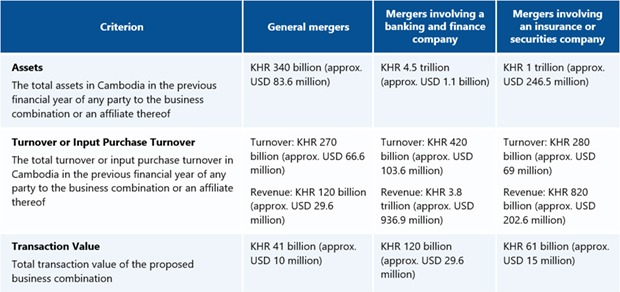
In current practice, the term “turnover” typically refers to a company’s total sales revenue, while “input purchase turnover” denotes the value of materials or equipment acquired for production purposes. Although this reflects the initial interpretation of these terms, it is advisable to seek confirmation or clarification from the CCC before the filing to ensure accuracy and alignment with their current definitions, as it is conceivable that the interpretation may change.

Decision No. 095 leaves room for the Ministry of Commerce to amend these thresholds as deemed necessary.

Outlook

In the last two years, Cambodia has steadily issued regulations to strengthen its legal framework for competition. Although gaps remain, especially with regard to enforcement of fines and certain unclear terms, more regulations are likely in 2025 and 2026.


RELATED INSIGHTS​ 

March 17, 2023
On March 6, 2023, Cambodia issued requirements and procedures for merger and acquisition (M&A) filings to allow the country’s competition regulator to monitor the impact of M&A transactions on the Cambodian market. These rules are contained in Sub-decree No. 60 on the Requirements and Procedures for Business Combinations. This subdecree is the latest in a series of detailed regulations issued to develop Cambodia’s competition and antitrust law framework since the 2021 enactment of the Law on Competition, which formally established the Cambodia Competition Commission (CCC), set out the CCC’s complaint and investigation procedures, listed prohibited anticompetitive practices, and outlined applicable penalties. Sub-decree No. 60 applies to any business combination that may materially affect competition in Cambodia, regardless of where in the world it takes place. Premerger and Postmerger Notifications The parties to a business combination must notify the CCC of the proposed combination if the transaction meets certain thresholds, which will be determined by the CCC at a future date. The notification must include, among other things, key terms of the relevant agreements, incorporation documents and financial statements of the parties, and an indication of the types of goods or services provided by the parties. All documentation submitted must be in Khmer, except for names, addresses, and certain other items. The CCC will determine within seven working days whether it requires additional information or documentation. Once it has all necessary documentation, the CCC will issue a decision on the proposed business combination within 30 days—the combination may be approved outright or declared subject to a secondary review. Sub-decree No. 60 states that a proposed business combination will not be subject to secondary review if the market share of each party does not exceed 30 percent in each relevant market, among other criteria. However, the CCC reserves to right to
March 7, 2023
According to the Ministry of Health of Vietnam, many healthcare facilities in the country are facing a shortage of drugs, medical devices, and materials/chemicals. To address the urgent needs of medical examination and treatment in public healthcare facilities, on March 4, 2023, the government of Vietnam promulgated Resolution No. 30/NQ-CP on continuing to implement solutions to ensure the availability of drugs, medical equipment, and healthcare supplies (“Resolution 30”). Resolution 30 amends item 4 of Resolution No. 144/NQ-CP dated November 5, 2022, allowing medical examination and treatment expenses to continue to be covered by health insurance for technical services carried out with medical devices supplied by contractors after winning tenders to supply materials and chemicals. The new mechanism brings more benefit to patients by removing the previous ending date of November 5, 2023, and will be applicable until there is further guidance from the government. Resolution 30 also allows the use of medical devices that were donated or gifted by domestic and foreign entities (including those that were provided under now-expired joint ventures or cooperation contracts) regardless of whether those entities have fulfilled the procedures for ownership establishment. Technical services that are performed by such devices will be covered by health insurance. This provision will help address the shortage of medical devices used in public hospitals. The determination of bid price is also a highlight of Resolution 30, which pilots a simpler price determination procedure for the purchase of drugs and medical devices. Instead of requiring purchasers to obtain quotations from three suppliers, Resolution 30 allows them to compare prices based on the quotations actually received, even from only one or two suppliers. Alternatively, price determination can be based on the winning bid price for a similar medical device procurement package that was awarded within the last 120 days. This
March 3, 2023
The newly released Licensing 2023 guide published by Lexology Getting the Deal Through features a chapter on Vietnam by four licensing specialists from Tilleke & Gibbins. The comparative guide provides companies and other interested readers with information on licensing law and practice in various jurisdictions around the world. Licensing 2023 provides detailed information on the following topics: Restrictions, laws and licensing arrangements Intellectual property issues: Paris Convention for the Protection of Industrial Property, contesting the validity of licensor’s IP rights, invalidity and expiry of IP rights, security interests, proceedings against third parties, sublicensing, jointly owned IP, first to file, scope of patent protection, trade secrets, copyright Software licensing: Perpetual licensing, legal requirements, user restrictions Royalties and payments, currency conversion, and taxes: Relevant legislation, restrictions, taxation of foreign licensors Competition law issues: Restrictions on trade, legal restrictions, and IP-related court rulings Indemnification, disclaimers, and damages: Prevalence and enforceability of indemnity provisions and contractual waivers of damages Termination: Right to terminate, impact of termination Bankruptcy: Impact of licensee or licensor bankruptcy Dispute resolution: Governing law, arbitration, enforceability, injunctive relief, contractual waivers The Vietnam chapter was authored by Linh Thi Mai Nguyen, partner and head of Tilleke & Gibbins’ trademark team in Vietnam; Son Thai Hoang, trademark executive; and Chi Lan Dang, associate, of Tilleke & Gibbins’ trademark team, along with corporate and commercial senior associate Tu Ngoc Trinh, who has extensive experience in franchising and competition law. The Vietnam chapter is available below as a PDF. Tilleke & Gibbins also contributed the Thailand chapter to Licensing 2023. To browse all jurisdictions covered by the guide, please visit the Getting the Deal Through website.
March 3, 2023
Two of Tilleke & Gibbins’ life science specialists in Bangkok have contributed the Thailand chapter to the newly issued Licensing 2023, a comprehensive guide from Lexology Getting the Deal Through to licensing in various jurisdictions around the world. The Thailand chapter covers the following topics: Laws and licensing arrangements: Unfair Contract Terms Act, Trade Competition Act, pre-contractual disclosure, registration of international licensing, implied obligations, Civil and Commercial Code, Trademark Act, Patent Act, Trade Secrets Act Intellectual property issues: Paris Convention for the Protection of Industrial Property, contesting the validity of licensor’s IP rights, invalidity and expiry of IP rights, security interests, proceedings against third parties, sublicensing, jointly owned IP, first to file, scope of patent protection, trade secrets, copyright Software licensing: Perpetual licensing, legal requirements, user restrictions Royalties and payments, currency conversion, and taxes: Relevant legislation, restrictions, taxation of foreign licensors Competition law issues: Restrictions on trade, legal restrictions, and IP-related court rulings Indemnification, disclaimers, and damages: Prevalence and enforceability of indemnity provisions and contractual waivers of damages Termination: Right to terminate, impact of termination Bankruptcy: Impact of licensee or licensor bankruptcy Dispute resolution: Governing law, arbitration, enforceability, injunctive relief, contractual waivers The full Thailand chapter is available below as a PDF. Tilleke & Gibbins also contributed the Vietnam chapter to Licensing 2023. To browse all jurisdictions covered by the guide, please visit the Getting the Deal Through website.