You are using an outdated browser and your browsing experience will not be optimal. Please update to the latest version of Microsoft Edge, Google Chrome or Mozilla Firefox. Install Microsoft Edge

March 29, 2023

Cambodia Issues Decision on Thresholds for Merger Filings

On March 14, 2023, the Competition Commission of Cambodia (CCC) set out its merger filing thresholds in Decision No. 095 on Thresholds for Prior Notification of Business Mergers. This was a follow-up to the recent issuance of a regulation outlining the requirements and procedures for merger and acquisition filings. Decision No. 095 applies to all business combinations subject to premerger notification requirements under this prior regulation.

The thresholds for when the CCC must be notified of a merger are laid out in the table below.
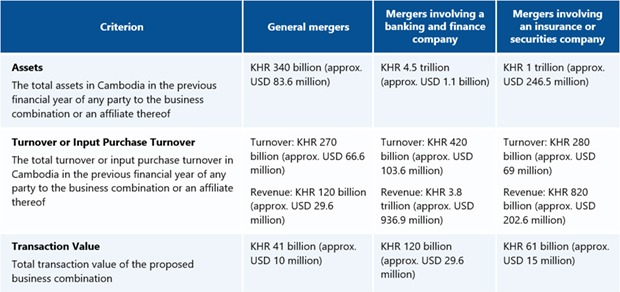
In current practice, the term “turnover” typically refers to a company’s total sales revenue, while “input purchase turnover” denotes the value of materials or equipment acquired for production purposes. Although this reflects the initial interpretation of these terms, it is advisable to seek confirmation or clarification from the CCC before the filing to ensure accuracy and alignment with their current definitions, as it is conceivable that the interpretation may change.

Decision No. 095 leaves room for the Ministry of Commerce to amend these thresholds as deemed necessary.

Outlook

In the last two years, Cambodia has steadily issued regulations to strengthen its legal framework for competition. Although gaps remain, especially with regard to enforcement of fines and certain unclear terms, more regulations are likely in 2025 and 2026.


RELATED INSIGHTS​ 

February 21, 2023
On December 28, 2022, the Ministry of Health of Laos issued Decision No. 3789/MOH on the Control of Hemp for Medication and Products (the “Decision”). The Decision approves the regulated cultivation, extraction, production, processing, storage, distribution, utilization, import-export, and transport of hemp. The Decision also authorizes the use of hemp and hemp-related products by the general population, although use of certain products is limited to those with medical prescriptions. Background In 2019, the Lao government established an ad hoc committee to consider the legalization of cannabis, as reported previously. The government permitted certain local companies to grow cannabis in specific zones under pilot programs, although it continued to strictly prohibit the use and commercialization, as well as consumption, of cannabis-related products, regardless of the level of psychoactive tetrahydrocannabinol (THC) in the products. Overview of the Decision The Decision was issued by the Ministry of Health (which led the ad hoc committee) and permits authorized companies to engage in certain activities involving the use of hemp and the consumption of hemp and hemp-related products. The Decision defines hemp (“porkeo” in Lao) as a “plant that belongs to the same family as ganja and bears the scientific name Cannabis Sativa L. (Cannabis sativa L. subsp. sativa var. sativa) which is a subspecies of ganja (Cannabis Sativa L.).” This definition aims at differentiating hemp from the general definition of ganja or marijuana, which continues to be listed as a prohibited narcotic in Laos. The Law on Narcotics (2007) and the Penal Code (2017) still prohibit the production, trade and use of all types of cannabis. These laws will need to be amended to ensure that they are aligned with changes set out in the Decision.  Authorized Hemp Activities The Decision allows approved companies to engage in the cultivation, extraction, production, processing, storage,
February 20, 2023
On December 20, 2022, the Notification re: Rules, Procedures, and Conditions on Transfer of Energy Licenses of the Thailand Energy Regulatory Commission (ERC) became effective. The notification sets out the new standard and procedure for transferring licenses for energy industry operation. The notable changes in the notification are provided below. Anti-Competition Consideration and Impact Assessment Report In considering the transfer of a license, in addition to ensuring the transferee meets all the qualifications for an applicant for the license, the ERC will consider if the transfer would (1) create a monopoly, reduce or restrict competition, or result in market dominance; (2) affect the contracting parties of the transferors or energy users; or (3) affect energy security or the public interest. In this respect, the vetting process for an application for license transfer would be separated into two different approaches. If the ERC believes that the transfer of the energy license would affect competition, energy users, energy security, or the public interest, the transferor will need to submit an impact assessment report on the license transfer to the ERC. In this regard, the ERC may establish a sub-committee or an independent consultant to contemplate the transfer at the transferor’s expense. However, if the ERC believes that the transfer of license would not lead to any impact, the transferor will not be required to submit the impact assessment. Also, if the license transfer is related to any transactions specified under the ERC’s Regulation re: Rules and Procedures on Merger and Cross-Shareholding in Energy Businesses, B.E. 2565, the ERC can combine the license transfer application with the M&A application. After approval, the ERC might require the transferee to periodically report to the ERC and comply with measures stipulated by the ERC. Therefore, an energy license holder which plans to carry out M&A
February 16, 2023
Thailand has issued a Royal Decree on the Supervision of Regulated Digital Identification Authentication and Verification Service Businesses B.E. 2565 (2022) (the “Royal Decree”), aimed at regulating business operators that provide digital identification authentication and verification services (“Digital ID Services”). The Royal Decree was published in the Government Gazette in December 2022, and will take effect 180 days from the publication date, i.e., on June 21, 2023. The key details and requirements of the Royal Decree are as follows: Regulated Digital ID Services Under the Royal Decree, the provision of the following Digital ID Services requires prior approval from the Electronic Transaction Development Agency: Identity verification service – Services for collecting and identifying information relating to the identity of a person, and verifying the connections between the person and the identity. Authenticator issuance and management service – Services relating to the connection between a person who has passed the identification process with an authenticator, and managing actions which are used to identify a person. Authentication service – A process to authenticate a person by inspecting his/her authenticator. Digital ID networks/systems – Provision of networks or systems used to exchange information for digital identification purposes, excluding services provided by an intermediary. Exempted Digital ID Services The Royal Decree also specifies a list of Digital ID Services that are exempted from supervision under the Royal Decree, as follows: Issuance of certificates to support the use of electronic signatures in accordance with the Electronic Transaction Act. Digital ID Services conducted for use within the operator’s own business only, and which do not involve the provision of such services to third parties. Other Digital ID Services as prescribed by the Electronic Transaction Committee. Qualifications of Business Operators The types of business operators qualified to operate Digital ID Services include (i) private limited companies;
February 16, 2023
On February 10, 2023, the government of Vietnam issued Decree No. 03/2023/ND-CP regulating the functions, rights and duties, and organizational structure of the National Competition Commission (“Decree 03”). The National Competition Commission (official English name Vietnam Competition Commission or VCC) was first mentioned in the updated Law on Competition of 2018 and is meant to be the leading authority responsible for the state management of competition matters in Vietnam. However, nearly five years later, no penalty decisions for competition violations under the Law on Competition 2018 have been issued, due to a lack of regulations on the functions of the VCC. Thus, the issuance of Decree 03 is an important milestone and is expected to increase the authorities’ enforcement against competition-related violations in Vietnam. The VCC is an agency under the Ministry of Industry and Trade (MOIT) and consolidates the previous Vietnam Competition Council and Vietnam Competition Authority. The VCC is mainly responsible for: (1) carrying out competition proceedings, (2) controlling economic concentration, (3) deciding on exemptions from prohibited anti-competitive agreements, (4) handling appeals of decisions on settlement of competition cases; (5) advising and assisting the MOIT in performing the state management of competition, protecting consumers’ interests, and managing multi-level marketing activities; and (6) other responsibilities as may be assigned by the MOIT. For each case of alleged anti-competition, the chair of the VCC will establish a Council for Handling Anti-Competitive Case, which will dissolve itself upon the fulfillment of its responsibilities. The VCC is made up of 15 members, including the chair and one or more vice chairs, and will also include the following departments: Competition investigation agency; Secretariat of Councils for Handling Anti-Competitive Cases; Competition Supervision Board; and Units perform the function of state management of competition, protection of consumers’ interests, and management of multi-level marketing activities.