You are using an outdated browser and your browsing experience will not be optimal. Please update to the latest version of Microsoft Edge, Google Chrome or Mozilla Firefox. Install Microsoft Edge

March 29, 2023

Cambodia Issues Decision on Thresholds for Merger Filings

On March 14, 2023, the Competition Commission of Cambodia (CCC) set out its merger filing thresholds in Decision No. 095 on Thresholds for Prior Notification of Business Mergers. This was a follow-up to the recent issuance of a regulation outlining the requirements and procedures for merger and acquisition filings. Decision No. 095 applies to all business combinations subject to premerger notification requirements under this prior regulation.

The thresholds for when the CCC must be notified of a merger are laid out in the table below.
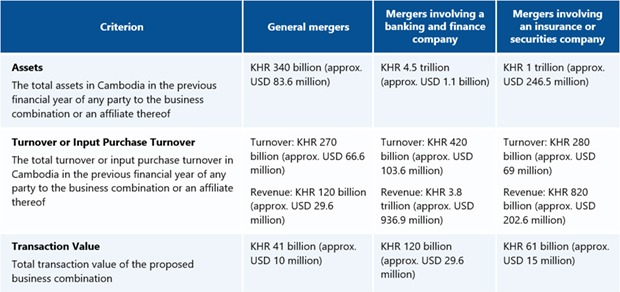
In current practice, the term “turnover” typically refers to a company’s total sales revenue, while “input purchase turnover” denotes the value of materials or equipment acquired for production purposes. Although this reflects the initial interpretation of these terms, it is advisable to seek confirmation or clarification from the CCC before the filing to ensure accuracy and alignment with their current definitions, as it is conceivable that the interpretation may change.

Decision No. 095 leaves room for the Ministry of Commerce to amend these thresholds as deemed necessary.

Outlook

In the last two years, Cambodia has steadily issued regulations to strengthen its legal framework for competition. Although gaps remain, especially with regard to enforcement of fines and certain unclear terms, more regulations are likely in 2025 and 2026.


RELATED INSIGHTS​ 

February 21, 2025
As Vietnam continues its government restructuring, including the merging of several key ministries, the country is signaling that mergers of provinces could be next. Conclusion 126-KL/TW of the Politburo and Secretariat, issued on February 14, 2025, sets out several tasks for continuing to streamline the political system in 2025, notably including, among others, the following: Elimination of intermediate administrative levels, and mergers of provincial units: The Government Party Committee is tasked with researching and planning for the elimination of intermediate administrative levels (district levels); reorganizing the commune level with structures, functions, duties, powers, and responsibilities aligned with the new organizational model; and proposing the merging of some provincial administrative units. A report to the Politburo is required by Q3 2025. Reorganization of police structure: The Central Public Security Party Committee is tasked with leading and coordinating the implementation of a three-tier police organization, eliminating the district-level police. Judicial system reforms: The Central Party Committees of the Supreme People’s Court and the Supreme People’s Procuracy are tasked with researching and advising on the organizational model for courts and procuracies, and proposing amendments and supplements to relevant party mechanisms and state laws, with the aim of eliminating the district level. A report to the Politburo is required by Q2 2025. Implications of Merging Provinces The merging of provinces could bring positive impacts as well as new challenges. The expected benefits include: Administrative efficiency and cost saving: Reducing the number of administrative units could lead to more efficient governance and decision-making processes, as well as lower administrative costs due to fewer government offices and personnel. Economic development: Larger administrative areas can benefit from better allocation of resources and infrastructure development. Larger provinces may also attract more investment due to increased economic potential and market size. Improved service delivery: Public services could improve
February 19, 2025
On January 3, 2025, the Bank of the Lao PDR (BOL) issued Decision No. 11/BOL on the Use of Foreign Currency in Lao PDR, taking effect on the same date. This decision sets out the rules for using foreign currency in Laos and ensures the Lao kip (LAK) remains the primary currency while allowing flexibility for international transactions. Key points in the decision are outlined below. Permissible Activities for Foreign Currency The decision provides that authorized entities can use foreign currency as a secondary currency to LAK in the setting of cost and pricing structures, announcing and advertising prices, and making or receiving payments for goods and services that are imported or have manufacturing inputs imported from other countries. Otherwise, LAK is the only permitted currency. The decision also stipulates that foreign exchange must be conducted only via authorized commercial banks or foreign exchange markets. The exchange rate for setting costs, pricing structures, announcing and advertising prices, and making and receiving payments for goods and services in foreign currency must match the exchange rate announced by commercial banks from time to time. Businesses Allowed to Use Foreign Currency The decision allows certain businesses and organizations to use foreign currency. These entities are divided into two groups: those that need approval before using foreign currency, and those that can use it immediately. Enterprises that can use foreign currency with BOL approval include: Businesses that export goods or services and entities that lease or obtain concessions from the government, generating revenue in foreign currency through commercial banks. Enterprises that provide international freight and passenger transportation services. Enterprises that provide services related to cross-border logistics and warehousing. Enterprises located at international borders and airports, such as duty-free shops and restaurants. Enterprises that have obligations to make payments in foreign currency to other
February 11, 2025
On January 24, 2025, the prime minister of Vietnam issued Decision No. 232/QD-TTg, approving the proposal for establishment and development of a carbon market in Vietnam. The decision establishes a compliance mechanism for greenhouse gas (GHG) emitters and creates opportunities for investors interested in carbon trading in Vietnam. Market Development Roadmap Decision 232 establishes a phased approach to developing Vietnam’s carbon market, with the following ambitious milestones: Before June 2025 (preparation period): The legal framework for trading of emissions quotas and carbon credits and a carbon-credit offset exchange mechanism will be developed, along with the necessary infrastructure for organization and operation of the carbon-credit market. From June 2025 to the end of December 2028 (pilot period): A pilot domestic carbon exchange will be launched, with continued legal refinements. From 2029 (official launch period): The carbon market will be fully operational. Carbon Market Structure and Trading Mechanisms Vietnam’s carbon market will function as a centralized, government-regulated exchange, trading two main assets: GHG emissions quotas (allowances) allocated to regulated emitters, which can be traded or auctioned; and Carbon credits generated from domestic and international projects that are certified for trading. The carbon credits generated from international projects include those originating from international exchange or offset-crediting mechanisms such as the Clean Development Mechanism (CDM), the Joint Credit Mechanism (JCM), and Article 6 of the Paris Agreement. The National Registration System for GHG emissions quotas and carbon credits will be primarily developed and operated by the Ministry of Natural Resources and Environment. Transactions of GHG emissions quotas and carbon credits will occur on the domestic carbon exchange, managed by the Hanoi Stock Exchange, and will follow a centralized process where verified quotas and credits receive unique domestic codes for trading and participants must have depository accounts. The Vietnam Securities Depository and Clearing Corporation
February 7, 2025
Vietnam’s political system is currently undergoing a significant reorganization to streamline government operations and improve efficiency. In this regard, Plan 141/KH-BCDTKNQ18, issued on December 6, 2024, provided guidelines on the restructuring of existing ministries, ministerial-level agencies, and government-affiliated agencies. Accordingly, the number of ministries is being reduced from 18 to 14 through mergers and consolidations and the establishment of a new Ministry of Ethnic and Religious Affairs. The number of ministerial-level agencies is being reduced to three, and government-affiliated agencies to five. Similar streamlining is happening at provincial levels. The newly consolidated state agencies will assume all functions, rights, and responsibilities of the merged entities, and will continue handling all ongoing matters previously handled by the former agencies. Some examples of these changes include the following: The Ministry of Science and Technology (MOST) will oversee telecommunications, IT applications, cybersecurity, e-transactions, and national digital transformation, which had previously been managed by the Ministry of Information and Communications (MIC). MOST will also be responsible for issuing licenses related to these areas, such as licenses for G1 online game services and telecommunication services. The Ministry of Culture, Sports, and Tourism will assume the responsibility of press management, previously under the MIC. The Ministry of Finance will assume state management functions related to investment, previously handled by the Ministry of Planning and Investment. Provincial Departments of Finance will issue Investment Registration Certificates and Enterprise Registration Certificates, a responsibility previously held by the Departments of Planning and Investment. The Ministry of Home Affairs will oversee labor and employment matters. Provincial Departments of Home Affairs will be authorized to issue work permits and will be the designated authorities for companies to register their internal labor regulations. Advantages for Businesses The restructuring aims to simplify regulations and expedite licensing processes. By reducing the number of agencies