You are using an outdated browser and your browsing experience will not be optimal. Please update to the latest version of Microsoft Edge, Google Chrome or Mozilla Firefox. Install Microsoft Edge

March 29, 2023

Cambodia Issues Decision on Thresholds for Merger Filings

On March 14, 2023, the Competition Commission of Cambodia (CCC) set out its merger filing thresholds in Decision No. 095 on Thresholds for Prior Notification of Business Mergers. This was a follow-up to the recent issuance of a regulation outlining the requirements and procedures for merger and acquisition filings. Decision No. 095 applies to all business combinations subject to premerger notification requirements under this prior regulation.

The thresholds for when the CCC must be notified of a merger are laid out in the table below.
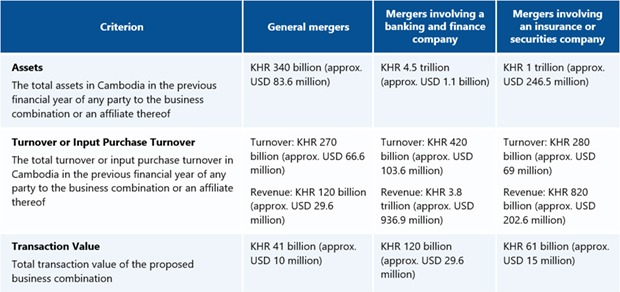
In current practice, the term “turnover” typically refers to a company’s total sales revenue, while “input purchase turnover” denotes the value of materials or equipment acquired for production purposes. Although this reflects the initial interpretation of these terms, it is advisable to seek confirmation or clarification from the CCC before the filing to ensure accuracy and alignment with their current definitions, as it is conceivable that the interpretation may change.

Decision No. 095 leaves room for the Ministry of Commerce to amend these thresholds as deemed necessary.

Outlook

In the last two years, Cambodia has steadily issued regulations to strengthen its legal framework for competition. Although gaps remain, especially with regard to enforcement of fines and certain unclear terms, more regulations are likely in 2025 and 2026.


RELATED INSIGHTS​ 

April 28, 2023
On March 28, 2023, Cambodia’s Ministry of Economy and Finance and Ministry of Commerce issued Inter-Ministerial Prakas No. 168 on Penalties for Persons Violating the Law on Competition. This release was in line with the country’s recent establishment of a framework and thresholds for merger filings. The penalties for violating the Law on Competition center on the following three offenses: 1.  Entering into vertical agreements. This can be done by: requiring buyers to resell goods or services in limited geographic locations; requiring buyers to resell goods or services to specific customers or specific types of customers; requiring buyers to purchase goods or services from one seller only; preventing sellers from selling goods or service to other buyers; or requiring buyers to buy additional goods or services that are not related to the goods or services being sold. 2. Abusing a dominant market position. This can be done by: requiring or persuading suppliers or customers to not do business with competitors; refusing to supply goods or services to competitors; selling goods or services subject to commercial terms that require buyers to buy other goods or services separately that are not related to the purpose of the transaction; selling goods or services below production cost; or refusing to give competitors access to the necessary means of selling their goods and services. 3.  Undertaking a business combination that actually or potentially restricts or distorts market competition. Each of these violations is punishable by a fine of 3% to 10% of the infringer’s total turnover during the period of violation, limited to three years. Next Steps The first half of 2023 has seen three new regulations strengthening Cambodia’s competition law framework, as noted above. Although certain unclear terms do remain, regulators are expected to issue additional decisions in 2023. For more details on
April 20, 2023
In 2018, following enactment of the Myanmar Companies Law (MCL), the Directorate of Investment and Company Administration (DICA) launched Myanmar Companies Online (MyCO), an official online platform for corporate registration. The MCL required companies to re-register in MyCO, but some companies did not complete this step within the date provided by the law. In addition, the MCL introduced a requirement for companies to file an annual return through MyCO. Some companies have also failed to do this, which can eventually lead to DICA automatically striking the company’s name from the register. If a company has not re-registered, it must follow specific administrative procedures to “activate” the company in MyCO. There are also administrative procedures allowing for restoration of companies that have been struck from the DICA register. This article considers the ramifications of each of these scenarios and outlines potential next steps for companies facing these challenges. Activating a Company Not Yet Re-registered Prior to enactment of the MCL, all companies were formed under the Myanmar Companies Act 1914, which was the primary law governing registration and operation of companies in the country. Once the MCL was passed, companies were required to re-register online via MyCO by January 31, 2019. For companies that did not re-register on MyCO, the company’s name, old registration number, and registration date under the Myanmar Companies Act 1914 was recorded in MyCO, and the status of the company was set as “Not Yet Re-registered.” Companies assigned this status should not assume that it means the company was struck off the DICA register. Rather, the DICA states that if a company is listed as not re-registered on MyCO, it can still re-register by fulfilling the requirements specified in the MCL. In order to re-register under the MCL, the company must obtain a court order to
April 10, 2023
On April 1, 2023, Myanmar’s Directorate of Investment and Companies Administration (DICA) announced additional reporting requirements for newly registered companies. According to the announcement, newly established companies must submit the required information to DICA by email within two months of their registration and before submitting their first annual return (AR) to DICA through the Myanmar Companies Online (MyCO) system as required under the Myanmar Companies Law 2017 (MCL). The reporting requirements include: Proof that the bank account established in the company’s name has been credited with the paid-up capital shown in the MyCO system. Verification of individuals listed as directors of the company. For directors who are Myanmar citizens, this consists of confirmation from the relevant township police office that the director actually resides at the address stated in the national registration card and the application for company registration (Form A). For directors who are foreign nationals, the required verification is proof of compliance with the Registration of Foreigners Rules 1948 (such as Immigration Form C). Confirmation from the relevant township police office that the registered address of the company matches an actual location and that the company is planning to open an office. Verification of individuals and entities listed as members of the company. For individual registered members, the requirements are the same as for individual directors (see above). For legal entities that are registered members, the entity’s certificate of incorporation must be provided. Once a newly registered company submits this information by email, the registrar will review it manually. Companies that fail to submit the required information will not be able to submit their first AR documentation. If this happens, the DICA registrar will issue a notice, and the company will have 28 days to submit its AR and pay all outstanding fees and penalties, or face automatic
March 22, 2023
Attorneys from Tilleke & Gibbins have contributed the Cambodia, Laos, Myanmar, and Vietnam sections to DLA Piper’s Global Government Contracting Country by Country guide, which provides essential information for businesses in 75 jurisdictions on how to source and enter into government contracting opportunities. The guide provides procurement information for jurisdictions in Africa, the Americas, Asia-Pacific, Europe, and the Middle East, and includes information on how to find procurement opportunities, the structure of procurement laws, and in-country resources and relevant publications. Each jurisdictional section includes valuable information on procedures for government tenders, bidding, and contract execution, as well as an overview of the legal and regulatory framework governing government procurement. Businesses can refer to the guide to gain a better understanding of procurement processes and regulations in each jurisdiction, which can help them identify potential opportunities and make informed decisions when pursuing government contracts. The guide’s procurement information for Cambodia, Laos, Myanmar, and Vietnam, combined with the online platform’s comprehensive resources, provides businesses and governments with a valuable tool to navigate the complex regulatory landscape of government contracting in the region. The full Global Contracting Country-by-Country guide is available on the DLA Piper website.