You are using an outdated browser and your browsing experience will not be optimal. Please update to the latest version of Microsoft Edge, Google Chrome or Mozilla Firefox. Install Microsoft Edge

March 29, 2023

Cambodia Issues Decision on Thresholds for Merger Filings

On March 14, 2023, the Competition Commission of Cambodia (CCC) set out its merger filing thresholds in Decision No. 095 on Thresholds for Prior Notification of Business Mergers. This was a follow-up to the recent issuance of a regulation outlining the requirements and procedures for merger and acquisition filings. Decision No. 095 applies to all business combinations subject to premerger notification requirements under this prior regulation.

The thresholds for when the CCC must be notified of a merger are laid out in the table below.
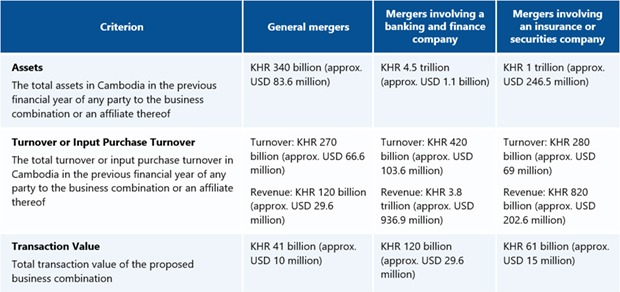
In current practice, the term “turnover” typically refers to a company’s total sales revenue, while “input purchase turnover” denotes the value of materials or equipment acquired for production purposes. Although this reflects the initial interpretation of these terms, it is advisable to seek confirmation or clarification from the CCC before the filing to ensure accuracy and alignment with their current definitions, as it is conceivable that the interpretation may change.

Decision No. 095 leaves room for the Ministry of Commerce to amend these thresholds as deemed necessary.

Outlook

In the last two years, Cambodia has steadily issued regulations to strengthen its legal framework for competition. Although gaps remain, especially with regard to enforcement of fines and certain unclear terms, more regulations are likely in 2025 and 2026.


RELATED INSIGHTS​ 

December 15, 2023
Vietnam’s new Law on Electronic Transactions No. 20/2023/QH15 (LOET 2023) was promulgated by the National Assembly on June 22, 2023, and will replace the existing Law on Electronic Transactions No. 51/2005/QH11 (LOET 2005) when it enters into effect on July 1, 2024. The LOET 2023 is aimed at facilitating transactions carried out in an electronic environment in all sectors. Derived from the fundamental principles of the LOET 2005, the LOET 2023 is similarly considered a framework law, developed based on the Model Law on E-Commerce of the United Nations Commission on International Trade Law (UNCITRAL). The main points of interest of the LOET 2023 are summarized below. 1. Scope of Application Unlike the LOET 2005, which explicitly excludes certain areas such as the issuance of certificates of land use rights and birth certificates from the scope of application, the LOET 2023 covers all areas without exception. However, the LOET 2023 will still not interfere with the regulations of substantive laws that stipulate the content, conditions, and forms of transactions in their respective areas (Article 1.2). The LOET 2023 also provides that it will only be applicable if other laws either allow or remain silent on the electronic execution of transactions; otherwise, if another law specifically does not permit a transaction to be carried out electronically, such law shall apply (Article 1.3). This emphasizes that the applicability of the LOET 2023 depends on the electronic readiness of specific sectors. 2. Enabling E-Transactions in All Sectors For traditional transactions or contracts to be legally valid, they typically require written documentation, the signatures of the involved parties, and the seals of organizations or companies, if required by substantive laws or common practice. Additionally, certain sectors mandate further steps like notarization or certification, such as in property transactions like house sales or inheritance
December 13, 2023
Thailand’s economy in recent years has felt the impact of a seemingly endless list of challenges, such as the COVID-19 pandemic, global economic recession, repercussions from wars and armed conflicts, slumping exports, and recurring internal political turmoil. Many Thai companies simply went bankrupt during this time, but many others have gone through the process of business rehabilitation as laid out in Thailand’s Bankruptcy Act. This article outlines Thailand’s business rehabilitation procedures and explains how creditors can collect debts from companies involved in rehabilitation. Business rehabilitation in Thailand Under the Bankruptcy Act, a creditor, debtor, or government agency under certain circumstances can file a business rehabilitation petition when all of the following conditions are met: The debtor is insolvent or unable to pay the debt due for payment (cash-flow insolvency). The debtor is a juristic person indebted to one or more creditors for a total of at least 10 million baht. The debt can be determined in a definite amount, irrespective of whether it is due for payment immediately or in the future. There is a reasonable prospect of the debtor’s business being rehabilitated. “Insolvency” means a debtor has more debts than assets. However, the Bankruptcy Act also gives some criteria for being able to assume that a debtor is insolvent. Examples include debtors declaring to the court that they are unable to pay their debts, or debtors defaulting on debt payments after receiving at least two demand letters from a creditor (with at least 30 days between the letters). Once the court receives a business rehabilitation petition, the debtor will be protected under an “automatic stay.” This means that any creditor cannot sue or force the debtor to pay a debt, and the debtor is not allowed to pay any debt unless it falls into one of the exceptions
December 4, 2023
Thailand’s Ministry of Industry (MOI) has issued a notification adopting the polluter-pays principle for generators of industrial waste in factories. The Notification of the Ministry of Industry on Management of Waste or Unused Materials B.E. 2566 (2023), enacted under the Factory Act B.E. 2535 (1992), marks a pivotal shift in the responsibilities and liabilities of factory operators as waste generators, which under the new notification no longer end when the waste is collected by a third-party waste processor. The notification, which was first issued in May 31, 2023, took effect on November 1, 2023, after the expiration of a grace period set by the MOI. The new MOI notification extends waste generators’ responsibilities and liabilities for management and disposal of waste from the time the waste is generated until it is properly and completely disposed of. These responsibilities include delivering the waste to the waste processor and overseeing the waste disposal processing, as well as undertaking proper measures in the event of failure by the waste processor, accident, or loss of the waste. Similar to the rules under the previous MOI notification on factory waste, the transport of waste outside the factory premises for disposal still requires permission from the Department of Industrial Works (DIW). However, the permission under the new MOI notification can now be applied for either electronically via its customer registration system (“i-Industry system”) or in person at the DIW. The MOI’s adoption of the polluter-pays principle for industrial waste heralds a significant shift in waste management liability and the costs of pollution prevention to the waste generators, who now need to ensure compliance with the rigorous criteria and compliance procedures outlined in the new MOI notification. For more details on the new rules, or on any aspect of Thailand’s waste management or environmental regulations for
November 17, 2023
On October 3, 2023, Thailand’s Board of Investment (BOI) issued a new regulation clarifying the eligibility criteria for investment promotion under the BOI category “5.10 Development of software, platforms for digital services, or digital content.” To be eligible for BOI promotion under the digital activity category, projects must meet criteria related to local development, minimum investment amount, machinery and equipment, and development processes. These criteria for category 5.10 activities, along with the latest clarifications from the BOI, are detailed in the table below. Tax Incentives The BOI also clarified the method for calculating corporate income tax (CIT) exemptions. The CIT cap amount is calculated on an annual basis from the prescribed expenses incurred after applying for BOI promotion and occurring during the year for which the CIT exemption is claimed. The allowances include 100% of expenses for salaries for newly hired Thai IT personnel, technology-related training, and obtaining quality standards (such as ISO 29110). The revenue of projects that qualify for CIT exemption must be from sales or services directly related to software, platforms for digital services, or digital content developed as promoted by the BOI, including licensing fees, subscription fees, pay-per-use expenses, in-app purchase fees, usage fees, revenue sharing, advertising fees, and so on. For more details on BOI promotion for digital activities, or on any aspect of investment promotion in Thailand, please contact Athistha (Nop) Chitranukroh at [email protected] or +66 2056 5600, Napassorn Lertussavavivat at [email protected] or +66 2056 5662, or Thammapas Chanpanich at [email protected] or +66 2056 5561.