
You are using an outdated browser and your browsing experience will not be optimal. Please update to the latest version of Microsoft Edge, Google Chrome or Mozilla Firefox. Install Microsoft Edge

November 17, 2023

Thailand Clarifies Rules on Digital Platform Investment Promotion

On October 3, 2023, Thailand’s Board of Investment (BOI) issued a new regulation clarifying the eligibility criteria for investment promotion under the BOI category “5.10 Development of software, platforms for digital services, or digital content.”

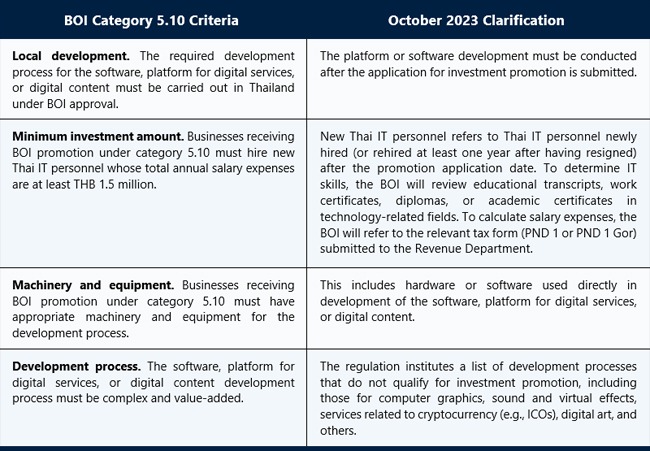
To be eligible for BOI promotion under the digital activity category, projects must meet criteria related to local development, minimum investment amount, machinery and equipment, and development processes. These criteria for category 5.10 activities, along with the latest clarifications from the BOI, are detailed in the table below.
Tax Incentives

The BOI also clarified the method for calculating corporate income tax (CIT) exemptions. The CIT cap amount is calculated on an annual basis from the prescribed expenses incurred after applying for BOI promotion and occurring during the year for which the CIT exemption is claimed. The allowances include 100% of expenses for salaries for newly hired Thai IT personnel, technology-related training, and obtaining quality standards (such as ISO 29110).

The revenue of projects that qualify for CIT exemption must be from sales or services directly related to software, platforms for digital services, or digital content developed as promoted by the BOI, including licensing fees, subscription fees, pay-per-use expenses, in-app purchase fees, usage fees, revenue sharing, advertising fees, and so on.

For more details on BOI promotion for digital activities, or on any aspect of investment promotion in Thailand, please contact Athistha (Nop) Chitranukroh at [email protected] or +66 2056 5600, Napassorn Lertussavavivat at [email protected] or +66 2056 5662, or Thammapas Chanpanich at [email protected] or +66 2056 5561.

RELATED INSIGHTS​ 

September 4, 2026
Foreign business restrictions on telecommunications, treasury center businesses, and intragroup support services were eased when Thailand published the Ministerial Regulation Prescribing Service Businesses Not Requiring Permission for Foreign Business Operations (No. 5) B.E. 2569 (2026) in the Government Gazette on August 28, 2026. The ministerial regulation expands the categories of service businesses that foreign investors may operate without a foreign business license (FBL) under the Foreign Business Act B.E. 2542 (1999) (FBA). Of particular relevance to the telecommunications, fintech, and technology sectors, the ministerial regulation exempts: Type 1 telecommunications licensees, which do not have their own networks; Treasury center businesses operated in accordance with Thailand’s exchange control regulations; and Certain intragroup administrative, human resources, and information technology management services. Telecommunications Services Foreign-owned businesses providing telecommunications services under a type 1 telecommunications license may now operate without obtaining an FBL. This may streamline market entry for qualifying telecommunications and digital infrastructure businesses. The exemption applies only to the FBA licensing requirement. Operators must continue to comply with applicable requirements under the Telecommunications Business Act and the regulations of the National Broadcasting and Telecommunications Commission, and the change does not affect foreign ownership restrictions applicable to type 2 or type 3 telecommunications businesses. Treasury Center Businesses The ministerial regulation also exempts qualifying treasury center businesses from the FBL requirement. This may facilitate centralized treasury functions in Thailand, including liquidity management, foreign exchange management, and intragroup funding arrangements. Treasury center operations remain subject to applicable requirements of the Bank of Thailand and other competent authorities. Intragroup Administrative, HR, and IT Services Certain administrative, human resources, and information technology management services provided between affiliated entities are also exempt, provided the relevant entities satisfy prescribed ownership or management criteria. The exemption is available where the service provider and recipient are related through specified ownership
September 2, 2026
Thailand and China have a longstanding and significant trade relationship, which increasingly extends to e-commerce and digitally enabled supply chains. While these channels create new opportunities for businesses to reach consumers across borders, their growth also brings greater exposure to intellectual property (IP) infringement across jurisdictions and online platforms. Effective cooperation between the two countries’ enforcement authorities has therefore become increasingly important. To strengthen cooperation in this area, Thailand and China signed a memorandum of understanding (MOU) on IP enforcement in Beijing on July 20, 2026, during the Thai prime minister’s official visit to China. Officially titled “Memorandum of Understanding Between the State Administration for Market Regulation of the People’s Republic of China and the Ministry of Commerce of the Kingdom of Thailand on Cooperation in the Field of Intellectual Property Enforcement,” the MOU forms part of a broader bilateral agenda covering industrial and supply chains, participation by micro, small, and medium-sized enterprises (MSMEs), cooperation associated with the ASEAN–China Free Trade Area 3.0, and progress on the registration of Thai geographical indications in China. The MOU establishes a bilateral framework for cooperation and coordination in five broad areas: Strengthening dialogue in IP enforcement; Enhancing information sharing; Facilitating the enforcement of IP rights in cases arising in the parties’ domestic markets and on online platforms, in accordance with their respective domestic laws; Promoting cooperation in IP enforcement training and human resource development; and Undertaking other cooperation activities agreed upon by both sides. The Department of Intellectual Property (DIP) will serve as the principal coordinating agency for Thailand, while the Bureau of Law Enforcement and Inspection in China’s State Administration for Market Regulation (SAMR) will serve in that role for China. The framework is particularly relevant to the growth of e-commerce, as it covers infringement in the domestic markets and on
September 2, 2026
On August 21, 2026, Thailand’s Securities and Exchange Commission (SEC) published two consultation papers that would broaden regulated access to crypto assets while tightening custody standards. The first proposes a framework for establishing crypto exchange-traded funds (crypto ETFs) in Thailand. The second proposes enhanced qualification requirements for foreign digital asset custodians serving mutual funds and private funds that invest in digital assets. The proposals seek to expand regulated access to crypto assets while strengthening custody, governance, disclosure, and investor protection, and they affect fund managers, trustees, and licensed digital asset operators. Comments on both papers are due by September 20, 2026, and the SEC expects the resulting rules to take effect later in 2026. Elevating Foreign Custodian Standards Under current rules in effect since January 16, 2025, mutual funds and private funds investing in digital assets may use foreign custodians that meet qualifications similar to those set for domestic digital asset business operators. The SEC now proposes that foreign digital asset custodians satisfy two cumulative requirements: Compliance with the existing baseline qualifications: demonstrated expertise, robust cybersecurity measures, segregation of client assets, controls preventing unauthorized asset transfers, and sound financial standing. Supervision by a regulator that is either (1) an IOSCO Signatory A member under the Multilateral Memorandum of Understanding, the international arrangement through which securities regulators share information and cooperate on enforcement, or (2) a regulator in a jurisdiction that the Thai SEC designates as having adequate supervisory and investor protection standards. The SEC is initially considering 11 jurisdictions for the approved-country list: France, Germany, Hong Kong SAR, Ireland, Japan, Liechtenstein, Luxembourg, Malaysia, Singapore, South Korea, and the United States. The SEC may expand this list over time based on its assessment of other jurisdictions’ regulatory frameworks governing custodian licensing, asset segregation, secure custody practices, client rights in insolvency,
August 27, 2026
The Bank of Thailand (BOT) is seeking public feedback on a proposed overhaul of the regulatory framework for licensed money changers authorized by the finance minister, under the Exchange Control Act, to buy and sell foreign banknotes separately from commercial banks and specialized financial institutions. The BOT published the draft principles on August 19, 2026, for public consultation, with comments accepted through September 18, 2026. If adopted in its current form, the new framework would substantially raise licensing standards, require existing licensees to undergo a review and upgrade process, temporarily freeze new applications in 2027, and reduce application intake rounds from 2028 onward, with significant implications for both existing operators and prospective new entrants. The overhaul initiative stems from the BOT’s recognition of a need to prevent the use of licensed money changers as channels for financial crime. The stated objectives are to build public confidence, ensure the safety of financial service users, and align the supervisory framework with the current risk profile of the business and evolving market conditions. Upgraded Licensing Standards The BOT intends to significantly revise the licensing framework, including requirements relating to registered capital, branch management, operational standards, and customer transaction limits. Detailed criteria have not yet been released and are expected to be subject to further consultation. All existing licensees will be required to upgrade to meet the new standards and submit evidence of compliance for BOT review on a case-by-case basis. Existing licensees that are unable to satisfy the upgraded requirements may face regulatory consequences, subject to the final framework and BOT review process. Freeze and Reopening The BOT will temporarily stop accepting new license applications throughout 2027 to focus resources on inspecting and upgrading existing money changers. Any party wishing to obtain a new money changer license must submit its application by

