You are using an outdated browser and your browsing experience will not be optimal. Please update to the latest version of Microsoft Edge, Google Chrome or Mozilla Firefox. Install Microsoft Edge

March 29, 2023

Cambodia Issues Decision on Thresholds for Merger Filings

On March 14, 2023, the Competition Commission of Cambodia (CCC) set out its merger filing thresholds in Decision No. 095 on Thresholds for Prior Notification of Business Mergers. This was a follow-up to the recent issuance of a regulation outlining the requirements and procedures for merger and acquisition filings. Decision No. 095 applies to all business combinations subject to premerger notification requirements under this prior regulation.

The thresholds for when the CCC must be notified of a merger are laid out in the table below.
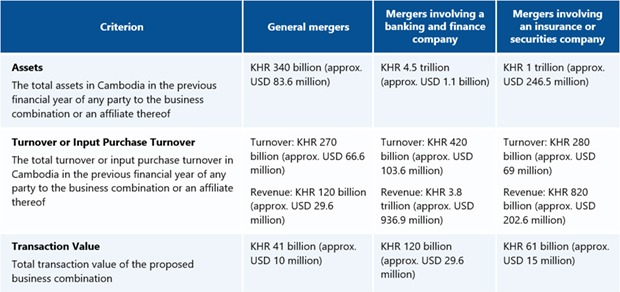
In current practice, the term “turnover” typically refers to a company’s total sales revenue, while “input purchase turnover” denotes the value of materials or equipment acquired for production purposes. Although this reflects the initial interpretation of these terms, it is advisable to seek confirmation or clarification from the CCC before the filing to ensure accuracy and alignment with their current definitions, as it is conceivable that the interpretation may change.

Decision No. 095 leaves room for the Ministry of Commerce to amend these thresholds as deemed necessary.

Outlook

In the last two years, Cambodia has steadily issued regulations to strengthen its legal framework for competition. Although gaps remain, especially with regard to enforcement of fines and certain unclear terms, more regulations are likely in 2025 and 2026.


RELATED INSIGHTS​ 

November 14, 2025
Interest in data center land acquisition has increased significantly over the past year, with a notable rise in inquiries from investors seeking to establish digital infrastructure in Thailand. Although the sector is still in its early stages, this emerging wave of development represents a significant shift in Thailand’s technology infrastructure landscape, driven primarily by multinational technology companies and operators looking to expand their regional presence. Project Development The data center sector in Thailand is attracting a diverse range of international investors, though with clear geographic patterns. Most investors are from China, Singapore, and Japan, with some additional interest from countries outside Asia, including the United States and Europe. This investor base consists primarily of multinational tech companies and operators seeking to establish new facilities rather than acquire existing assets. Data center business activities are also a sector promoted by Thailand’s Board of Investment (BOI), which offers investors both tax and nontax privileges as well as exemptions to foreign investment and land-ownership restrictions. Projects currently underway are still largely in the land acquisition and construction phase. Unlike more mature markets where many facilities are operational and generating revenue, the predominant focus in Thailand remains on securing suitable land and beginning the building process. This means that while interest is high and land assembly is accelerating, the sector as a whole has not yet reached the operational phase that will ultimately drive licensing applications and full regulatory compliance. The licensing process itself remains at an early stage, as most projects must first complete their facilities before applying for the specific licenses required from the telecommunications authority. Once the facilities are built, the next critical step will be obtaining these telecommunications licenses, which are mandatory for data center operations. Legal and Regulatory Considerations The complexity of data center development in Thailand requires
November 13, 2025
Tilleke & Gibbins has contributed the Thailand chapter to Franchise 2026, part of the International Comparative Legal Guides (ICLG) series published by Global Legal Group. This annual guide offers comparative analysis of franchise laws and regulations across jurisdictions worldwide, providing practical insights for businesses and legal practitioners operating in the global franchise sector. Each country chapter in the 12th edition follows a Q&A format covering key aspects of franchise law and operations, including: Relevant legislation and rules governing franchise transactions Business organization options for franchised operations Competition law considerations Protection of intellectual property and brands Liability issues and risk mitigation Governing law and dispute resolution Real estate matters Online trading regulations Termination requirements Joint employer risks and vicarious liability Currency controls and taxation Commercial agency considerations Good faith obligations and fair dealing requirements Ongoing relationship management Franchise renewal processes Franchise migration procedures Sustainability commitments Electronic signatures and document retention Current developments in the franchise sector The Thailand chapter, authored by Alan Adcock and Kasama Sriwatanakul, provides an in-depth overview of the legal landscape for franchising and franchising-related activities in Thailand. The complete Thailand chapter is available as a PDF below. The Thailand chapter—and the full Franchise 2026 guide—are also freely available on the ICLG website.
November 7, 2025
Thailand and the United States signed a memorandum of understanding (MOU) titled “Cooperation to Diversify Global Critical Minerals Supply Chains and Promote Investments” on October 26, 2025, signaling a new strategic alignment aimed at developing Thailand’s mineral sector, particularly in rare earth elements (REEs). The MOU has implications for investments in technology, manufacturing, and other related sectors. This update outlines the key provisions of the MOU and the potential opportunities and legal navigating points for businesses. Objectives The primary driver of this agreement is the US initiative to diversify global supply chains for critical minerals and reduce reliance on current market leaders, particularly China. For Thailand, it represents a major opportunity to attract high-tech investment and develop its downstream processing industries. The cooperation is set to focus on five main areas: Technical knowledge: Exchange of technical expertise and international best practices to strengthen Thailand’s mining and processing sector. Joint cooperation: Establishing workshops, seminars, and scientific collaboration to boost innovation. Regulatory practice: Promoting good governance and streamlining regulatory and licensing procedures. Information sharing: Sharing data on potential projects and global market prices. Full-value chain: The MOU covers the entire mineral lifecycle, from exploration and extraction to processing, refining, and recycling. “First Opportunity to Invest” Clause The most debated provision within the MOU states that “participants expect to have the first opportunity to invest . . . in critical minerals assets that may be sold in Thailand.” Business implications: This clause is widely interpreted as granting US companies a first look or preferential access to investment opportunities in Thailand’s critical minerals sector. This could be a significant advantage for US-based or affiliated companies in mining, technology, and energy seeking to secure a foothold in a developing REE supply chain. Thai government position: Thai officials, including the prime minister, have publicly clarified
October 31, 2025
On September 29, 2025, Thailand’s Office of the Personal Data Protection Committee (PDPC Office) published its Regulations on the Review and Certification of Binding Corporate Rules B.E. 2568 (2025) (the Regulations). The Regulations provide clarity on the PDPC Office’s approach to reviewing and certifying binding corporate rules (BCRs) under Section 29 of the Personal Data Protection Act B.E. 2562 (2019) (PDPA), and aim to facilitate international data transfers within a group of undertakings or enterprises (a “corporate group”). In conjunction with this development, the PDPC Office also approved BCRs for two companies operating in Thailand on September 30, 2025. This milestone represents the first concrete progress since the PDPC’s Notification on Criteria for the Protection of Personal Data Sent or Transferred to a Foreign Country pursuant to Section 29 of the PDPA B.E. 2566 (2023) came into effect in March 2024. Some key features of the Regulations are set out below. Categorization of BCRs BCRs are classified into two types: (1) BCRs for Controllers (BCR-C) and (2) BCRs for Processors (BCR-P). The category must be clearly specified when submitting the BCRs to the PDPC Office. Documentation Requirement The applicant must prepare and submit the application (a standard template may be provided by the PDPC Office in the future) along with supporting documents for review and certification in the Thai language. If the supporting documents are in a foreign language, a certified Thai translation should be provided. The translation must be notarized by a notary public or qualified person. Supporting documents may include, among others, a binding instrument such as an intra-group agreement, or a list of entities subject to the BCRs. Expedited Process Requirement Organizations with existing BCR approvals under the EU or UK GDPR, or from countries announced by the PDPC under Section 28, may apply through an