You are using an outdated browser and your browsing experience will not be optimal. Please update to the latest version of Microsoft Edge, Google Chrome or Mozilla Firefox. Install Microsoft Edge

March 29, 2023

Cambodia Issues Decision on Thresholds for Merger Filings

On March 14, 2023, the Competition Commission of Cambodia (CCC) set out its merger filing thresholds in Decision No. 095 on Thresholds for Prior Notification of Business Mergers. This was a follow-up to the recent issuance of a regulation outlining the requirements and procedures for merger and acquisition filings. Decision No. 095 applies to all business combinations subject to premerger notification requirements under this prior regulation.

The thresholds for when the CCC must be notified of a merger are laid out in the table below.
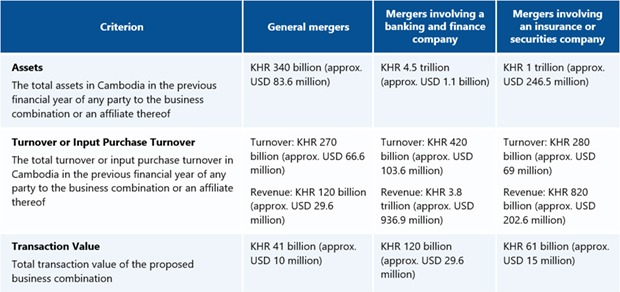
In current practice, the term “turnover” typically refers to a company’s total sales revenue, while “input purchase turnover” denotes the value of materials or equipment acquired for production purposes. Although this reflects the initial interpretation of these terms, it is advisable to seek confirmation or clarification from the CCC before the filing to ensure accuracy and alignment with their current definitions, as it is conceivable that the interpretation may change.

Decision No. 095 leaves room for the Ministry of Commerce to amend these thresholds as deemed necessary.

Outlook

In the last two years, Cambodia has steadily issued regulations to strengthen its legal framework for competition. Although gaps remain, especially with regard to enforcement of fines and certain unclear terms, more regulations are likely in 2025 and 2026.


RELATED INSIGHTS​ 

October 30, 2025
Recent events at a Thai listed company, where a proposal to remove the director was not successful, amid claims that a competitor was attempting to gain control of the company, illustrate how disputes over corporate control can unfold differently at the board level and shareholder level. At the board level, removing directors of a listed company mid-term to gain corporate control is not an easy task under Thai law, as it requires a higher threshold than appointing a new director, which typically only requires a simple majority vote in a listed company. At the shareholder level, Thailand’s tender offer and competition regimes add complexity where different shareholder groups act in concert to remove opposing board representatives or otherwise influence control. In this article, we will explore why the attempted removal of a director may fail, and how the tender offer regime may apply. Key Issues at a Glance Shareholder groups may seek to convene meetings to propose changes to board composition or company authority. Such proposals can be delayed or complicated by regulatory requirements and the need for additional disclosures. Regulatory authorities and minority shareholders may raise concerns when major shareholders coordinate to influence board control, especially if such actions could trigger tender offer or merger control obligations. Companies often respond by seeking further information on shareholder relationships and potential conflicts before proceeding. Why the Director Removal Failed Under Section 76 of the Public Limited Companies Act B.E. 2535 (as amended), the early removal of a director requires two conditions to be satisfied at the same meeting of shareholders: Headcount test: At least 75% of shareholders attending and entitled to vote must vote in favor. If multiple shareholders appoint the same person as proxy, each proxy is counted as a separate head for the purpose of the headcount test,
October 24, 2025
Thailand currently lacks a specific franchise act. Consequently, the legality of any franchise agreement is determined by its compliance with various existing laws, such as the Civil and Commercial Code, the Trademark Act B.E. 2534 (1991) (as amended), and the Unfair Contract Terms Act B.E. 2530 (1997). Thailand is a freedom-to-contract jurisdiction. This allows for a high degree of flexibility and autonomy in contractual arrangements, provided that the terms do not violate any laws or public policy and do not fall under the scope of unfair contract terms. Given this, the requirement for fairness in franchise agreement terms often leads to uncertainty, but decisions from the Trade Competition Commission of Thailand (TCCT) can provide guidance on whether specific contentious terms are in fact fair.  One issue worth examining in this light is the inclusion of terms on nonrefundable franchise fees and strict purchasing conditions. Franchise Fee: Unfair to Refuse Refund? Nonrefundable franchise fees represent a significant upfront investment for franchisees, often becoming a point of contention if the franchise relationship deteriorates or the franchisor ceases operations. Their fairness and enforceability are frequently scrutinized by regulatory bodies like the TCCT, highlighting the critical balance between contractual freedom and franchisee protection. Faced with one such case, the TCCT considered whether it was unfair for the franchisor to refuse to refund the franchise fee after the franchisor ceased operations.  The franchisee had entered into a service agreement on August 2, 2021, and begun operating on October 9, 2021. However, by November 21, 2023, the franchisee was notified that the system would be shut down for maintenance, and by December 26, 2023, the franchisor announced the cessation of operations due to financial losses. The franchisee then requested a refund of the franchise fee. Unfortunately for the franchisee, the TCCT found that the franchisor’s
October 24, 2025
On October 22, 2025, the Thai government posted a directive not to grant gambling licenses for gambling involving poker nationwide to crack down on illegal gambling activities. The directive was issued by Thailand’s Ministry of Interior to align with government policies to prevent the legalization of all types of gambling businesses, including poker as a sporting activity. This will result in the revocation of poker activities as sport and institute a strict ban on such activities nationwide. Businesses should note the new government’s strict approach toward gambling activities as the legal situation regarding gambling in the country continues to draw close attention.
October 3, 2025
On September 26, 2025, the Contract Committee under Thailand’s Consumer Protection Board issued a regulation that aims to standardize contracts and enhance consumer protection within the beauty and wellness industry. The Notification on Prescribing the Beauty Service Business as a Contract-Controlled Business B.E. 2568 (2025), which takes effect on January 24, 2026, requires business operators to use a prescribed standard contract in Thai and adhere to strict mandatory provisions and prohibitions. These regulations apply to operators across all in-person and online service channels, including via digital platforms. “Beauty services business” is defined as the provision of services under an agreement allowing consumers to receive a series of treatments, either over a set number of sessions or within a set period. This includes massage, spa, other methods for cleanliness, beauty, or care of facial or body skin, and weight control and body shaping—including services offered electronically. The law excludes surgery, liposuction, and medical treatments performed by licensed practitioners. The notification establishes the following key requirements: Mandatory contract and formatting. All contracts with consumers must use the standard contract form, in Thai, with clear, readable text (minimum font size of 2 millimeters, no more than 11 characters per inch), and include all essential terms from the annexed form. Contract execution. Contracts must be made in duplicate, with one copy given to the consumer at signing. For agreements concluded through electronic channels, the process must comply with the Electronic Transactions Act and use the same required terms. Digital platforms. Business operators who provide services facilitated through a digital platform as an intermediary are ultimately responsible for ensuring the consumer receives a compliant contract. Prohibited clauses. The law prohibits clauses that limit or exclude liability for damages to life, body, health, mind, or property resulting from breach of contract or a wrongful act;