You are using an outdated browser and your browsing experience will not be optimal. Please update to the latest version of Microsoft Edge, Google Chrome or Mozilla Firefox. Install Microsoft Edge

September 6, 2024

ASEAN: Big Changes on Vitamin and Mineral Limits for Health Supplements

Addressing technical barriers to trade is a key priority for the Association of Southeast Asian Nations (ASEAN) as part of trade facilitation in achieving the single market and production base under the ASEAN Economic Community directive agreed in 2015. The region has been undertaking positive steps toward standard harmonization in ASEAN priority sectors, integrating and bringing about regulatory convergence by taking into account the diversities that exist in the ten ASEAN member states.

Health supplements in ASEAN are under the responsibility of the Traditional Medicine and Health Supplement Product Working Group (TMHS PWG). One of the TMHS PWG’s outputs is the ASEAN Agreement on a Regulatory Framework for Health Supplements, which includes various technical requirements for health supplements that participating member states must adopt by adjusting their domestic regulations.

The key ingredients of these health supplements are vitamins and minerals. While all ASEAN countries allow the use of vitamins and minerals in health supplements, the amounts allowed for use vary, depending on the nutritional requirements deemed appropriate by each country.

Partly in response to these efforts for regional harmonization, there have been important changes to vitamin and mineral limits in certain ASEAN countries that are worth monitoring. Some of these are outlined below.

Thailand

In January 2024, the Thai Food and Drug Administration (TFDA) updated the Thai Recommended Daily Intake (Thai RDI) guidelines for the Thai population. Subsequently, the TFDA adjusted the vitamin and mineral limits in order to comply with the updated Thai RDI and to follow the ASEAN Agreement on a Regulatory Framework for Health Supplements.

The TFDA’s adjustment of vitamin and mineral limits for use in food supplements came in Notification of the Ministry of Public Health (No. 448) B.E. 2566 (2023) Re: Food Supplements (No. 5), which was published in the Government Gazette on January 4, 2024. It increased the maximum limits for certain vitamins and minerals (see breakdown below) up to the limits that had previously only been allowed in drugs. The minimum limits of vitamins and minerals for use in food supplements should be more than 15% of Thai RDIs, as set out in the Notification of the Ministry of Public Health (No. 445) B.E. 2566 (2023) Re: Nutrition Labels. This notification took effect on July 2, 2024.

Before that date, if a party wished to use more than 60 mg of Vitamin C or more than 2 mcg of Vitamin B12 in a health supplement, they would have needed to register the product as a medicine (not a health supplement) in Thailand. Now, health supplements are allowed to use 1,000 mg of vitamin C and 600 mcg of vitamin B12—a level that previously would have required registration as a medicine.

Health supplements are classified as a type of food in Thailand—this differs from some other countries, which may include health supplements in the medicine group. The registration process for health supplements is straightforward and takes a short time (about one to two months) to receive approval. On the other hand, drug registration is more complex and time-consuming. Health supplement companies widely agree that the time needed to receive license approval is one of the main obstacles for a business getting their products to market.

This change allows products that in the past had to be registered as medicines to now be accepted as health supplements in Thailand. This regulatory change will help promote the health supplement business in Thailand and ASEAN.

Indonesia

In Indonesia, the maximum limits for vitamins and minerals for use in health supplements were first updated by the Indonesian FDA (known as BPOM) with the issuance of BPOM Regulation No. 11 of 2020 concerning the Criteria and Procedure for Health Supplement Registration, which has since been revoked by BPOM Regulation No. 32 of 2022. There is currently a draft amendment to BPOM Regulation No. 32 of 2022 that has not yet been finalized. However, the draft amendment does not propose any changes to the current maximum limits for vitamins and minerals.

This shows how BPOM has been actively updating the regulatory framework on health supplements due to the large presence of health supplement products in Indonesia. Businesses in this sector therefore need to be sure of the latest requirements before registering their health supplement products in Indonesia.

Vietnam

In contrast to the changes seen in recent years in Indonesia and Thailand, Vietnam has not amended or drafted any amendments to domestic regulations related to the maximum levels of vitamins and minerals in health foods since 2014. The current maximum limits for vitamins and minerals in Vietnam are not matched to those in neighboring countries or to those in the ASEAN Agreement on a Regulatory Framework for Health Supplements. Nevertheless, Vietnam may consider revising the maximum limits at some point to comply with the ASEAN standards.

In Vietnam, health supplements are classified as food rather than medicine. Under Vietnam’s current regulations, the vitamin and mineral content in health supplements (calculated according to the manufacturer’s recommended daily dose) must not exceed the maximum intake threshold for vitamins and minerals prescribed in Circular 43/2014/TT-BYT.

If the maximum intake threshold is not specified, the related Codex regulations or those of relevant international organizations apply.

Breakdown

The following table summarizes the current maximum daily limits for vitamins and minerals in health supplements for adults in Thailand, Indonesia, and Vietnam. It also shows how the limits have changed compared to the previous regulations in each country.
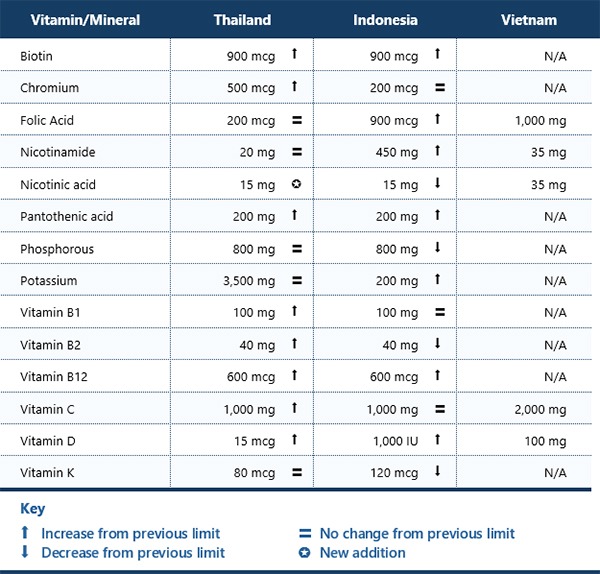
Where the limits are marked as not available, manufacturers may either follow the limitations under the ASEAN Agreement on a Regulatory Framework for Health Supplements or assume vitamins and mineral limits in health supplements based on generally accepted scientific data and taking into consideration, as appropriate, the varying degrees of sensitivity of different consumer groups.


RELATED INSIGHTS​ 

September 15, 2023
In May 2023, Thailand issued a regulation on conditional approval for emergency use of medicinal products, replacing a series of similar notifications that had been issued to aid mitigation efforts during the COVID-19 pandemic. During the pandemic, regulatory authorities worldwide—including the Thai Food and Drug Administration (FDA)—reshaped the approval pathway for emergency drugs intended for the treatment of COVID-19. The Thai FDA published five Notifications Re: Conditional Approval for the Emergency Use of Medicinal Products to outline the registration requirements and channels of distribution for drugs intended for the diagnosis, treatment, or prevention of COVID-19. As the threat from COVID-19 was receding, the Thai FDA saw fit to prepare for the potential emergence of other serious communicable diseases by enabling the supply of timely medications for disease diagnosis, treatment, and prevention. The Thai FDA therefore cancelled the five COVID-19-related emergency use notifications, which were published in 2020 and 2022, and replaced them with the Notification Re: Conditional Approval for Emergency Use of Medicinal Products published in May 2023. Under the May 2023 FDA notification on emergency use, conditional approval can be applied to drugs supported by empirical scientific evidence demonstrating their capacity to diagnose, treat, alleviate, cure, or prevent a serious communicable disease. The drugs eligible for approval under this new emergency pathway include novel drugs that are not yet approved in Thailand, as well as existing drugs approved in Thailand but recently discovered to have additional potential indications for the diagnosis, treatment, alleviation, cure, or prevention of a serious communicable disease. Distribution The 2023 FDA notification also clearly defines permissible distribution channels based on the dosage form of drug products: Vaccines can be distributed to governmental organizations that have a duty to prevent or treat diseases, such as the Thai Red Cross Society (TRCS), the Government Pharmaceutical Organization
September 7, 2023
Thailand is a member state of the ASEAN Economic Community, and next year, it is expected that the ASEAN Harmonization of Traditional Medicines and Health Supplements will be signed by the economic minister of each ASEAN country. Following ratification, the ASEAN Guidelines on Claims and Claims Substantiation for Traditional Medicines and Health Supplements will become the standard guidelines in the region, and various implementation efforts and instruments will follow. These guidelines cover a wide range of medicines and supplements; however, it is not possible to cover all herbal products. There are three types of health supplement claims: nutritional claims, functional claims, and disease risk reduction claims. Examples of the three types of claims include the following: Nutritional claims: supplements nutrition, nourishes the body, supports healthy growth and development, etc. Functional claims: maintains healthy joints, supports immunity, maintains liver function, etc. Disease risk reduction claims: helps to reduce risk of dyslipidemia, helps to reduce risk of osteoporosis, etc. The degree of evidence required for substantiating disease risk reduction claims is higher than for functional claims and nutritional claims. Functional claims and disease risk reduction claims must be substantiated by efficacy studies and the relevant toxicity data. It is the responsibility of the health supplement company to provide the required evidence in order to comply with the criteria for making such claims. Tips on Health Claims for Health Supplements 1. Nutritional Claims For essential nutrients such as vitamins and minerals, as listed by the Thai Food and Drug Administration (FDA), the amount included in a supplement must be between 15% and 100% of the Thai Recommended Daily Intake (RDI) values. Rules for specific kinds of nutritional claims are provided in the Notification of the Thai FDA RE: Nutrient Function Claims. For example, the nutrients that can be claimed as boosting the
August 29, 2023
Laos’ Ministry of Health (MOH) has promulgated a regulation detailing registration and notification protocols for medical devices. Decision on the Registration and Notification of Medical Devices No. 1470/MOH will come into force 60 days after both the signing of the regulation (which already occurred in July) and publication in the Official Gazette, which has not yet been specified by the government. Registration of medical devices in Laos is mentioned in the country’s Law on Drugs and Medical Products No. 07/NA, dated December 21, 2011, but a registration procedure has not been put in place. There was only a separate requirement to furnish certain required documents when importing medical devices. Now, the decision outlines the registration and notification process for medical devices through the Ministry of Health’s Food and Drug Department (FDD), in line with the regulatory principles in the ASEAN Medical Device Directive of 2015, which Laos has ratified. Medical Devices in Laos The decision defines medical devices as any instrument, apparatus, implement, machine, appliance, implant, in vitro reagent or calibrator, software, material, or other similar or related article intended for any of the following uses in humans: Diagnosis, prevention, monitoring, recovery from, or alleviation or treatment of a disease; Diagnosis, monitoring, recovery from, or alleviation of or compensation for an injury; Replacement, modification, or support of anatomy or a physiological process; Supporting and sustaining life; Controlling or assisting in conception; or Disinfection and sterilization of tools and medical devices. Medical devices in Laos are given one of four classifications based on their level of risk: Class A – Low risk (e.g., rubber belts, cotton for medical purposes, nonwoven swabs, adhesive bandages) Class B – Low-moderate risk (e.g., neonatal suction equipment, surgical gloves, gastro-catheters) Class C – Moderate-high risk (e.g., endoscopic surgical equipment, anesthesia equipment, peritoneal dialysis equipment) Class
August 29, 2023
Since the June 9, 2022, delisting of all parts of the cannabis plant according to the Narcotics Code, there has been an explosion of cannabis dispensaries operating in Thailand. The Department of Thai Traditional and Alternative Medicine (DTTAM) has issued more than 12,000 cannabis dispensary licenses to businesses in Thailand. A license allows a dispensary to sell cannabis flowers legally. In addition, the DTTAM requests the cooperation of dispensaries in submitting monthly reports about the sourcing, selling, and inventory of cannabis flowers. The DTTAM may suspend the selling license of dispensaries that fail to submit these reports. Apart from the enforcement duties and administrative acts of the DTTAM, the enactment of the laws and regulations pertaining to cannabis seemed to be drastically winding down. One of the reasons was that Thailand had delays in the process of forming a new government following the general election of May 14, 2023. These delays dampened Thailand’s thriving cannabis industry. In particular, the industry has concerns about the uncertainty of the nascent cannabis law. On August 11, 2023, the Narcotics Control Division of the Thai Food and Drug Administration (FDA) posted the Draft Regulation Re: Application for Approval and Approval for Manufacture, Importation, Exportation, Distribution or Possession of Narcotics under Category 5 (Extracts from Cannabis or Hemp Plants Only). This may be the first regulation that the newly formed government implements with regard to cannabis extracts. Unlike the DTTAM’s enforcement activities, the Thai FDA requests that a domestic manufacturer, importer, exporter, or seller of cannabis extracts apply for a license. The Thai FDA, as the authority, will consider granting a license only in the following cases: For medical benefits; For commercial or industrial benefits; For the benefit of medical or scientific analysis or research; and For use by the government for preventing and