You are using an outdated browser and your browsing experience will not be optimal. Please update to the latest version of Microsoft Edge, Google Chrome or Mozilla Firefox. Install Microsoft Edge

September 6, 2024

ASEAN: Big Changes on Vitamin and Mineral Limits for Health Supplements

Addressing technical barriers to trade is a key priority for the Association of Southeast Asian Nations (ASEAN) as part of trade facilitation in achieving the single market and production base under the ASEAN Economic Community directive agreed in 2015. The region has been undertaking positive steps toward standard harmonization in ASEAN priority sectors, integrating and bringing about regulatory convergence by taking into account the diversities that exist in the ten ASEAN member states.

Health supplements in ASEAN are under the responsibility of the Traditional Medicine and Health Supplement Product Working Group (TMHS PWG). One of the TMHS PWG’s outputs is the ASEAN Agreement on a Regulatory Framework for Health Supplements, which includes various technical requirements for health supplements that participating member states must adopt by adjusting their domestic regulations.

The key ingredients of these health supplements are vitamins and minerals. While all ASEAN countries allow the use of vitamins and minerals in health supplements, the amounts allowed for use vary, depending on the nutritional requirements deemed appropriate by each country.

Partly in response to these efforts for regional harmonization, there have been important changes to vitamin and mineral limits in certain ASEAN countries that are worth monitoring. Some of these are outlined below.

Thailand

In January 2024, the Thai Food and Drug Administration (TFDA) updated the Thai Recommended Daily Intake (Thai RDI) guidelines for the Thai population. Subsequently, the TFDA adjusted the vitamin and mineral limits in order to comply with the updated Thai RDI and to follow the ASEAN Agreement on a Regulatory Framework for Health Supplements.

The TFDA’s adjustment of vitamin and mineral limits for use in food supplements came in Notification of the Ministry of Public Health (No. 448) B.E. 2566 (2023) Re: Food Supplements (No. 5), which was published in the Government Gazette on January 4, 2024. It increased the maximum limits for certain vitamins and minerals (see breakdown below) up to the limits that had previously only been allowed in drugs. The minimum limits of vitamins and minerals for use in food supplements should be more than 15% of Thai RDIs, as set out in the Notification of the Ministry of Public Health (No. 445) B.E. 2566 (2023) Re: Nutrition Labels. This notification took effect on July 2, 2024.

Before that date, if a party wished to use more than 60 mg of Vitamin C or more than 2 mcg of Vitamin B12 in a health supplement, they would have needed to register the product as a medicine (not a health supplement) in Thailand. Now, health supplements are allowed to use 1,000 mg of vitamin C and 600 mcg of vitamin B12—a level that previously would have required registration as a medicine.

Health supplements are classified as a type of food in Thailand—this differs from some other countries, which may include health supplements in the medicine group. The registration process for health supplements is straightforward and takes a short time (about one to two months) to receive approval. On the other hand, drug registration is more complex and time-consuming. Health supplement companies widely agree that the time needed to receive license approval is one of the main obstacles for a business getting their products to market.

This change allows products that in the past had to be registered as medicines to now be accepted as health supplements in Thailand. This regulatory change will help promote the health supplement business in Thailand and ASEAN.

Indonesia

In Indonesia, the maximum limits for vitamins and minerals for use in health supplements were first updated by the Indonesian FDA (known as BPOM) with the issuance of BPOM Regulation No. 11 of 2020 concerning the Criteria and Procedure for Health Supplement Registration, which has since been revoked by BPOM Regulation No. 32 of 2022. There is currently a draft amendment to BPOM Regulation No. 32 of 2022 that has not yet been finalized. However, the draft amendment does not propose any changes to the current maximum limits for vitamins and minerals.

This shows how BPOM has been actively updating the regulatory framework on health supplements due to the large presence of health supplement products in Indonesia. Businesses in this sector therefore need to be sure of the latest requirements before registering their health supplement products in Indonesia.

Vietnam

In contrast to the changes seen in recent years in Indonesia and Thailand, Vietnam has not amended or drafted any amendments to domestic regulations related to the maximum levels of vitamins and minerals in health foods since 2014. The current maximum limits for vitamins and minerals in Vietnam are not matched to those in neighboring countries or to those in the ASEAN Agreement on a Regulatory Framework for Health Supplements. Nevertheless, Vietnam may consider revising the maximum limits at some point to comply with the ASEAN standards.

In Vietnam, health supplements are classified as food rather than medicine. Under Vietnam’s current regulations, the vitamin and mineral content in health supplements (calculated according to the manufacturer’s recommended daily dose) must not exceed the maximum intake threshold for vitamins and minerals prescribed in Circular 43/2014/TT-BYT.

If the maximum intake threshold is not specified, the related Codex regulations or those of relevant international organizations apply.

Breakdown

The following table summarizes the current maximum daily limits for vitamins and minerals in health supplements for adults in Thailand, Indonesia, and Vietnam. It also shows how the limits have changed compared to the previous regulations in each country.
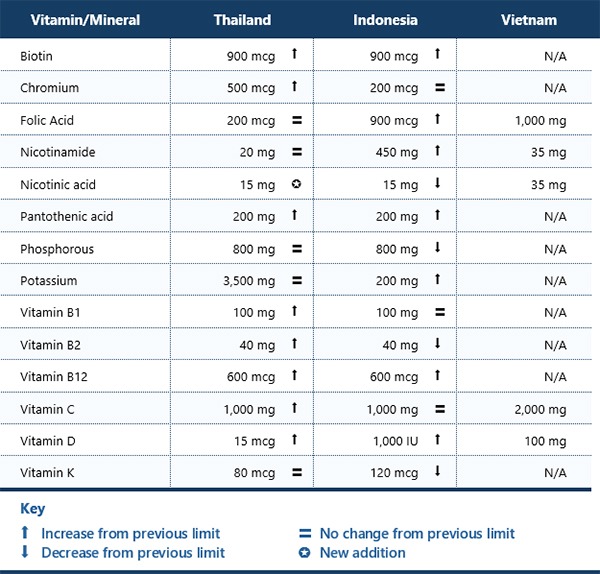
Where the limits are marked as not available, manufacturers may either follow the limitations under the ASEAN Agreement on a Regulatory Framework for Health Supplements or assume vitamins and mineral limits in health supplements based on generally accepted scientific data and taking into consideration, as appropriate, the varying degrees of sensitivity of different consumer groups.


RELATED INSIGHTS​ 

July 11, 2023
Enacted in 2009, Indonesia’s current Law on Health (Law No. 36/2009) is due for a refresh. The government realized that the law has not maintained its relevance when it comes to health trends such as digital health, which refers to the provision of health services online (also commonly known as telemedicine). While regulations and policy blueprints, such as Ministry of Health (MOH) Regulation No. 46/2017 concerning National E-Health Strategies, have addressed these shifting trends, Indonesia’s main health legislation has proved inadequate in this regard. For this reason, the government began making plans for an update to the law, and the first draft Omnibus Health Law was published in March 2023. The law addresses digital health and other important issues in today’s health landscape, and it seeks to promote the use of locally made health supplies. The draft Omnibus Health Law represents a notable step forward, but in its attempt to govern and regulate all aspects of health, there are also some issues in the draft that may overlap with some existing government regulations, such as provisions on Halal certification, compulsory licensing of patents, and addictive substances. This article outlines some of the draft law’s key aspects as well as some potential issues. Digital Health In addressing the growing health trend of telemedicine, the draft law confirms, reinforces, and fills gaps left by Indonesia’s three main regulations concerning telemedicine. namely, MOHR No. 20/2019 concerning Telemedicine, MOHR No. 24/2022 concerning Medical Records, and Medical Council Regulation No. 74/2020 concerning Telemedicine (MCR No. 74/2020). One of these regulations, MOH Regulation No. 20/2019, allows health service facilities to provide telemedicine services to other health service facilities. This covers telemedicine services related to radiology, electrocardiography, ultrasonography, and telemedicine consultancy services—including those that reflect developments in science and technology. This is the only regulation concerning
July 10, 2023
One of the more positive outcomes of the COVID-19 pandemic is that telemedicine has become remarkably important as an interactive system between patients and healthcare professionals. Thailand, which ranks near the top as a world medical hub, is a highly favored destination in Asia for expat workers. Currently, the Thai market has both Thai-based and foreign-based platforms with information about healthcare providers and telemedicine readily available. “Doctor Locator,” “Weed Map,” and “Find a Teeth Aligner Dentist” are examples of online platforms connecting patients with medical and telemedicine services. These digital platforms provide information about the location of specialized clinics, cannabis dispensaries, pharmacy stores, and orthodontic practitioners in Thailand. These platforms act as intermediaries between medical care businesses and consumers. As actual medical services are not offered or provided, these digital platforms do not have to be regulated under the Medical Facility Act of Thailand. However, healthcare digital platform services that act as an intermediary or conduit managing information used to connect medical clinics or cannabis dispensaries with patients or customers via a computer network are now regulated under the soon-to-be-implemented Royal Decree on Digital Platforms, regardless of whether payment is actually made via the platform. The regulatory authority for this is the Electronic Transactions Development Agency (ETDA). Under this royal decree, digital platform providers that intend to operate a digital platform service must notify the ETDA prior to initiating operations. The extent of the details to be included in the notification to the ETDA will be more comprehensive if the digital platform: has annual revenue (before expenses) for digital platform services within Thailand exceeding THB 1.8 million (approx. USD 51,200) for an individual operator or THB 50 million (approx. USD 1.42 million) for a corporate or entity operator; or has more than 5,000 users (on average) per month. Apart
July 10, 2023
On June 30, 2023, the Ministry of Health of Vietnam issued Circular No. 14/2023/TT-BYT stipulating the process and procedure for building bidding package prices for procurement of goods and services in the field of medical devices at public health facilities (“Circular 14”). Circular 14 took effect on July 1, 2023, and will be valid through the end of 2023. Circular 14 applies to the procurement of medical devices/equipment and their accessories, spare parts, and supplies, as well as related services of repair, maintenance, inspection, and calibration. Under Circular 14, there are three methods of determining the price of bidding packages: Collecting quotations provided by suppliers of goods and services in the field of medical devices. Surveying the winning bid prices of similar goods and services on the national bidding network system (https://muasamcong.gov.vn). Using the results of price appraisal of a competent state agency that conducts price appraisal, or a specialized price appraisal enterprise. Method (i) must be used first; the two remaining methods can be applied only after method (i) has been unsuccessful. If the investor/procuring entity uses two or more methods to determine the price of bidding packages, it can select the highest price that is suitable to its financial capacity and professional requirements. Circular 14 further sets out the specific step-by-step process to build prices for procuring products and services in the field of medical devices/equipment. Transitional Provision For bidding packages that have already approved a contractor selection plan before July 1, 2023, the approved contractor selection plan will be followed. For bidding packages for which a contractor selection plan has been submitted by the investor/procuring entity but the plan has not yet been approved, the competent person can decide on the approval of the submitted plan or can request the investor/procuring entity to rebuild the bidding
July 4, 2023
Practitioners from Tilleke & Gibbins’ Vietnam offices contributed content for the latest edition of the Practical Law Life Sciences Global Guide. The guide provides a comparative overview, in Q&A format, of laws and regulations on pharmaceuticals, medical devices, and other life sciences products in dozens of jurisdictions around the world. The Life Sciences Global Guide is divided into two sections: Regulation (see more details here) and Commercialization, which covers the following topics: Overview of the life sciences sector Pricing, government funding, and reimbursement: National health care system, price regulation and reimbursement Distribution and sale Cross-border trade and parallel imports Advertising to the public and engagement with patient organizations Advertising to healthcare professionals and organizations: Gifts and incentives and transparency and disclosure Patents: Conditions for patentability, registration, length of protection, infringement, international treaties Trademarks: Requirements, registration Competition law issues: Authorities and legislation, commercial contracts and competition law, licensing approvals and formalities Product liability: Regulators, medicinal product liability law, liable partners, defenses, product liability claims, remedies Practical Law, produced by Thomson Reuters, is the world’s leading legal know-how resource for business lawyers, publishing a huge range of guides covering hundreds of jurisdictions and practice areas. The full “Life Sciences Commercialization in Vietnam” section can be found on the Practical Law website.