You are using an outdated browser and your browsing experience will not be optimal. Please update to the latest version of Microsoft Edge, Google Chrome or Mozilla Firefox. Install Microsoft Edge

September 6, 2024

ASEAN: Big Changes on Vitamin and Mineral Limits for Health Supplements

Addressing technical barriers to trade is a key priority for the Association of Southeast Asian Nations (ASEAN) as part of trade facilitation in achieving the single market and production base under the ASEAN Economic Community directive agreed in 2015. The region has been undertaking positive steps toward standard harmonization in ASEAN priority sectors, integrating and bringing about regulatory convergence by taking into account the diversities that exist in the ten ASEAN member states.

Health supplements in ASEAN are under the responsibility of the Traditional Medicine and Health Supplement Product Working Group (TMHS PWG). One of the TMHS PWG’s outputs is the ASEAN Agreement on a Regulatory Framework for Health Supplements, which includes various technical requirements for health supplements that participating member states must adopt by adjusting their domestic regulations.

The key ingredients of these health supplements are vitamins and minerals. While all ASEAN countries allow the use of vitamins and minerals in health supplements, the amounts allowed for use vary, depending on the nutritional requirements deemed appropriate by each country.

Partly in response to these efforts for regional harmonization, there have been important changes to vitamin and mineral limits in certain ASEAN countries that are worth monitoring. Some of these are outlined below.

Thailand

In January 2024, the Thai Food and Drug Administration (TFDA) updated the Thai Recommended Daily Intake (Thai RDI) guidelines for the Thai population. Subsequently, the TFDA adjusted the vitamin and mineral limits in order to comply with the updated Thai RDI and to follow the ASEAN Agreement on a Regulatory Framework for Health Supplements.

The TFDA’s adjustment of vitamin and mineral limits for use in food supplements came in Notification of the Ministry of Public Health (No. 448) B.E. 2566 (2023) Re: Food Supplements (No. 5), which was published in the Government Gazette on January 4, 2024. It increased the maximum limits for certain vitamins and minerals (see breakdown below) up to the limits that had previously only been allowed in drugs. The minimum limits of vitamins and minerals for use in food supplements should be more than 15% of Thai RDIs, as set out in the Notification of the Ministry of Public Health (No. 445) B.E. 2566 (2023) Re: Nutrition Labels. This notification took effect on July 2, 2024.

Before that date, if a party wished to use more than 60 mg of Vitamin C or more than 2 mcg of Vitamin B12 in a health supplement, they would have needed to register the product as a medicine (not a health supplement) in Thailand. Now, health supplements are allowed to use 1,000 mg of vitamin C and 600 mcg of vitamin B12—a level that previously would have required registration as a medicine.

Health supplements are classified as a type of food in Thailand—this differs from some other countries, which may include health supplements in the medicine group. The registration process for health supplements is straightforward and takes a short time (about one to two months) to receive approval. On the other hand, drug registration is more complex and time-consuming. Health supplement companies widely agree that the time needed to receive license approval is one of the main obstacles for a business getting their products to market.

This change allows products that in the past had to be registered as medicines to now be accepted as health supplements in Thailand. This regulatory change will help promote the health supplement business in Thailand and ASEAN.

Indonesia

In Indonesia, the maximum limits for vitamins and minerals for use in health supplements were first updated by the Indonesian FDA (known as BPOM) with the issuance of BPOM Regulation No. 11 of 2020 concerning the Criteria and Procedure for Health Supplement Registration, which has since been revoked by BPOM Regulation No. 32 of 2022. There is currently a draft amendment to BPOM Regulation No. 32 of 2022 that has not yet been finalized. However, the draft amendment does not propose any changes to the current maximum limits for vitamins and minerals.

This shows how BPOM has been actively updating the regulatory framework on health supplements due to the large presence of health supplement products in Indonesia. Businesses in this sector therefore need to be sure of the latest requirements before registering their health supplement products in Indonesia.

Vietnam

In contrast to the changes seen in recent years in Indonesia and Thailand, Vietnam has not amended or drafted any amendments to domestic regulations related to the maximum levels of vitamins and minerals in health foods since 2014. The current maximum limits for vitamins and minerals in Vietnam are not matched to those in neighboring countries or to those in the ASEAN Agreement on a Regulatory Framework for Health Supplements. Nevertheless, Vietnam may consider revising the maximum limits at some point to comply with the ASEAN standards.

In Vietnam, health supplements are classified as food rather than medicine. Under Vietnam’s current regulations, the vitamin and mineral content in health supplements (calculated according to the manufacturer’s recommended daily dose) must not exceed the maximum intake threshold for vitamins and minerals prescribed in Circular 43/2014/TT-BYT.

If the maximum intake threshold is not specified, the related Codex regulations or those of relevant international organizations apply.

Breakdown

The following table summarizes the current maximum daily limits for vitamins and minerals in health supplements for adults in Thailand, Indonesia, and Vietnam. It also shows how the limits have changed compared to the previous regulations in each country.
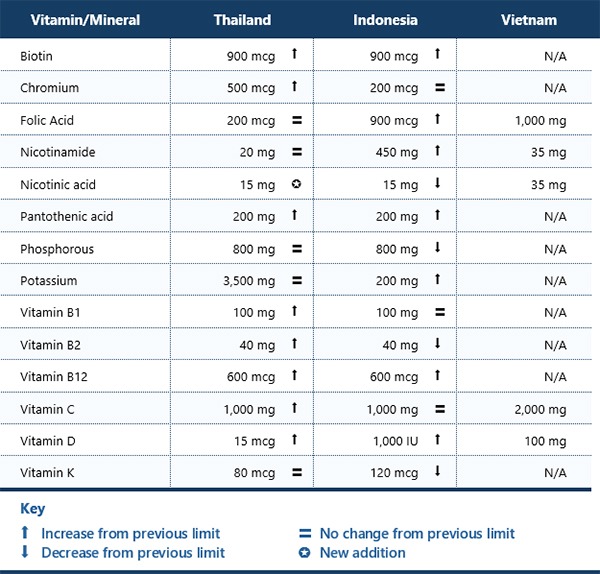
Where the limits are marked as not available, manufacturers may either follow the limitations under the ASEAN Agreement on a Regulatory Framework for Health Supplements or assume vitamins and mineral limits in health supplements based on generally accepted scientific data and taking into consideration, as appropriate, the varying degrees of sensitivity of different consumer groups.


RELATED INSIGHTS​ 

October 25, 2023
Cambodia’s Ministry of Health (MOH) continues to increase awareness among the public and private sector of the need for strict healthcare regulations and strict enforcement to advance the quality of the country’s healthcare sector. In April 2023, the MOH issued a notification letter reminding advertisers of health products that they need to obtain a permit before advertising their products in Cambodia. On October 12, 2023, the MOH issued two press releases on continued noncompliance in the healthcare sector. The two press releases address the illegal advertising of both healthcare products and private healthcare services. The releases also address unlicensed healthcare professionals and general noncompliance by private healthcare services. These releases indicate that the MOH, in cooperation with local authorities, will substantially increase its enforcement efforts across Cambodia. Since October 12, several private healthcare clinics have had their operations closed and licenses suspended or revoked, signaling the ministry’s intent to enforce the legal framework. Noncompliant Advertising of Health Products The first press release focuses on the continued illegal advertising of health products and the advertising of unregistered health products. Health products include modern medicines, traditional medicines, health supplements, medical devices, cosmetics, and other products that prevent or treat diseases. The release highlights that the MOH has noticed ongoing unauthorized and illegal advertising, commenting that these are often found online and on social media. The noncompliant advertising referenced in the release includes advertising of health products without the required advertising permit, advertising products that are not properly registered with the MOH, and advertising by unlicensed companies and individuals. The MOH also states in the release that some advertisements are using inappropriate and noncompliant content that is not based on medical science and exaggerates the qualities of the health products—specifically mentioning skin-whitening cosmetics. The ministry’s press release also informs the public of
October 25, 2023
One significant development in the health sector in Indonesia is the use of information technology and communication in the implementation of health efforts—particularly digital health services such as telehealth and telemedicine integrated into the country’s National Health Information System. This development was addressed in a major new piece of legislation for the healthcare sector in Indonesia. Enacted in August 2023, Law No. 17 of 2023 concerning Health (the “Health Law”) provides the updates needed to support the development of healthcare services in Indonesia. Under the Health Law, health information system (HIS) providers must: Carry out processing of data and health information in the territory of Indonesia, except for certain limited and specific processing activities that may be conducted outside Indonesia when permitted by the relevant authorities and in compliance with relevant regulations. Ensure the reliability of its HIS, including availability, security, maintenance, and integration with Indonesia’s National Health Information System. Provide quality health data and information. Process data and health information, which includes planning, collection, storage, inspection, transfer, utilization, and destruction. Record its data- and information-processing history. Protect every person’s data and health information. Obtain approval from the relevant personal data subject or comply with relevant regulations if the processing of data and health information involves an individual’s health data. Inform the data owner if there is a failure to protect data and individual health information. The Health Law’s personal data protection requirements listed above appear to be aligned with the provisions in Law No. 27 of 2022 concerning Personal Data Protection (the “PDP Law”). Under this law, data and information relating to health are identified as “specific personal data,” the processing of which carries a high potential risk of impacting the relevant personal data subject. In the implementation of digital health services, patients’ personal data or medical records
October 19, 2023
Cambodia’s Law on Food Safety came into force on June 8, 2022. This law has been widely regarded as a major legal development of the food safety framework in Cambodia, providing new rules, clarifying existing rules, and setting a clear framework for its implementation and enforcement. In addressing some of the key features of this new law shortly after it was passed in 2022, we remarked that we eagerly await implementing regulations. Since then, various regulations have been adopted, such as two regulations (Sub-Decree No. 13 and Prakas No. 80) on food surveillance, recalls, and seizure. These implementing rules are essential in ensuring that enforcement officers can remove noncompliant and unsafe foods from the market. Another key aspect of the Law on Food Safety is that it requires Khmer-language labeling on prepackaged food products. There has been a notable increase in the inclusion of Khmer labeling on food products in the market since June 2022, but noncompliance is still considerable, especially for imported foods. Further interesting labeling rules set by the Law on Food Safety include a requirement to provide nutrition information. This requirement has not yet been widely adopted, with many in the industry highlighting that the details of this labeling requirement are not clear. Indeed, the relevant article of the Law on Food Safety itself only sets the requirement for food products to bear nutrition labeling and does not spell out what detailed information should be provided or in what manner. However, a prakas (ministerial regulation) adopted months prior to the Law on Food Safety does set out clear guidance on nutrition labeling. As long as this earlier regulation is not replaced or abrogated, and as far as it does not conflict with later laws or regulations, it can be relied upon for guidance. What are the
September 20, 2023
Thailand is preparing to open its first renewal period for drug marketing authorizations (MAs) since the passage of the Drug Act (No. 6) B.E. 2562 (2019). Before 2019, MAs for pharmaceuticals and vaccines in Thailand had lifelong validity. The 2019 Drug Act stipulated that all new MAs would be valid for seven years and could be renewed. The 2019 law also set out expiration dates for existing pharmaceutical products registered and approved prior to the implementation of the law (i.e., before October 13, 2019): Drug MAs issued before January 1, 1997, expire on October 13, 2024. Drug MAs approved between January 1, 1997, and December 31, 2007, expire on October 13, 2026. Drug MAs approved between January 1, 2008, and October 13, 2019, expire on October 13, 2028. Based on these dates, the first renewal period for drug MAs will commence in the fourth quarter of 2023. To facilitate the renewal process, the Thai Food and Drug Administration (FDA) has publicized draft regulations and notifications on the required application form and documents, the rules and conditions, and the process for renewing an MA. In May 2023, the Thai FDA issued Ministerial Regulation Re: Renewal of Drug MA Licenses B.E. 2566 (2023) to prescribe the essential requirements for filing a renewal application: To renew a drug MA, holders must submit their renewal application to the Thai FDA within the one-year period before the MA’s expiration date. Renewal applications can only be submitted online via the Thai FDA’s electronic system. The Thai FDA will grant approval for an MA renewal if the following conditions are satisfied: The documents in relation to efficacy and safety are up-to-date, accurate, and in accordance with academic principles. The specification and analytical method comply with the official pharmacopeias as prescribed in the Drug Act, as amended.