You are using an outdated browser and your browsing experience will not be optimal. Please update to the latest version of Microsoft Edge, Google Chrome or Mozilla Firefox. Install Microsoft Edge

September 6, 2024

ASEAN: Big Changes on Vitamin and Mineral Limits for Health Supplements

Addressing technical barriers to trade is a key priority for the Association of Southeast Asian Nations (ASEAN) as part of trade facilitation in achieving the single market and production base under the ASEAN Economic Community directive agreed in 2015. The region has been undertaking positive steps toward standard harmonization in ASEAN priority sectors, integrating and bringing about regulatory convergence by taking into account the diversities that exist in the ten ASEAN member states.

Health supplements in ASEAN are under the responsibility of the Traditional Medicine and Health Supplement Product Working Group (TMHS PWG). One of the TMHS PWG’s outputs is the ASEAN Agreement on a Regulatory Framework for Health Supplements, which includes various technical requirements for health supplements that participating member states must adopt by adjusting their domestic regulations.

The key ingredients of these health supplements are vitamins and minerals. While all ASEAN countries allow the use of vitamins and minerals in health supplements, the amounts allowed for use vary, depending on the nutritional requirements deemed appropriate by each country.

Partly in response to these efforts for regional harmonization, there have been important changes to vitamin and mineral limits in certain ASEAN countries that are worth monitoring. Some of these are outlined below.

Thailand

In January 2024, the Thai Food and Drug Administration (TFDA) updated the Thai Recommended Daily Intake (Thai RDI) guidelines for the Thai population. Subsequently, the TFDA adjusted the vitamin and mineral limits in order to comply with the updated Thai RDI and to follow the ASEAN Agreement on a Regulatory Framework for Health Supplements.

The TFDA’s adjustment of vitamin and mineral limits for use in food supplements came in Notification of the Ministry of Public Health (No. 448) B.E. 2566 (2023) Re: Food Supplements (No. 5), which was published in the Government Gazette on January 4, 2024. It increased the maximum limits for certain vitamins and minerals (see breakdown below) up to the limits that had previously only been allowed in drugs. The minimum limits of vitamins and minerals for use in food supplements should be more than 15% of Thai RDIs, as set out in the Notification of the Ministry of Public Health (No. 445) B.E. 2566 (2023) Re: Nutrition Labels. This notification took effect on July 2, 2024.

Before that date, if a party wished to use more than 60 mg of Vitamin C or more than 2 mcg of Vitamin B12 in a health supplement, they would have needed to register the product as a medicine (not a health supplement) in Thailand. Now, health supplements are allowed to use 1,000 mg of vitamin C and 600 mcg of vitamin B12—a level that previously would have required registration as a medicine.

Health supplements are classified as a type of food in Thailand—this differs from some other countries, which may include health supplements in the medicine group. The registration process for health supplements is straightforward and takes a short time (about one to two months) to receive approval. On the other hand, drug registration is more complex and time-consuming. Health supplement companies widely agree that the time needed to receive license approval is one of the main obstacles for a business getting their products to market.

This change allows products that in the past had to be registered as medicines to now be accepted as health supplements in Thailand. This regulatory change will help promote the health supplement business in Thailand and ASEAN.

Indonesia

In Indonesia, the maximum limits for vitamins and minerals for use in health supplements were first updated by the Indonesian FDA (known as BPOM) with the issuance of BPOM Regulation No. 11 of 2020 concerning the Criteria and Procedure for Health Supplement Registration, which has since been revoked by BPOM Regulation No. 32 of 2022. There is currently a draft amendment to BPOM Regulation No. 32 of 2022 that has not yet been finalized. However, the draft amendment does not propose any changes to the current maximum limits for vitamins and minerals.

This shows how BPOM has been actively updating the regulatory framework on health supplements due to the large presence of health supplement products in Indonesia. Businesses in this sector therefore need to be sure of the latest requirements before registering their health supplement products in Indonesia.

Vietnam

In contrast to the changes seen in recent years in Indonesia and Thailand, Vietnam has not amended or drafted any amendments to domestic regulations related to the maximum levels of vitamins and minerals in health foods since 2014. The current maximum limits for vitamins and minerals in Vietnam are not matched to those in neighboring countries or to those in the ASEAN Agreement on a Regulatory Framework for Health Supplements. Nevertheless, Vietnam may consider revising the maximum limits at some point to comply with the ASEAN standards.

In Vietnam, health supplements are classified as food rather than medicine. Under Vietnam’s current regulations, the vitamin and mineral content in health supplements (calculated according to the manufacturer’s recommended daily dose) must not exceed the maximum intake threshold for vitamins and minerals prescribed in Circular 43/2014/TT-BYT.

If the maximum intake threshold is not specified, the related Codex regulations or those of relevant international organizations apply.

Breakdown

The following table summarizes the current maximum daily limits for vitamins and minerals in health supplements for adults in Thailand, Indonesia, and Vietnam. It also shows how the limits have changed compared to the previous regulations in each country.
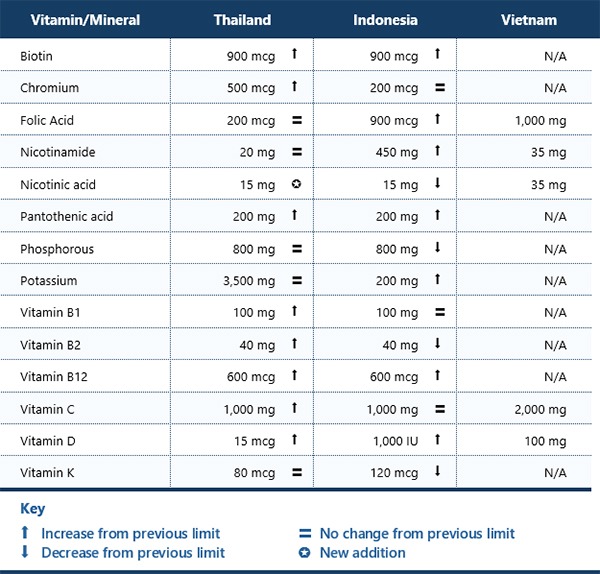
Where the limits are marked as not available, manufacturers may either follow the limitations under the ASEAN Agreement on a Regulatory Framework for Health Supplements or assume vitamins and mineral limits in health supplements based on generally accepted scientific data and taking into consideration, as appropriate, the varying degrees of sensitivity of different consumer groups.


RELATED INSIGHTS​ 

June 11, 2024
Advances in biotechnology have enabled the development of a range of new agricultural tools. From DNA sequencing to plant tissue culture and gene editing, these advances are facilitating the development of better crops. Genetically modified organisms (GMOs) are one well-known example of agricultural biotechnology. GMOs are organisms whose genetic material has been artificially altered by inserting a piece of foreign DNA. This DNA may be synthetic in origin or sourced from other organisms. Genome editing (also called gene editing or GEd) involves making precise changes to an organism’s genome without the integration of foreign DNA elements. Several approaches to genome editing have been developed. A well-known one is called CRISPR-Cas9, in which scientists make precise “cuts” in the DNA to create a new genetic variation. Unlike with GMOs, this introduces only minor modifications that are indistinguishable from natural mutations, typically by transplanting genes that code desirable traits from one species into another. GEd technology has been recognized and supported by the Food and Agriculture Organization of the United Nations (FAO). Thirteen FAO-member countries who are also members of the Organization for Economic Cooperation and Development (OECD) announced their support of the use of GEd technology for commercial uses and consumption at a recent WTO meeting. In addition, over 40 countries around the world, such as Argentina, Australia, Brazil, Canada, Chile, China, England, Japan, Kenya, the Philippines, Russia, the UK, and the US, have published policies emphasizing that foods free of transgenes (i.e., foods that do not contain genes transferred from external sources) are not GMOs, concluding that GEd plants are as safe as normal plants. In February 2024, the European Parliament approved new genomic techniques (NGTs), or GEd. As a result, plants that are produced using GEd technology are not classified by the EU as GMOs, and the EU
February 14, 2024
Thailand is preparing to implement new rules on drug importation for clinical studies. The Medicines Regulation Department of Thailand’s Food and Drug Administration (Thai FDA) first issued the Notification Re. Detailed Requirements for Drug Importation into Thailand for Clinical Studies almost a year ago, and the notification is expected to come into effect on March 1, 2024. Key Provisions The notification aims at enhancing the efficiency of conducting clinical studies while ensuring the protection of human subjects participating in such studies within Thailand. Some of its key provisions include: Definition of Clinical Study. The notification defines a “clinical study” as a study of a medicine involving human subjects, conducted to provide supporting evidence for the registration of a medicinal product in Thailand or other countries, including for additional indications or variations of a registration dossier. Compliance with ICH GCP. Clinical studies conducted in Thailand must adhere to the current edition of the International Council for Harmonization of Technical Requirements for Pharmaceuticals for Human Use (ICH) Good Clinical Practice (GCP) guidelines. Clinical Trial Application. Sponsors are required to submit a clinical trial application along with supporting documents to the Thai FDA for approval before commencing a clinical study. The permit remains valid for five years and is renewable. Supply of Investigational Drugs. Sponsors must obtain investigational drugs from manufacturers compliant with Good Manufacturing Practice (GMP) standards as recognized by the Thai FDA. Postapproval Obligations. The secretary-general of the Thai FDA may impose postapproval conditions or order investigators to conduct or suspend certain activities to ensure human subject protection and regulatory compliance. Regulatory Oversight. The Thai FDA is responsible for inspecting and overseeing the regulatory compliance of clinical studies, including during prestudy, ongoing, and poststudy phases. The Thai FDA may also conduct inspections of clinical studies conducted overseas. The Thai FDA
December 15, 2023
As part of its membership in Lex Mundi, Tilleke & Gibbins has published an updated edition of its Guide to Doing Business in Thailand for 2023. This guide outlines the key factors for starting and operating a business in the Thai market. Issues covered include: Investment incentives Financial facilities Exchange controls Import and export regulations Structures for doing business Requirements for the Establishment of a Business Operation of the Business Cessation or Termination of the Business Labor legislation, relations, and supply Tax Immigration requirements This publication is part of Lex Mundi’s Country Guides series prepared by member firms in more than 100 jurisdictions worldwide. The guides serve as a useful resource for planning international business strategy and researching new markets. The full Guide to Doing Business in Thailand is available through the button below.
December 6, 2023
New regulatory requirements for medical device registration and notification in Laos are set to enter into force in the coming weeks under the plan found in Notification No. 9606 to implement Decision No. 1470/MOH on Registration and Notification of Medical Devices (Decision 1470). The notification, issued on October 25, 2023, by the Food and Drug Department (FDD) under the Ministry of Health (MOH), outlines the FDD’s strategic plan for phased-in registration and notification requirements for medical devices. In the first phase, starting January 1, 2024, the FDD will initiate the registration process for class C (moderate-high risk) and D (high risk) medical devices. Meanwhile, operators dealing with class A (low risk) and B (low-moderate risk) devices can continue applying for import permits without having to register the devices or notify the FDD. In the subsequent phase, starting January 1, 2025, operators will have to notify the FDD about class A devices and complete the registration process for class B devices. To prepare for these requirements, import-export companies in the pharmaceutical and medical products sector must submit a list of medical devices, including their classification based on the country of manufacture, to the FDD by December 15, 2023. This measure is aimed at enabling the FDD to streamline the collection, guidance, and preparation processes to ensure efficient registration within the set time frame. While import-export companies can still submit their lists after either December 15, 2023, or January 1, 2024 (the registration commencement date), registration may be delayed since the FDD will prioritize those who submit their lists by the December 15 deadline. The list of medical devices should encompass medical devices imported in the past as well as those intended for future import permission applications. During the initial registration stage (i.e., from January 1, 2024), import-export companies that are