You are using an outdated browser and your browsing experience will not be optimal. Please update to the latest version of Microsoft Edge, Google Chrome or Mozilla Firefox. Install Microsoft Edge

September 6, 2024

ASEAN: Big Changes on Vitamin and Mineral Limits for Health Supplements

Addressing technical barriers to trade is a key priority for the Association of Southeast Asian Nations (ASEAN) as part of trade facilitation in achieving the single market and production base under the ASEAN Economic Community directive agreed in 2015. The region has been undertaking positive steps toward standard harmonization in ASEAN priority sectors, integrating and bringing about regulatory convergence by taking into account the diversities that exist in the ten ASEAN member states.

Health supplements in ASEAN are under the responsibility of the Traditional Medicine and Health Supplement Product Working Group (TMHS PWG). One of the TMHS PWG’s outputs is the ASEAN Agreement on a Regulatory Framework for Health Supplements, which includes various technical requirements for health supplements that participating member states must adopt by adjusting their domestic regulations.

The key ingredients of these health supplements are vitamins and minerals. While all ASEAN countries allow the use of vitamins and minerals in health supplements, the amounts allowed for use vary, depending on the nutritional requirements deemed appropriate by each country.

Partly in response to these efforts for regional harmonization, there have been important changes to vitamin and mineral limits in certain ASEAN countries that are worth monitoring. Some of these are outlined below.

Thailand

In January 2024, the Thai Food and Drug Administration (TFDA) updated the Thai Recommended Daily Intake (Thai RDI) guidelines for the Thai population. Subsequently, the TFDA adjusted the vitamin and mineral limits in order to comply with the updated Thai RDI and to follow the ASEAN Agreement on a Regulatory Framework for Health Supplements.

The TFDA’s adjustment of vitamin and mineral limits for use in food supplements came in Notification of the Ministry of Public Health (No. 448) B.E. 2566 (2023) Re: Food Supplements (No. 5), which was published in the Government Gazette on January 4, 2024. It increased the maximum limits for certain vitamins and minerals (see breakdown below) up to the limits that had previously only been allowed in drugs. The minimum limits of vitamins and minerals for use in food supplements should be more than 15% of Thai RDIs, as set out in the Notification of the Ministry of Public Health (No. 445) B.E. 2566 (2023) Re: Nutrition Labels. This notification took effect on July 2, 2024.

Before that date, if a party wished to use more than 60 mg of Vitamin C or more than 2 mcg of Vitamin B12 in a health supplement, they would have needed to register the product as a medicine (not a health supplement) in Thailand. Now, health supplements are allowed to use 1,000 mg of vitamin C and 600 mcg of vitamin B12—a level that previously would have required registration as a medicine.

Health supplements are classified as a type of food in Thailand—this differs from some other countries, which may include health supplements in the medicine group. The registration process for health supplements is straightforward and takes a short time (about one to two months) to receive approval. On the other hand, drug registration is more complex and time-consuming. Health supplement companies widely agree that the time needed to receive license approval is one of the main obstacles for a business getting their products to market.

This change allows products that in the past had to be registered as medicines to now be accepted as health supplements in Thailand. This regulatory change will help promote the health supplement business in Thailand and ASEAN.

Indonesia

In Indonesia, the maximum limits for vitamins and minerals for use in health supplements were first updated by the Indonesian FDA (known as BPOM) with the issuance of BPOM Regulation No. 11 of 2020 concerning the Criteria and Procedure for Health Supplement Registration, which has since been revoked by BPOM Regulation No. 32 of 2022. There is currently a draft amendment to BPOM Regulation No. 32 of 2022 that has not yet been finalized. However, the draft amendment does not propose any changes to the current maximum limits for vitamins and minerals.

This shows how BPOM has been actively updating the regulatory framework on health supplements due to the large presence of health supplement products in Indonesia. Businesses in this sector therefore need to be sure of the latest requirements before registering their health supplement products in Indonesia.

Vietnam

In contrast to the changes seen in recent years in Indonesia and Thailand, Vietnam has not amended or drafted any amendments to domestic regulations related to the maximum levels of vitamins and minerals in health foods since 2014. The current maximum limits for vitamins and minerals in Vietnam are not matched to those in neighboring countries or to those in the ASEAN Agreement on a Regulatory Framework for Health Supplements. Nevertheless, Vietnam may consider revising the maximum limits at some point to comply with the ASEAN standards.

In Vietnam, health supplements are classified as food rather than medicine. Under Vietnam’s current regulations, the vitamin and mineral content in health supplements (calculated according to the manufacturer’s recommended daily dose) must not exceed the maximum intake threshold for vitamins and minerals prescribed in Circular 43/2014/TT-BYT.

If the maximum intake threshold is not specified, the related Codex regulations or those of relevant international organizations apply.

Breakdown

The following table summarizes the current maximum daily limits for vitamins and minerals in health supplements for adults in Thailand, Indonesia, and Vietnam. It also shows how the limits have changed compared to the previous regulations in each country.
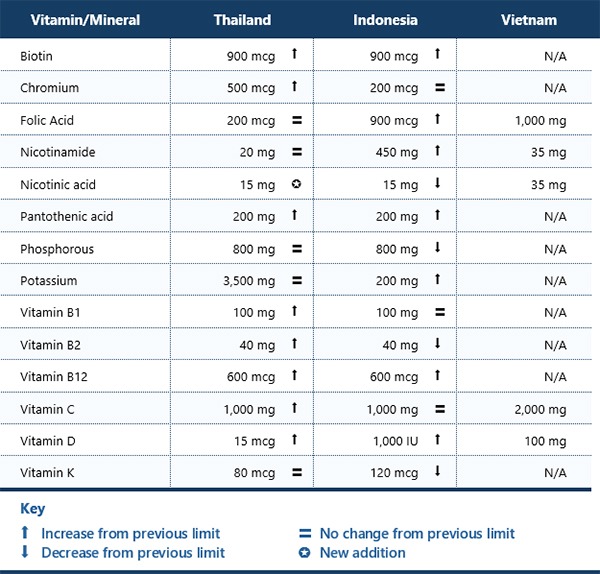
Where the limits are marked as not available, manufacturers may either follow the limitations under the ASEAN Agreement on a Regulatory Framework for Health Supplements or assume vitamins and mineral limits in health supplements based on generally accepted scientific data and taking into consideration, as appropriate, the varying degrees of sensitivity of different consumer groups.


RELATED INSIGHTS​ 

December 4, 2024
On October 28, 2024, Indonesia officially amended its existing Patent Law when the president ratified Law Number 65 of 2024. This comprehensive update—the third such amendment in the history of Indonesia’s Patent Law—introduces several key changes that will significantly impact patent protection and application processes in Indonesia. Key highlights and changes are outlined below. Definition of Invention The new law broadens the definition of “invention” to explicitly include systems, methods, and uses. Additionally, the law introduces formal definitions for traditional knowledge and genetic resources. Patentability Criteria Notable changes include: Computer programs are now excluded, with an exception for computer-implemented inventions. Theories and methods in science and mathematics are added to the list of excluded inventions. Previous restrictions on new uses of existing products are removed. Grace Periods The grace periods for some patent-related actions have been adjusted: The grace period for disclosures has been extended to 12 months (from 6 months previously), providing inventors with more flexibility in filing patent applications after initial disclosure. A newly introduced item is the grace period for a conventional patent application claiming priority rights, which is 4 months after the 12-month filing deadline under the Paris Convention. The grace period for annuity payments is 6 months (from 12 months previously) with a fine for late payments of 100% of the annual fee payable. Patent Holder Rights and Obligations Patent holders can now grant permissions to enforce patents. There is a new requirement for patent holders to submit annual statements on patent implementation in Indonesia. Compulsory Licensing Significant changes to compulsory licensing include: Establishment of licenses based on the principle of expediency. Limitations on license scope and transferability. Prioritization of domestic market needs. New provisions for technical improvements and economic significance. Government Patent Exploitation The new law contains specific provisions for the government’s implementation
December 4, 2024
Thailand Legal Basics, a valuable primer for foreign investors, explores all aspects of living and doing business in Thailand. Written by specialists at Tilleke & Gibbins in Bangkok, it is the only comprehensive English-language guide to the Thai legal system with a focus on the concerns of foreign business and investment.
December 2, 2024
Kratom (Mitragyna speciosa) was once listed as a prohibited substance under the Narcotics Act. Kratom was then removed from the narcotics list in 2021 and is now regulated under the Kratom Plant Act B.E. 2565 (2022), which allows the trading, use, import, and export of kratom. Furthermore, the Ministry of Public Health has allowed the use of kratom in food and drink, food supplements, and herbal products. Anyone who wishes to launch kratom food or herbal products must first obtain a product license from the Thai Food and Drug Administration (FDA). On September 4, 2024, the Thai FDA announced guidelines specifically for powdered kratom leaves and kratom leaf extracts (using water or ethanol as solvents) as ingredients in food supplements. These guidelines aim to provide business operators with a clear framework for launching kratom-based food products in Thailand. Key points from these guidelines include: Raw material specifications and standards: Powdered kratom leaves and kratom leaf extracts must contain at least the prescribed amount of mitragynine (one of the primary active compounds in kratom) as a marker of quality. For example, mitragynine must account for at least 1% by mass for powdered kratom leaves. Food supplement specification and standards: Food supplements containing powdered kratom leaves or kratom leaf extracts must not have a dosage of over 0.2 mg/day of mitragynine (including 7-hydroxymitraglynine, which may occur naturally), or 1 mg/day for food supplements containing kratom extracts that use water as a solvent. Addition of 7-hydroxymitraglynine to food supplements is prohibited. Mitragynine content in food supplement products must not exceed the specified dosage limit. Additionally, the food supplement product must be in a ready-to-eat form (e.g., liquid, gel, tablet, or capsule). If powdered kratom leaves or kratom leaf extracts are to be used as ingredients in food categories other than food supplements,
October 1, 2024
The Indonesian food and drug authority, also known as “BPOM,” issued a draft regulation on September 9, 2024, proposing standard labeling disclosing the sugar, salt, and fat content of packaged food products sold in the country. The draft Regulation on Nutritional Value Information on Food Labels to implement Government Regulation No. 28 of 2024 on the Implementation of the Health Law seeks to mandate “Nutri-Level” front-of-pack nutrition labeling to indicate the amount of sugar, salt, and fat at four possible levels, with a modified stoplight-color system: Level “A” (lowest amount) has a dark green background Level “B” has a light green background Level “C” has a yellow background Level “D” (highest amount) has a red background These levels are shown in the following sample image: The requirements for sugar, salt, and fat content for each level are based on amounts per 100 milliliters of ready-to-eat processed food as follows: Further requirements relating to nutrients reflected in the Nutri-Level labeling include: Foods labeled as level A are not allowed to contain natural or artificial sweetening food additives, either through direct addition or carried over from other ingredients. Foods labeled as level B may only contain natural sweetening food additives. Foods labeled as level C or D may use natural and artificial sweetening food additives. “Sugar” includes all monosaccharides and disaccharides, excluding lactose. Processed plain liquid milk and plain milk powder are exempt from the requirement to declare total fat content on the Nutri-Level label. Labeling Implementation The implementation of Nutri-Level labeling must comply with the following requirements: The Nutri-Level label must list all four letters (as shown in the examples below) unless the package meets the criteria for display of a simplified format label. The Nutri-Level of the processed food must be indicated by enlarging the relevant letter, as shown